 Vietnamnet.vn

 Podcast



The meeting took place within the framework of state visit to Russia by General Secretary of the Communist Party of Vietnam Central Committee and President To Lam.
At the working session, Nghi praised the RANEPA’s long-standing tradition in training, research and policy advice, saying that it is one of Russia’s major training institutions and an important centre for developing the country’s leadership and management personnel as well as conducting policy research and consultancy.
He expressed appreciation for the RANEPA and its predecessor institutions for their contributions to training and fostering Vietnamese officials. Over the past decades, nearly 1,000 Vietnamese officials and leaders have studied and received training there, many of whom have gone on to hold important positions in Vietnam’s political system.
He noted that the long-standing cooperation between the RANEPA and Vietnamese training and research institutions has continued to develop, making practical contributions to the comprehensive strategic partnership between Vietnam and Russia.
Nghi said Vietnam is entering a new development period, with the goal of becoming a high-income developed country by 2045. The country is focusing on science and technology, innovation, economic resilience and improving national governance.
In this context, Vietnam is particularly interested in Russia’s experience in national governance, strengthening economic self-reliance and enhancing resilience to external shocks, he said.
He proposed that the RANEPA share its experience in conducting research and policy consultancy, mobilising experts and interdisciplinary knowledge, as well as policy tools to promote domestic production and reduce external dependence.
Regarding cooperation between the two institutions, Nghi said they share similarities in strategic research and policy advisory functions and have considerable room for practical cooperation.
He proposed joint research on development governance, strategic autonomy, science and technology, innovation and human resource development; sharing research reports, methodologies and policy forecasts; and exchanges of experts and short-term training programmes. The Vietnamese side also suggested considering a cooperation agreement to facilitate regular policy dialogues, joint research and exchanges of delegations and experts.
For his part, Komissarov said Vietnam is one of the RANEPA’s important partners in capacity-building projects for public officials. He praised Vietnam’s economic achievements, high growth and deep integration into international institutions, which have helped enhance the country’s role and position regionally and globally.
He said agreements reached following his meeting with General Secretary and President Lam in December 2025 had produced positive results, including a pilot project assessing the management capacity of 80 Vietnamese officials. The Russian side sees strong potential for expanding the project.
The two sides agreed to continue discussions to turn the cooperation proposals into concrete activities, contributing to deeper comprehensive strategic partnership between Vietnam and Russia.
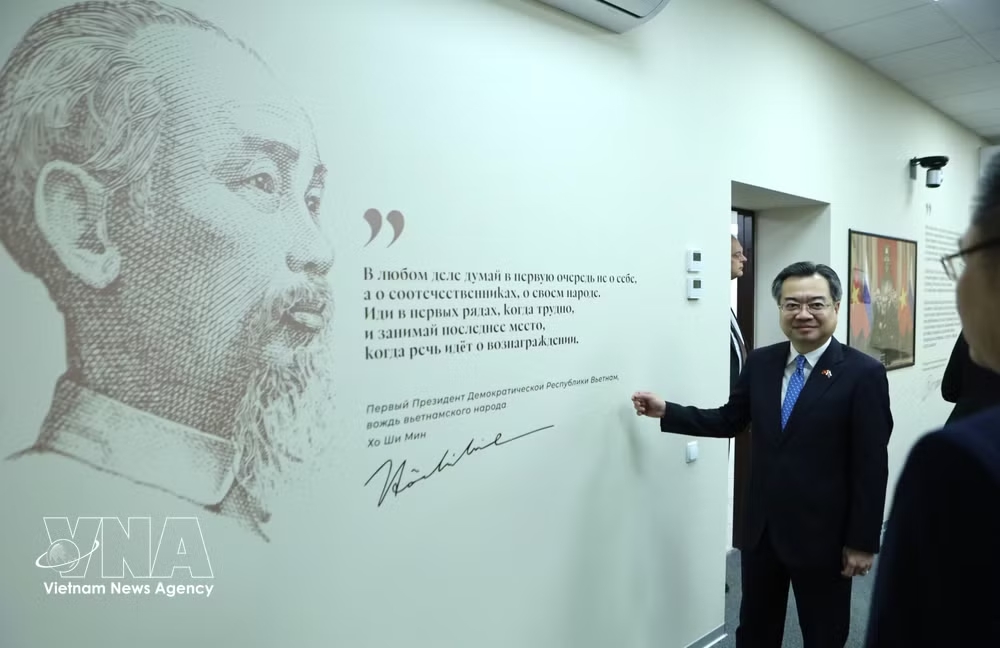
During the visit, Nghi and the delegation also visited a lecture hall at the RANEPA named “Comrade To Lam, General Secretary of the Communist Party of Vietnam Central Committee”./.
.svg)
