 Vietnamnet.vn

 Podcast


Speaking at a workshop titled "Carbon Capture, Utilization and Storage (CCUS): A Solution to Accelerate Net Zero in Vietnam," Deputy Minister of Agriculture and Environment Le Trong Yen said the country must rethink its growth model and transform how it produces goods and uses resources to achieve its net-zero emissions target by 2050.
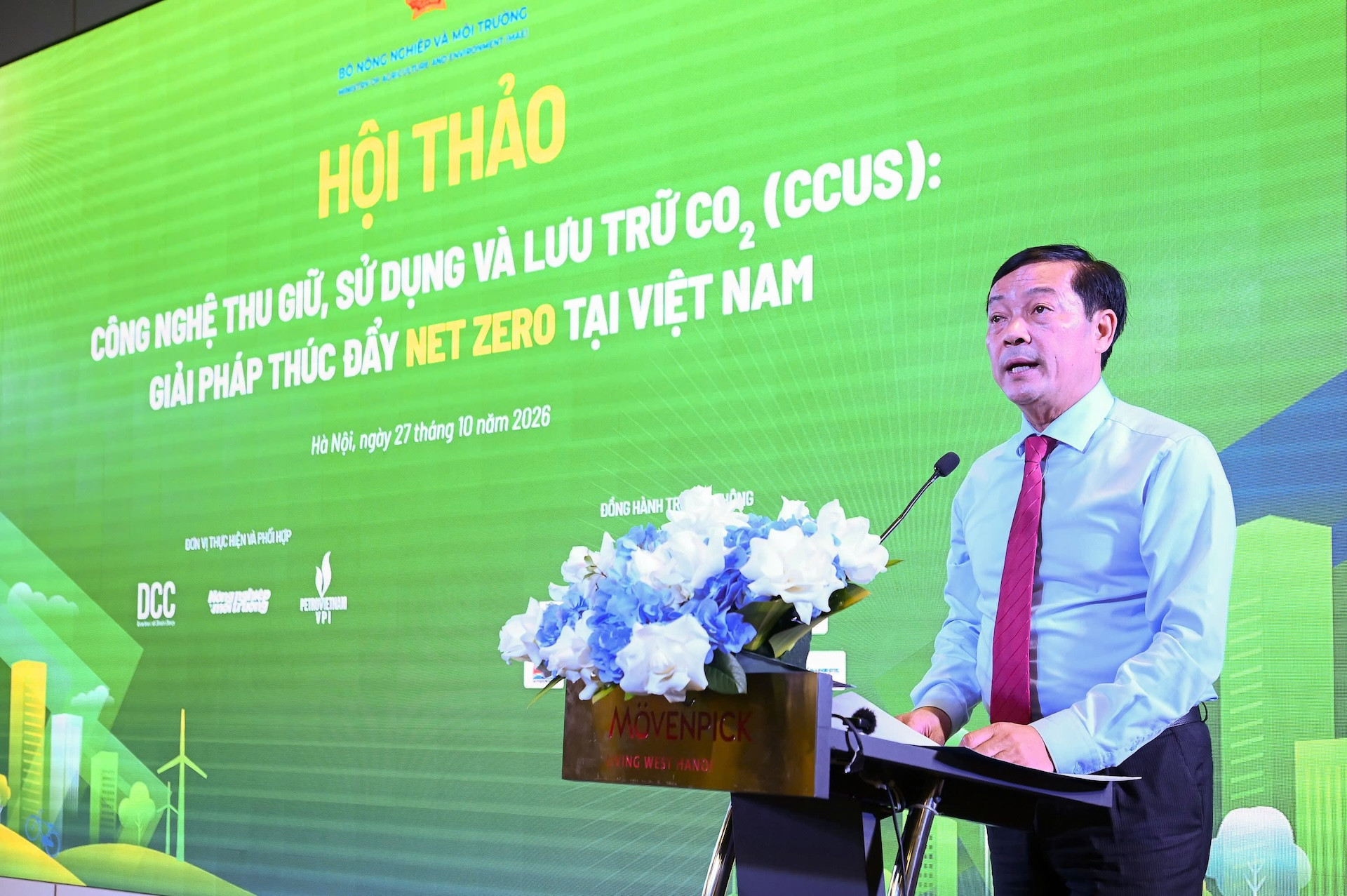
That transition, he said, must focus on greater resource efficiency and lower emissions while safeguarding energy security and maintaining the competitiveness of Vietnamese businesses.
For Vietnam, preliminary studies on offshore CO₂ storage, experience in the oil and gas industry, and growing pressure on industrial sectors to decarbonize provide a foundation for exploring practical applications of CCUS technology.
Potential applications include using captured CO₂ to produce chemicals, fuels and construction materials, as well as combining carbon capture with hydrogen production. These approaches are opening up new opportunities for research and cooperation, although each must be carefully assessed for technical feasibility, emissions reduction benefits and commercial potential.
Vietnam's vast carbon storage potential
According to Dr. Nguyen Huu Luong, a senior expert at the Vietnam Petroleum Institute, carbon capture and storage technology is expanding rapidly worldwide, with 77 projects currently operating and another 610 under development.
Globally, CO₂ can be stored in several types of geological formations, including depleted oil and gas reservoirs, deep saline aquifers and unmineable coal seams.
Luong said Vietnam ranks among the Southeast Asian countries with the greatest geological CO₂ storage potential, estimated at approximately 71 billion tons.
Most of this capacity is concentrated in three major geological basins: Song Hong, Nam Con Son and Cuu Long.
Vietnam also has several advantages that could support the development of carbon capture, utilization and storage technology.
"Preliminary assessments have already been conducted on the CO₂ storage potential of 34 offshore oil and gas fields. In 2011, Vietnam became the first country in Southeast Asia to successfully inject CO₂ at the Rang Dong oil field," Luong said.
Erskine Rozario, Director of Engineering and Construction at Z.E.G Technology, noted that Germany and several other countries are already using captured CO₂ to produce sustainable aviation fuel (SAF), e-methanol and other synthetic fuels, commonly known as e-fuels.
He suggested that CCUS could eventually develop into an entirely new industry in Vietnam, creating opportunities to train specialized workers and build domestic expertise in advanced technologies.
The challenge of financing carbon storage
Despite its considerable potential, the high cost of CCUS projects remains one of the biggest obstacles to their development.
According to Luong, a typical CO₂ storage project can require investment ranging from several hundred million to several billion US dollars.
Le Van Nghi, Chairman and CEO of QIS Global, said a carbon capture project at a thermal power plant with a generating capacity of around 600 megawatts could require approximately $30 million in capital investment.
Such costs mean businesses must carefully weigh the financial viability of projects and their prospects for recovering the initial investment.
To reduce upfront financial pressure, Nghi proposed a modular approach, starting with facilities capable of capturing approximately 10,000 to 20,000 tons of CO₂ annually.
Companies could then assess their operational and economic performance before deciding whether to expand capacity.
Darshil Korde, Head of Sustainability at ISSPL Limited, said financing mechanisms for CCUS projects should involve financial intermediaries capable of connecting different sources of capital.
These could include public funds, international bond markets, commercial credit, private equity and revenue generated through carbon credit markets.
Ta Dinh Thi, Deputy Chairman of the National Assembly's Committee on Science, Technology and Environment, said Vietnam already has political support and the beginnings of a legal framework for CCUS development.
However, effective implementation will require further institutional reforms, suitable financing mechanisms, more comprehensive geological assessments and stronger international cooperation.
Vietnam also needs to expand international partnerships, facilitate technology transfer, develop a skilled workforce and explore financing models capable of attracting investment into the sector.
Closer coordination among government agencies, businesses and researchers will be essential to bringing the country's first CCUS projects into operation and supporting its commitment to achieve net-zero emissions by 2050.
Kieu Oanh

