 Vietnamnet.vn

 Podcast



Vietnam's focused digital technology zones are proving to be economic powerhouses, delivering up to $10 million in annual revenue per hectare. These zones are not only hubs for innovation but also elevate labor productivity and income far above the national average.
The figures were announced by Nguyen Khac Lich, Director of the Department of ICT Industry under the Ministry of Science and Technology, during the Investment Promotion Conference for Focused Digital Zones recently held in Ho Chi Minh City.
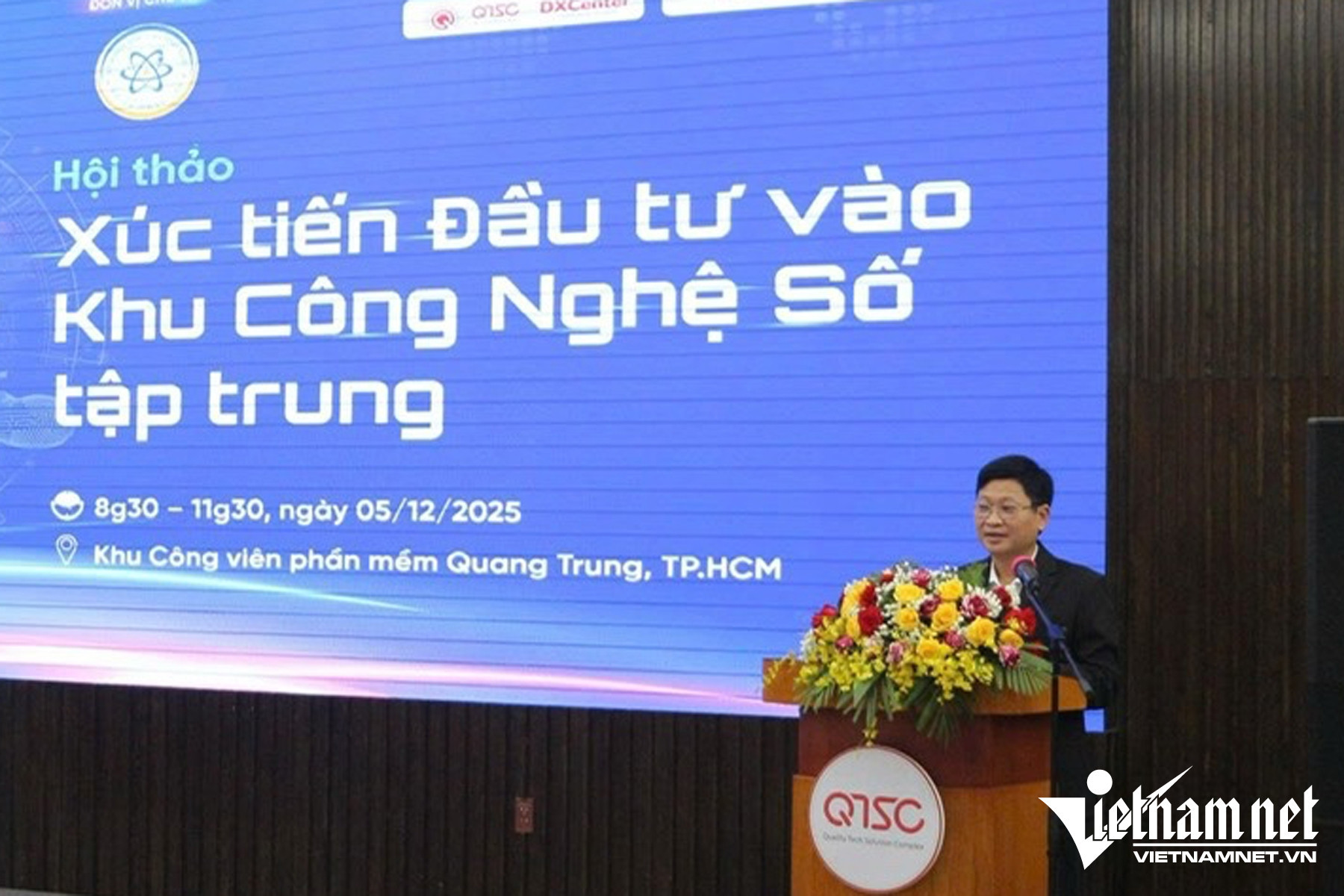
Mr. Lich emphasized that after over 12 years of development, Vietnam has successfully established a robust infrastructure foundation for its digital technology industry.
A decade of digital zone evolution
The model of concentrated ICT zones was first introduced under Decree 154 in 2006. With the adoption of the Digital Industry Law in 2025, the name was updated to "Focused Digital Zones."
According to Mr. Lich, there are currently eight focused digital zones across Vietnam, located in Hanoi, Ho Chi Minh City, Da Nang, and Can Tho.
These zones collectively span 2.588 million square meters - more than ten times their size in 2013 - and host over 630 digital technology enterprises, a 20% increase in participation.
Most notably, these zones generate extremely high economic value relative to the land they occupy. “Land productivity reaches about $10 million per hectare per year, which is very high compared to other functional zones,” Mr. Lich noted.
He added that these digital zones are not just operational spaces for businesses, but ecosystems of value creation, knowledge cultivation, and innovation acceleration. Labor productivity and income among the 42,450 highly skilled workers in these zones are “significantly higher than the national average,” he said.
A shift in national tech strategy
With global technology shifting rapidly, Vietnam is redefining its development model. Instead of focusing on software and applications, the trend is moving toward integrated ecosystems of AI, big data, semiconductors, and disruptive technologies.
Mr. Lich stated: “Developing focused digital zones is not about industrial real estate. We are building an ecosystem where every company - from startups to global corporations - can innovate, experiment, scale, and go global.”
A major shift introduced in the Digital Industry Law includes stronger incentives, streamlined institutional frameworks, regulatory sandboxes, and access to shared digital infrastructure such as cloud computing, data centers, chip testing labs, and supercomputers for AI training.
At the conference, representatives from Yen Binh Digital Zone, Quang Trung Software Park, and Becamex Binh Duong shared successful models and strategies to attract global tech giants.
Unprecedented tax and land incentives

To accelerate development, the government has introduced a groundbreaking incentive framework.
In terms of finance, investment projects within focused digital zones can access the highest corporate income tax benefits:
10% tax rate for 15 years
4 years of full exemption
50% reduction for the following 9 years
For mega-projects (valued over 6 trillion VND, or approx. 250 million USD) in core tech sectors like semiconductors and high-performance computing (HPC), the tax period is extended by 1.5 times, and companies can deduct 200% of R&D expenses.
On land policy, infrastructure developers of digital zones are fully exempt from land rent for the project's entire duration.
The same land exemptions apply to enterprises producing key digital products, such as semiconductors and AI solutions.
To attract top talent, the new policy waives personal income tax for five years for high-skilled professionals in the digital industry.
Foreign experts are also granted five-year visas for themselves and their immediate family (spouse and children under 18), exempted from work permits, and provided with financial support, housing, work environments, and transportation.
Simplified governance for faster deployment
To streamline operations, the Digital Industry Law decentralizes approval authority for focused digital zones from the Prime Minister to provincial People's Committees.
Administrative procedures are also cut by 50%, including the elimination of the previous project proposal approval step.
This is seen as a clear signal of Vietnam’s readiness to lead in the digital age, with a “go fast, go first” mindset.
The Ministry of Science and Technology has pledged to work closely with local governments and investors to resolve bottlenecks and help Vietnam become a leading destination in the global digital industry.
Du Lam
.svg)
