 Vietnamnet.vn

 Podcast



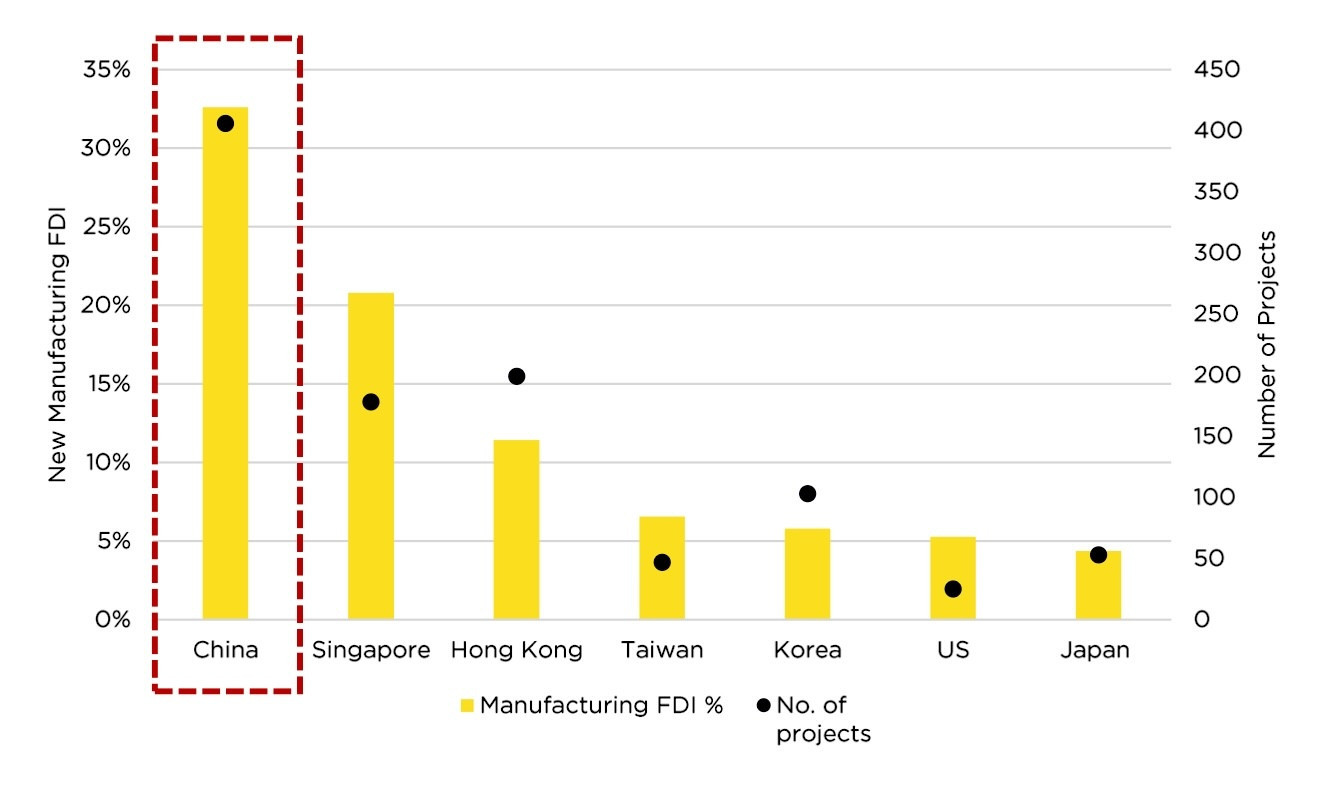
A recent report by Savills Vietnam titled “Industrial Real Estate Spotlight 2025: A Shift Toward Growth” reveals that foreign direct investment (FDI) in Vietnam's manufacturing sector reached approximately 18.22 billion USD in the first ten months of 2025, accounting for nearly 60% of total FDI inflows, which stood at 31.52 billion USD.
Bac Ninh currently leads the nation in newly registered manufacturing FDI, accounting for around 13.8% of total investment. It is followed by Hai Phong (10.5%), Dong Nai (9.8%), and Hung Yen (7%).
In terms of investor origin, China ranked first during the period with 406 new manufacturing projects, representing 33% of the total and valued at 2.6 billion USD. Singapore followed with 178 projects worth 1.7 billion USD, while Hong Kong (China) came third with 199 projects (19%).
When broken down by industry, electronics attracted the most manufacturing FDI with 1.5 billion USD across 148 projects. Metal fabrication followed with 1.2 billion USD from 181 projects. Electrical equipment secured 730 million USD via 87 projects, and rubber and plastics drew 663 million USD from 179 projects.
John Michael Campbell, Head of Industrial Services at Savills Vietnam, emphasized that manufacturing and processing alone accounted for nearly 60% of newly registered FDI capital, indicating a clear pivot toward high-value industries such as electronics, advanced equipment, and semiconductors.
He also highlighted infrastructure as a key differentiator, citing expansions at the Cai Mep–Thi Vai port cluster and inter-regional expressways that enhance logistics efficiency and make Vietnam more attractive to industries with demanding supply chains.
Campbell noted that Vietnam is experiencing a shift in strategic manufacturing sectors, including advanced electronics, industrial equipment, and data centers, all aiming to scale operations.
This transformation is further substantiated by an analysis from HSBC.
In 2013, about 60% of Vietnam’s exports to the US came from light manufacturing - mainly garments, footwear, and toys - while electronics accounted for just 13%.
However, that landscape has changed dramatically. Electronics exports have seen exponential growth. From just one-seventh the volume of light industrial goods in 2013, electronics reached near parity by 2024.
In early 2025, electronics officially surpassed light industrial goods to become Vietnam’s top export to the US.
According to HSBC experts, this transformation aligns with Vietnam’s progress in the global technology value chain. Since the onset of the US–China trade tensions, Vietnam has carved out a larger role in final electronics assembly, particularly for consumer electronics.

Changing share of electronics vs. light manufacturing in Vietnam’s US exports, 2013–2025. Source: CEIC, HSBC
Thanks in large part to early and continuous investment by Samsung - starting as far back as 2007 - Vietnam has evolved into one of the tech giant’s major production hubs, now responsible for about half of its global smartphone output.
While Vietnam has yet to surpass China, its export share in smartphone-related products has grown rapidly over the past 15 years, from virtually zero to significant levels.
Beyond consumer electronics, Vietnam’s growing role in semiconductor manufacturing - particularly integrated circuits (ICs), which carry higher value than mere assembly - has also been noteworthy. This is largely due to substantial investments by Intel, one of the world’s leading chipmakers.
Despite FDI inflows into manufacturing being lower than their peak last year, they are now roughly on par with pre-pandemic levels. HSBC reports that capital from mainland China and the US has increased significantly.
Looking ahead to 2026, John Michael Campbell believes it will be a pivotal year for Vietnam’s industrial market. He expects to see improved production prospects, a stable investment environment, and stronger infrastructure networks spanning seaports, energy, and digital connectivity.
He added that Vietnam is shifting from a cost-driven growth model to one based on system capacity - where infrastructure, energy, and data services must function in harmony to meet the evolving demands of advanced manufacturing.
According to Savills, Vietnam has attracted more than 526 billion USD in FDI over the past four decades.
Since the enactment of Vietnam’s Foreign Investment Law in December 1987, the country has drawn more than 526 billion USD in FDI through October 2025.
South Korea remains the largest investor with 10,329 active projects and a total capital contribution of 94 billion USD, accounting for 17.8% of all FDI into Vietnam. It is followed by Singapore, Japan, and Taiwan (China).
Tran Chung
.svg)
