 Vietnamnet.vn

 Podcast



What happens to young people’s emotions, concentration and habits when they temporarily step away from social media?
That was the question Ho Khanh Chi, Cao An Le and Ngo Quoc Anh, members of the Z&Alpha Initiative, set out to explore through an experimental project called “54 Hours Without Social Media.”
The project did more than record participants’ experiences during 54 hours offline. It also sought to understand how they dealt with the urge to return to social media and what strategies might help young people develop healthier relationships with these platforms.
What really happens when young people step away from social media?

The team presented the results at a workshop on social media and the mental health of children and adolescents, organized by the Department of Students under Vietnam’s Ministry of Education and Training, the University of Education at Vietnam National University Hanoi, UNICEF Vietnam and the Z&Alpha Initiative.
Conducted in January 2026, the experiment was carried out under the guidance of Associate Professor Tran Thanh Nam, rector of the University of Education, Vietnam National University Hanoi, and other experts.
According to Ngo Quoc Anh, a former student at Chu Van An High School for the Gifted in Hanoi, Vietnam has seen relatively few real-world experiments examining how young people’s behavior and emotions change when they stop or restrict their use of social media.
That gap prompted Quoc Anh and other Z&Alpha members to conduct the 54-hour experiment without Facebook and TikTok, two platforms widely used by young people.
Rather than simply asking whether social media has harmful effects, the team wanted to observe what actually happens when young users temporarily disconnect.
“The experimental report focused on three questions: how many participants broke their commitment not to use social media; how their moods and emotions changed over the 54 hours; and what strategies they used to cope with the urge to go back,” Quoc Anh said.
“The value of the experiment is not simply in confirming the effects of social media. More importantly, it is about finding ways to help young people use social media more healthily.”
When young people study their own generation
By observing changes in concentration, sleep, emotions and behavior, the group sought to understand how healthier technology habits might be developed.
Some countries have already introduced policies governing social media use among children and teenagers. For Quoc Anh, however, the 54-hour experiment offers a way to move the conversation beyond the familiar question of whether social media should be restricted or banned.
Instead, he argues, the more important question is how young people can grow up healthily in an increasingly digital world.
Associate Professor Tran Thanh Nam said social media’s impact on mental health is not one-dimensional. It depends significantly on how platforms are used, the content young people encounter and each child’s individual circumstances.
When used in healthy ways, he said, social media can strengthen connections among adolescents, provide a sense of social support, reduce loneliness and help them develop their identities.
It can also give young people access to mental health information and encourage them to seek help. For those experiencing mental health difficulties, digital environments may provide opportunities to connect with communities and support networks.
Nam stressed that children’s mental health in the digital age cannot be addressed by any single sector.
Education, psychology, healthcare, technology and public policy all need to work together to prevent risks, identify problems early and provide support when children need it.
For Quoc Anh, young people occupy a particularly important position in this conversation.
They are among the most intensive users of social media, but they are also the people experiencing technological change most directly. That means they should not be seen only as a group that needs protection.
They can also adjust their own behavior, share experiences and help develop solutions.
That is one reason Quoc Anh wants to expand the experiment to include a wider range of participants from different genders and regions, creating a broader and deeper picture of the relationship between social media, behavior and emotions.
Speaking to Vietnam Economic Magazine/VnEconomy, Quoc Anh said much of the current discussion about teenagers and social media is framed from the perspectives of parents, schools, education experts and policymakers.
Young people themselves - those who actually use the technology and experience its effects - have had fewer opportunities to ask their own questions, conduct experiments and contribute their own observations.
Through the project, its young organizers want to demonstrate that their generation can actively identify the issues affecting them, investigate those issues and contribute its own perspective to the wider social debate.
Looking deeper at social media, behavior and emotions
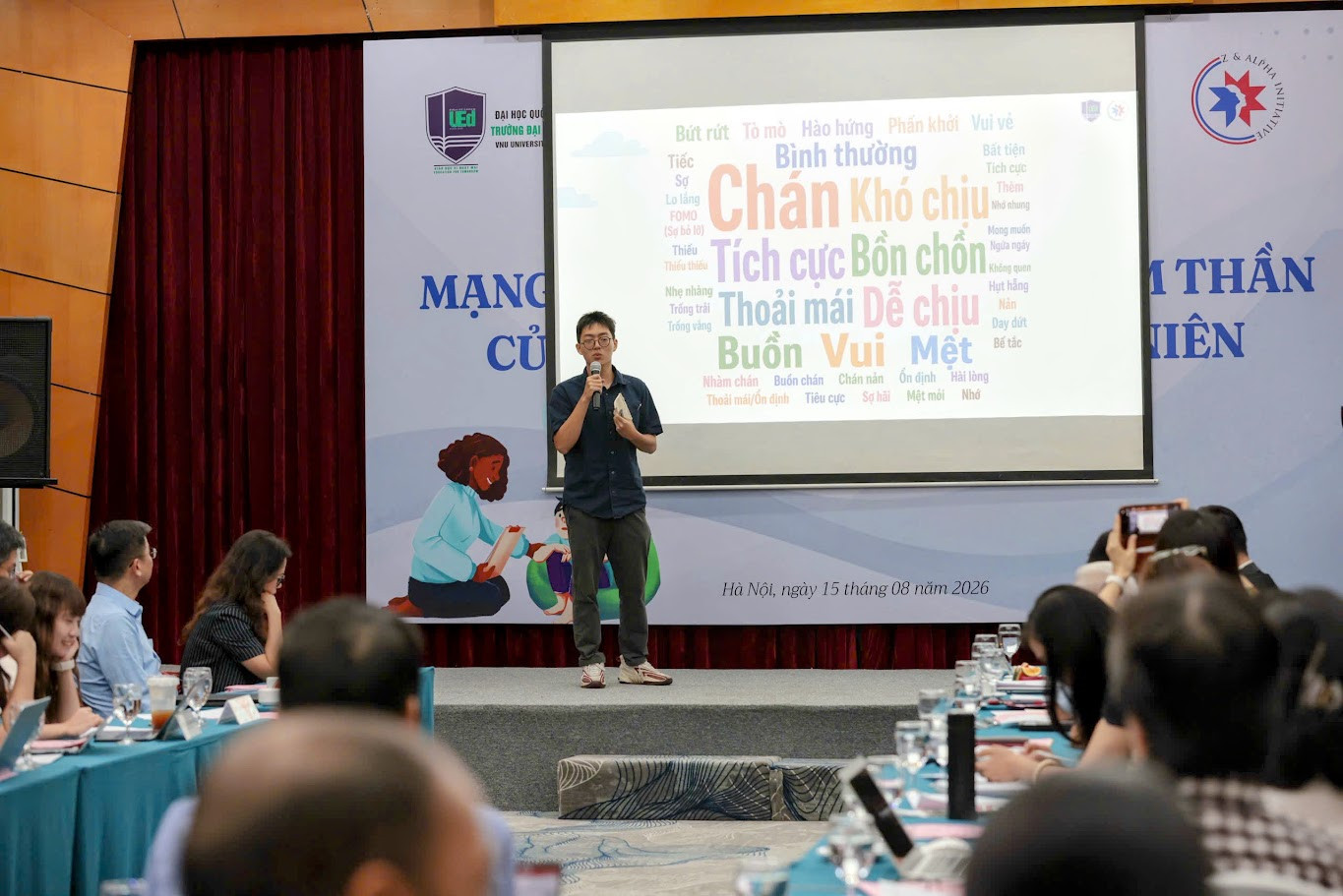
Before the 54-hour project, Z&Alpha had organized programs at schools including Vinschool, The Dewey Schools and Chu Van An High School for the Gifted in Hanoi.
These programs discussed how social media technologies and algorithms can affect students’ psychology and mental well-being.
“Young people need to recognize harmful effects and understand the algorithms social media platforms use to draw them in, so they can develop their own strategies for healthier social media use,” Quoc Anh said.
At school and at home, he believes the focus should not be limited to controlling how much time children spend on devices.
Families and schools should also provide more alternatives, from physical education and sports to clubs, group activities and face-to-face interaction.
Digital literacy, Quoc Anh argues, should go beyond teaching children how to use technology. It should also help them understand how digital environments influence their own behavior, emotions and attention.
Le Anh Lan, a representative of UNICEF Vietnam, said discussions about social media should not begin solely with fear or focus only on screen time.
What matters, she said, is recognizing both the opportunities and risks that digital environments create for children.
UNICEF emphasizes an approach based on children’s rights and best interests, including meaningfully listening to their voices and strengthening the responsibility of governments and technology platforms to create safer online environments.
For Quoc Anh, this again brings the conversation back to the role of young people themselves.
They are among social media’s heaviest users and are directly experiencing the transformations technology brings. They are therefore not merely people who need to be protected, but individuals capable of adjusting their behavior, sharing what they learn and taking part in designing solutions.
“The question is no longer whether we should leave Facebook or TikTok,” Quoc Anh said. “It is about how people - particularly a generation growing up with technology - can understand, regulate and protect themselves in the digital environment.
“Instead of only talking about young people, let young people ask their own questions, make their own observations and take part in finding answers to the issues shaping their future.”
That is also why Quoc Anh hopes to expand the experiment to more diverse groups of participants across genders and regions, providing a deeper and more varied understanding of how social media intersects with human behavior and emotions.
Bao Binh
.svg)
