 Vietnamnet.vn

 Podcast



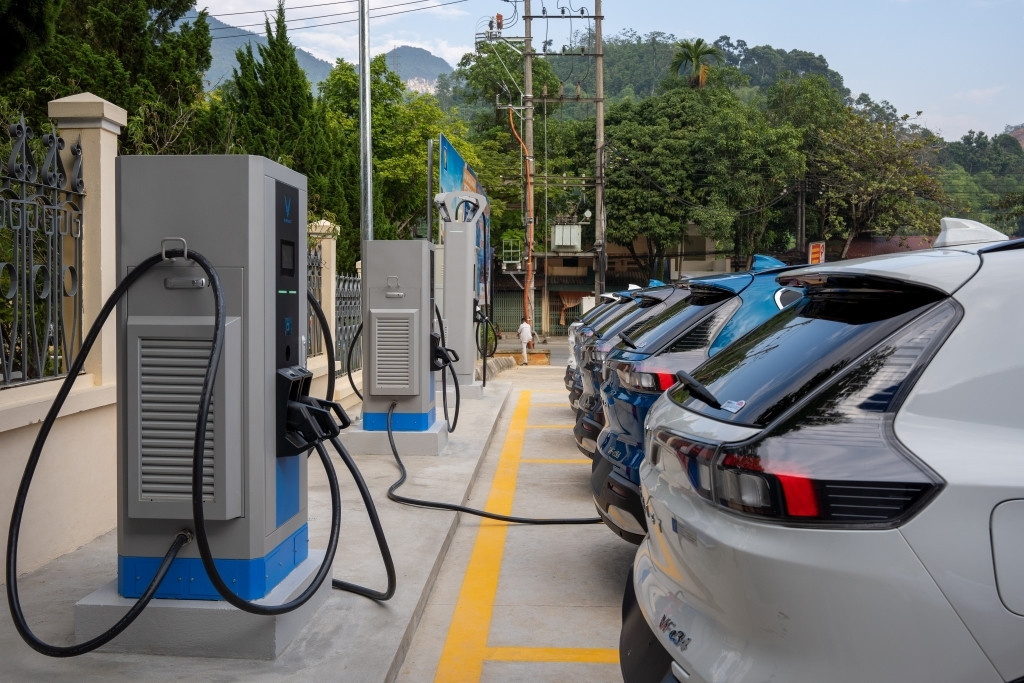
Many countries transitioning to green mobility have not stopped at replacing gasoline-powered vehicles with electric ones, but have instead implemented comprehensive and coordinated policy frameworks.
Nguyen Thi Xuan Thuy - lecturer at the University of Economics under Vietnam National University, Hanoi, and consultant to the United Nations Industrial Development Organization (UNIDO) - shared insights from international experiences and offered policy suggestions for Vietnam’s green transport transition.
According to Thuy, Hanoi in particular and Vietnam as a whole are facing increasingly complex transport challenges, including worsening air pollution, high emissions from personal vehicles and prolonged congestion. These pressures make the shift toward green mobility an urgent priority.
However, the challenge goes beyond the transport sector. Transition policies directly affect the domestic automobile and motorcycle manufacturing industries. The key question, therefore, is how to reduce emissions without weakening local industrial capacity.
Diverse approaches across countries
Drawing on international experience, Thuy noted that countries have adopted very different pathways depending on their development conditions and strategic priorities.
Countries without domestic automobile manufacturing industries, such as Norway and Singapore, tend to rely primarily on transport policies to achieve environmental goals.
Norway stands out with a long-term roadmap spanning 30 years and strong financial incentives, making the total cost of owning electric vehicles lower than that of gasoline cars. Singapore, meanwhile, focuses on managing vehicle use through electronic road pricing, strict vehicle registration controls and the development of charging infrastructure.
In contrast, countries with well-established automotive industries, such as Germany, Japan and the US, closely link green transition policies with industrial strategies.
Germany promotes both electric vehicles and battery production within the European Union framework. Japan pursues a multi-technology approach, including hybrid and hydrogen solutions, to preserve its technological advantages. The US treats electric vehicles as a strategic competitive tool, prioritizing battery supply chains and imposing high localization requirements.
Thailand, a major automotive production hub in ASEAN, has also introduced strong incentives to attract electric vehicle investment. However, experience shows that without effective controls, domestic firms may not benefit if supply chains remain dependent on external partners.
Regional management and emission control
A notable trend in Europe - including the UK, France and Germany - is the adoption of low-emission zones. Rather than imposing outright bans, these countries set emission standards, charge higher fees for non-compliant vehicles and provide support for transition.
This approach improves urban air quality while maintaining flexibility for both citizens and businesses.
For countries and territories with transport structures similar to Vietnam - such as India, Taiwan (China) and Indonesia - the lessons are even more directly relevant.
Taiwan (China) has strongly promoted electric motorcycles through battery-swapping models, closely tied to the development of its domestic technology and battery industries. India prioritizes electrification of two- and three-wheelers as well as commercial vehicles, segments with significant emission impact. Indonesia leverages its nickel resources to develop a battery industry, attracting investment across the entire electric vehicle value chain.
Policy implications for Vietnam
From these international experiences, Thuy emphasized that green transport transition is not merely an environmental issue, but a multi-dimensional objective closely linked to urban governance, infrastructure planning and national industrial strategy. Policies must therefore be designed holistically rather than in isolation.
The transition roadmap should be long-term, spanning at least 15-30 years. This ensures market stability, allowing businesses and citizens time to adapt while avoiding abrupt changes that could disrupt costs, technology adoption or consumer behavior.
Importantly, electric vehicles should not be treated as the sole solution. During the transition period, multiple technologies - including hybrids, biofuels and other emission-reduction solutions - should coexist to ensure flexibility and alignment with Vietnam’s practical conditions.
Instead of rigid administrative measures such as outright bans, policies should shift toward emission management. Economic and technical tools - including low-emission zones, pollution-based charges and emission standards - are likely to be more effective in influencing behavior without causing major social disruption.
At the same time, a coordinated policy toolkit is essential. Beyond financial incentives or tax measures, the state must invest in infrastructure such as charging stations and public transport systems, while also establishing technical standards and regulatory mechanisms to support the transition ecosystem.
A key requirement is to closely align green transport transition with national industrial strategy. This approach would not only help reduce emissions but also protect and develop Vietnam’s domestic automobile and motorcycle industries, avoiding overdependence on imported technologies and products.
“Green transition is not just a matter for the transport sector, but must be viewed as a comprehensive strategy connecting mobility with industrial development,” Thuy stressed.
Vu Diep
.svg)
