 Vietnamnet.vn

 Podcast



On September 27, Party General Secretary and President To Lam and Hanoi National Assembly deputies from Electoral Constituency No. 1 met voters from 10 city wards ahead of the second session of the 16th National Assembly.
Speaking at the meeting, he said many of the issues raised went beyond individual wards, neighborhoods or even Hanoi itself. They reflected challenges facing the country’s development, as well as concerns and aspirations shared by people nationwide.
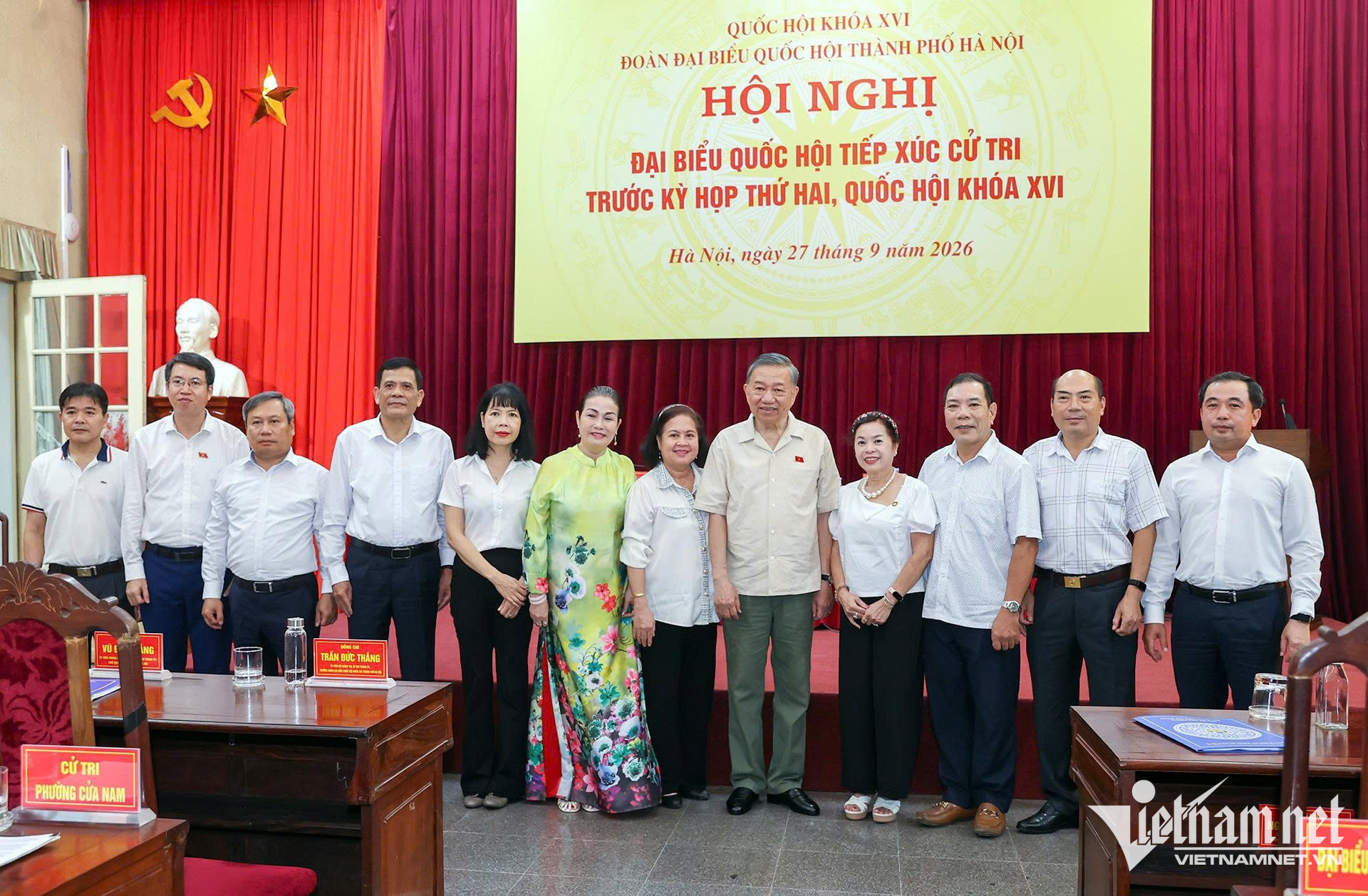
General Secretary and President To Lam with voters.
After outlining the national situation, he emphasized that the Party Central Committee, National Assembly, government and the entire political system were determined to avoid wasting time or allowing delays between resolutions and action, or between policy decisions and tangible results.
General Secretary and President To Lam said the Central Committee would hold four plenary meetings in the first year of its current term, more than was customary in previous terms. Three had already taken place, with preparations underway for the fourth.
Where resolutions needed to be translated into more specific measures or required direction from the Central Committee, that work must begin immediately, he said. Waiting until the second or third year would waste time and leave work unfinished.
The National Assembly is also holding three sessions, one more than usual. What mattered, Lam said, was not having more meetings but resolving issues more quickly and effectively.
He outlined the outcomes of the legislature’s first session and extraordinary session. Its upcoming second session is expected to consider 43 bills and decide on several important socioeconomic matters.
General Secretary and President To Lam called for further changes in thinking, saying laws should do more than regulate: they should enable development and make it easier for people, businesses and institutions to function.
“We must not allow unsuitable regulations to become barriers. We must promptly remove bottlenecks, unlock and release resources for development, while protecting people’s lawful and legitimate rights and interests,” he said.
Hundreds of laws have been reviewed and amended since the closing period of the 15th National Assembly’s term. To Lam recalled previously describing institutional constraints as “a bottleneck holding back development,” but said those obstacles had recently been cleared and institutions were no longer a bottleneck.
The ultimate measure of development, he stressed, was people’s quality of life.
Growth must deliver more and better jobs, higher incomes, better schools and hospitals, a cleaner environment and public institutions that serve people more effectively. Economic growth figures alone were insufficient if legitimate public grievances remained unresolved for too long.
From now until the end of the year, Vietnam’s key leaders will undertake several major diplomatic engagements. These include attending the APEC meeting in China to receive the handover of hosting responsibilities for the following year, attending the G20 meeting at the invitation of the US, and visiting several countries.
Speed must not come at the expense of quality or public consensus
Turning to Hanoi, General Secretary and President To Lam said the city was undergoing significant change, acting urgently and carrying out a substantial volume of work. Faster development, however, brought higher expectations.
The capital’s approach was shifting from addressing the immediate problems of a large city toward shaping its long-term future as a modern, internationally competitive capital grounded in its cultural heritage.
Hanoi recently put forward a planning vision spanning 100 years. Lam described it as the first time such a horizon had been proposed.
“What should Hanoi do today to leave something for our descendants that will become heritage 100 years from now?” he asked.
He said the capital needed projects worthy of the Ho Chi Minh era to mark the centenaries of the founding of the Communist Party and the nation.
As Hanoi maintains, preserves and restores its distinctive features, he urged the city to continue refining proposals on which voters and residents had offered feedback.
“Without public support, it cannot be done,” he said.
On transport, the city is focusing on completing its ring roads to resolve congestion once and for all.
General Secretary and President To Lam said he had received reports showing that 92% of residents consulted supported adjustments to planning for Hoan Kiem Lake and its surrounding area, while 71.8% supported the Red River zoning plan.
These remained preliminary concepts and proposals for public and institutional input, he stressed.
“Anyone with a better design is welcome,” he said, adding that implementation would begin only after agreement had been reached. Hanoi had not yet decided on the policies or model to adopt.
The capital is entering a crucial phase of development, with an overall plan and long-term vision now established. It is working out the details for individual areas and implementing major projects that could reshape the city for years to come.
Most residents support and welcome the broad development directions, although some specific proposals continue to raise concerns and differing views.
General Secretary and President To Lam said disagreement was normal and even necessary when decisions would have lasting consequences for the city’s appearance, heritage and the lives of successive generations. Proposals therefore needed further refinement, discussion and debate to arrive at sound conclusions.
“Nothing is easy,” he said.
The city must be genuinely receptive to constructive input from experts, scientists and residents. The larger a project and the longer its impact, the more thoroughly, scientifically and cautiously it must be prepared. Meeting deadlines must not take precedence over quality and public consensus.
General Secretary and President To Lam cited comments that in five years, in 2030, an additional 500km of subway lines would make Hanoi “very different.” Perhaps there would no longer be traffic jams, so many motorbikes or such crowded urban conditions, he said.
If new urban areas were only a 15-minute journey from the city center, he added, residents would be willing to relocate to attractive neighborhoods with convenient amenities.
Tran Thuong
.svg)
