 Vietnamnet.vn

 Podcast


Traffic congestion, flooding and pollution challenge urban development
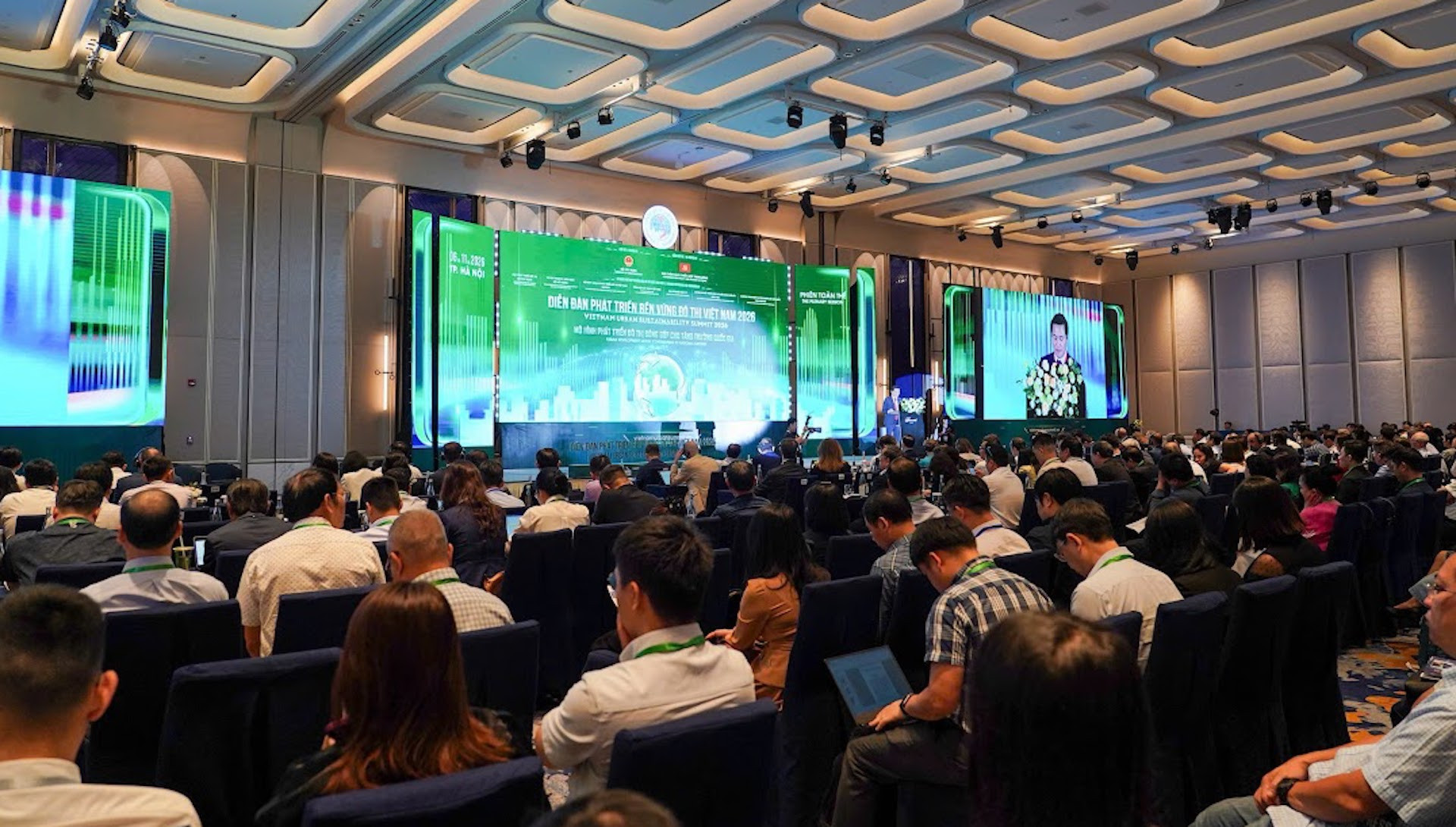
The Ministry of Construction, in coordination with the Party Central Committee's Commission for Policies and Strategies, recently held the Vietnam Sustainable Urban Development Forum 2026 in Hanoi.
The forum, themed "Urban Development Models Contributing to National Growth," brought together policymakers, experts and business representatives to discuss the future of Vietnam's cities.
Speaking at the event, Nguyen Ngoc Tuan, Deputy Head of the Commission for Policies and Strategies, said Vietnam had achieved significant progress in urbanization and urban development over four decades of economic reform.
The country currently has 910 urban areas, including two special-class urban areas, seven Class I urban areas and 901 Class II and III urban areas.
Vietnam's urbanization rate has reached 53.3%, while average residential floor space in urban areas exceeds 30 square meters per person.
An urban network has gradually taken shape, with major cities serving as centers of economic activity, culture, science, technology, education and training.
Meanwhile, medium-sized and smaller urban areas provide connections and services to surrounding communities.
However, Tuan acknowledged that Vietnam's urbanization process continues to face numerous shortcomings.
Infrastructure development remains fragmented in many locations, while traffic congestion, flooding, environmental pollution, insufficient green spaces and overloaded public infrastructure are persistent problems.
Urban redevelopment has yet to achieve the expected results, and mechanisms for mobilizing and allocating resources remain inadequate.
The potential of Vietnam's coastal urban network has also not been fully exploited.
Connections between coastal cities, seaports, economic zones and logistics hubs remain limited, while the competitiveness of many maritime economic centers has yet to meet development requirements.
Deputy Minister of Construction Nguyen Tuong Van said urban development models worldwide are undergoing fundamental changes.
Experience from other countries shows that the value of a city cannot be measured solely by its geographical size, population or number of buildings.
More important factors include planning quality, governance efficiency, resource productivity and the ability to create favorable living and working environments for residents and businesses.
Drawing on the experiences of Hanoi and Ho Chi Minh City, Van emphasized that reforming urban development models involves more than reorganizing physical space.
It also requires restructuring economic activities, making better use of emerging advantages, improving productivity and creating new growth drivers with broader economic benefits.
In many localities, urban growth still depends primarily on spatial expansion, land development and construction investment.
This approach has not delivered proportionate improvements in resource efficiency, while infrastructure and governance problems, including congestion, flooding and pollution, remain unresolved.
"The question is not simply how many more urban areas we develop, how much space we expand or how many additional projects we invest in," Van said.
"What matters more is what new value each city creates, how it contributes to productivity, the quality of growth and economic competitiveness, and how it improves people's quality of life."
Smart cities should be measured by real improvements in daily life
Data-driven smart urban governance was among the key topics discussed at the forum.
Experts described it as an essential foundation for improving administrative efficiency, allocating resources more effectively and addressing increasingly complex urban challenges.
Kieu Viet Cuong, Acting Head of the UN-Habitat Office in Vietnam, said that as databases and shared digital platforms gradually take shape, the priority should shift from simply collecting information to using it effectively.
Data should help authorities identify actual needs, determine investment priorities, coordinate service delivery and evaluate implementation outcomes.
Its use must be linked to specific objectives, decision-making procedures, clearly assigned responsibilities and mechanisms for making adjustments based on real-world results.
Cuong also emphasized that technology must support practical implementation and place people at the center of urban development.
The success of smart cities should not be assessed solely through overall improvements.
Authorities must also examine how benefits are distributed across different neighborhoods and population groups, particularly disadvantaged and vulnerable communities.
From the technology industry's perspective, Nguyen Anh Tuan, Government Affairs Director at Huawei Vietnam, said the country's digital connectivity infrastructure had made substantial progress.
However, he argued that urban residents had yet to experience corresponding improvements in their daily lives.
According to Tuan, people do not judge how smart a city is by counting its installed cameras or display screens.
Instead, they assess their experiences through practical issues such as traffic congestion, urban flooding and lengthy administrative procedures.
A city can only be considered genuinely smart when it possesses three fundamental capabilities operating as an integrated system: digital infrastructure, data and artificial intelligence (AI).
Shared digital infrastructure provides the foundation for deploying smart applications on a large scale.
As for data, its value lies not in the sheer volume collected but in the ability to connect, share and use information effectively.
Hong Khanh

