 Vietnamnet.vn

 Podcast



VNG Corporation, widely regarded as Vietnam’s first tech unicorn founded by Le Hong Minh, has seen its revenue climb sharply in recent years, yet continues to report persistent losses amounting to hundreds or even thousands of billions of dong.
Strong growth, recurring losses

VNG (UPCoM: VNZ) remains one of Vietnam’s largest technology companies, operating across gaming, Zalo, fintech payments, and cloud services. By 2025, its revenue had reached approximately VND10.9 trillion (US$430 million), up from nearly VND9.3 trillion (US$366 million) in 2024.
Despite this growth, the company has struggled to turn a profit. In 2025, VNG recorded a loss of nearly VND326 billion (US$12.8 million). The losses were even deeper in previous years, exceeding VND1.18 trillion (US$46 million) in 2024, VND2.317 trillion (US$91 million) in 2023, and nearly VND1.534 trillion (US$60 million) in 2022.
At the same time, total assets expanded significantly, reaching nearly VND11.4 trillion (US$448 million) by the end of 2025, compared to more than VND9.4 trillion (US$369 million) a year earlier.
VNG has also been listed among companies with trillion-dong revenues but thin profits or prolonged losses, according to a recent disclosure by tax authorities.
A closer look at its financial statements reveals that while gross profit remains substantial, operating costs continue to weigh heavily. In 2025, selling expenses rose to nearly VND2.558 trillion (US$100 million), up sharply from VND1.971 trillion (US$77 million) in 2024. Administrative costs also remained high at over VND1.3 trillion (US$51 million).
Additional expenses and other losses ranged between VND400-900 billion (US$16-35 million) annually.
These cost pressures, particularly from marketing new products and strategic investments, are seen as key reasons behind the company’s ongoing losses.
Stock volatility and investment bets
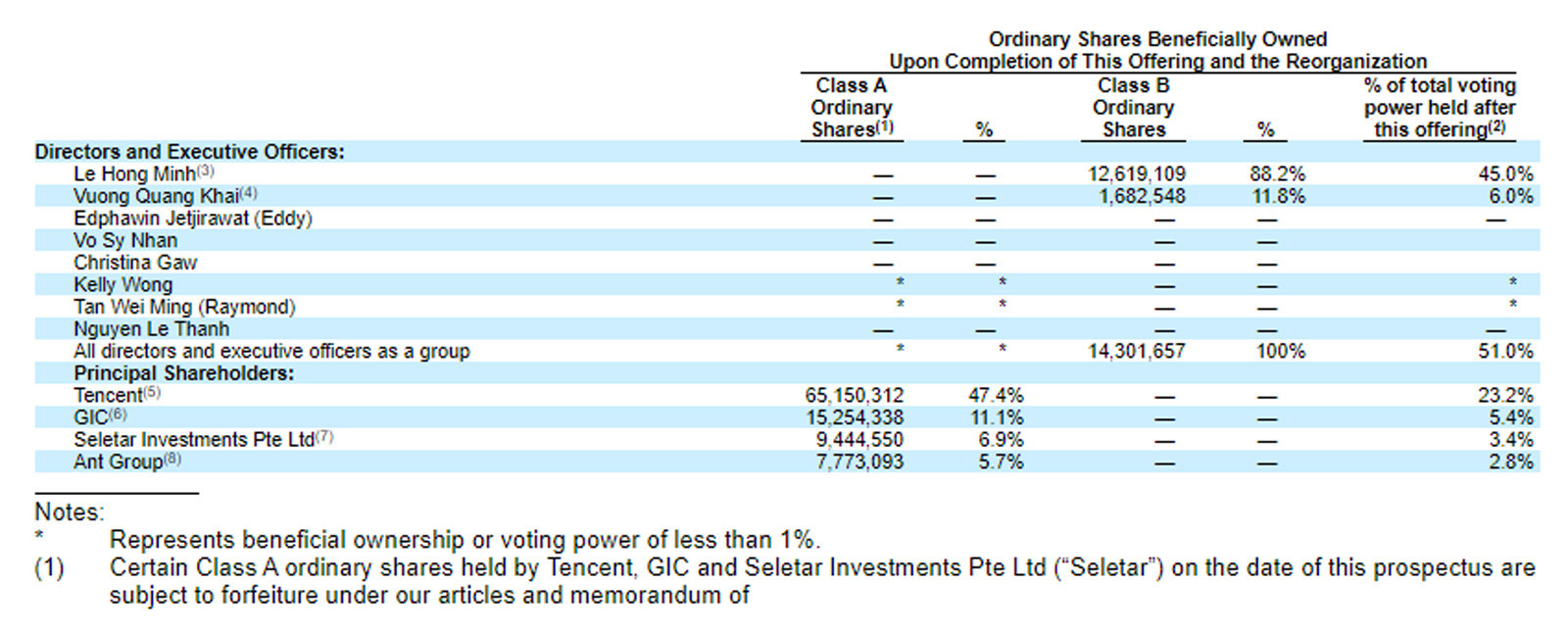
VNG’s stock has mirrored its financial challenges. Listed on UPCoM in early 2023 at a reference price of VND240,000 per share (US$9.40), it surged to over VND1.56 million (US$61) within weeks before falling sharply.
After fluctuating throughout 2023, the stock has since declined to around VND323,000 (US$12.70), reflecting investor concerns over sustained losses.
At present, VNG’s market capitalization stands at about VND9.6 trillion (US$355 million), significantly lower than its peak valuation of US$2.3 billion.
The company has also recorded setbacks in some investments, including a full write-off of VND510 billion (US$20 million) in Tiki Global.
At the same time, VNG continues to pour capital into long-term projects. In the first half of 2024 alone, it invested an additional VND1.777 trillion (US$70 million) into Zion JSC, the operator of ZaloPay, raising its ownership to nearly 100% and bringing total investment to over VND5.142 trillion (US$202 million).
Long-term prospects
Despite ongoing losses, investors remain cautiously optimistic about VNG’s long-term potential. The company holds a leading position in gaming and online advertising in Vietnam, while expanding into fintech, data centers, and cloud infrastructure.
Its strategic focus on artificial intelligence is beginning to generate revenue from international markets, and the company is expected to continue prioritizing this segment.
Broader industry trends also support its outlook. Vietnam’s information technology sector is projected to sustain strong growth, driven by rising demand for digital transformation, the expansion of 4G and 5G networks, and advances in AI, big data, and cloud computing.
Still, while VNG commands a strong domestic presence and a robust digital ecosystem, its global ambitions remain a work in progress.
The company’s challenge now is clear: translating scale and growth into sustainable profitability, without losing momentum in the fast-evolving digital economy.
Manh Ha
.svg)
