 Vietnamnet.vn

 Podcast


A promising new generation for Vietnam's national team
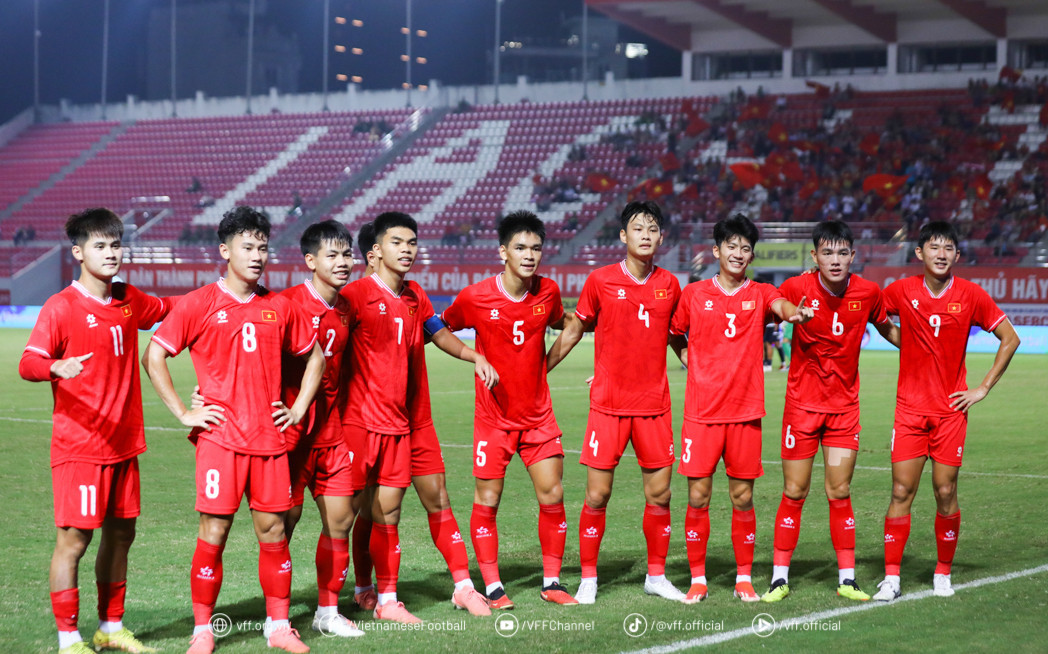
It has been quite some time since Vietnam's national football team entered a training camp with such a strong contingent of young players.
Of the 27 players called up by head coach Kim Sang Sik for the upcoming fixtures during November's FIFA international window, 13 are eligible for the U23 squad, accounting for nearly half the roster.
Notably, 10 of them were part of the Vietnam U23 squad that finished third at the 2026 AFC U23 Asian Cup, including Dinh Bac, Van Khang, Quoc Cuong, Nhat Minh, Ly Duc and Trung Kien.
That figure alone suggests Vietnamese football has a promising generation emerging, particularly given what these players have already demonstrated on the continental stage.
Of course, the absence of established stars such as Quang Hai, Hoang Duc, Xuan Son and Hoang Hen has forced Kim Sang Sik to reconsider his squad selection.
However, the inclusion of so many U23 players is clearly about more than simply filling vacancies.
Following their success at the AFC U23 Asian Cup, several young players have stepped into the spotlight and performed well when given opportunities in the V-League.
Dinh Bac, Van Khang, Quoc Cuong and Trung Kien, in particular, have become important figures at their respective clubs.
Looking at this generation, Vietnamese football fans have reason to hope for a successful transition, similar to what happened after the remarkable 2018 AFC U23 Championship campaign in Changzhou, China.
That achievement helped launch a generation of U23 players who subsequently formed the backbone of Vietnam's senior national team under former head coach Park Hang Seo.
Promise alone is not enough
Nevertheless, success at U23 level has never guaranteed a place in the senior national team.
The step up to international football remains significant, particularly in terms of pace, physical strength, experience and the ability to perform under pressure.
Among the 13 U23 players selected this time, Dinh Bac is arguably the one who has most clearly demonstrated his ability at senior international level.
The others, despite producing impressive performances in the past, still need more time to establish themselves.
More importantly, opportunities like this do not come around often.
When the senior players return, competition for places will inevitably become fiercer.
If the youngsters fail to make the most of the two upcoming matches, many may have to wait until future training camps for another chance.
They must therefore prove their worth through ability, current form and tactical discipline rather than relying solely on achievements at youth level.
At the same time, the South Korean coach will need patience if he hopes to build a squad with sufficient depth for the 2027 AFC Asian Cup and beyond.
A few mistakes or disappointing performances should not be enough to bring promising experiments to a premature end.
The two upcoming matches are therefore more than opportunities to assess individual players. They will also offer valuable insight into whether Vietnamese football has a generation capable of carrying the national team forward.
Eight years ago, a talented U23 generation emerged and helped usher in one of the most memorable periods in the national team's history.
The current crop does not need to replicate those achievements immediately, but it now has an opportunity to begin a similar journey.
Ultimately, the future of Vietnam's national team cannot be built on expectations alone. It must be shaped by opportunities, genuine competition and what young players deliver on the pitch.
Duy Nguyen

