 Vietnamnet.vn

 Podcast



The event took place on the sidelines of the sixth round of negotiations on the Vietnam – US Agreement on Reciprocal, Fair, and Balanced Trade, reflecting Vietnam’s determination to strengthen and elevate bilateral economic and trade ties in a stable, substantive, and sustainable manner.
In his speech, Hung affirmed the US as one of Vietnam’s most important economic and trade partners. Bilateral relations, he noted, should be shaped by a long-term vision, not merely based on trade volume or investment flows, but on the increasing complementarity of the two economies, Vietnam’s growing role in global supply chains, and strategic interest connectivity between the two countries.
On such basis, Vietnam hopes to work with the US to build a stable, balanced, and predictable framework for economic and trade cooperation, fostering long-term confidence among businesses in both countries.
Vietnam stays ready to further expand imports from the US, particularly through procurement contracts for machinery, equipment, and modern technologies, he stated, noting that in recent years, Vietnamese carriers have already placed major orders, including VietJet's commitment to buying 200 aircraft and Vietnam Airlines' purchase of 50 planes from Boeing, helping narrow the trade gap and foster mutual benefits.
On the energy-related issues of interest to US firms, with the presence of major corporations in oil and gas, liquefied natural gas (LNG), and renewable energy, Hung stressed that ensuring energy security is one of Vietnam’s key development priorities.
According to him, LNG is identified as an important transitional fuel to balance supply and demand and support energy transition, while offshore wind power and other clean energy sources form part of the long-term strategic orientation. The Ministry of Industry and Trade is also finalising transparent and stable regulations for electricity, gas, and renewables to enable large-scale and economically viable projects.
Vietnam values and wishes to foster long-term cooperation in modern industry, logistics, and aviation connectivity, he said, adding that Vietnam favours selective investments in foundational and high value-added industries tied to supply chains, support industries, technology transfer, and workforce training.
He called on Boeing to further expand its supply chain in Vietnam, boost partnerships with local firms and speed up deliveries, thereby assisting Vietnamese airlines in fleet expansion and operational capacity improvement.
In high-tech and digital areas, Hung told leading US technology corporations that semiconductors, advanced technology and digital economy are among Vietnam’s strategic priority areas.
The Vietnamese Government is committed to pushing ahead with institutional reforms, digital infrastructure buildup, clean energy adoption in production, and a healthy and secure competition environment for investors, he said.
With respect to logistics, trade, and market supporting services, the official spoke highly of US enterprises’ role in enhancing supply chain efficiency, market transparency, and international trade and investment.
Later, Hung held separate meetings with executives of Apple, Excelerate Energy, and ExxonMobil, delving into high-tech and energy collaboration.
At the event, he listened to their proposals while clarifying Vietnam’s policy focuses and commitment to a stable, transparent, and favourable investment environment for long-term projects.
The Vietnamese Government considers the US business community an important, long-term, and trustworthy partner, he said, pledging to further increase policy dialogue, promptly address difficulties within the legal framework, and accompany firms in the spirit of harmonised interests and shared prosperity. This serves as an important foundation for the continued consolidation of economic and trade ties in a stable, substantive, and sustainable direction in the time ahead.
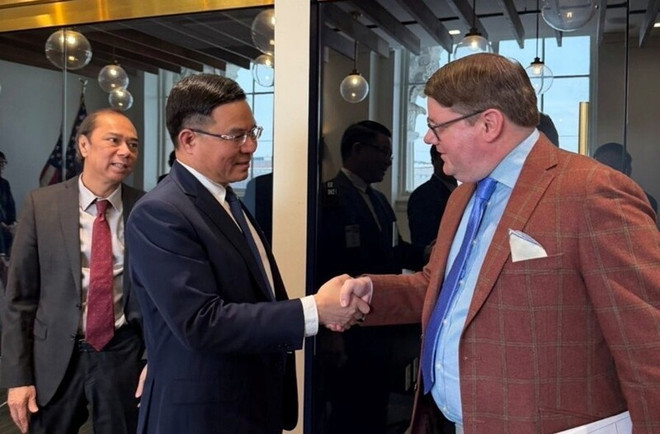
On the sidelines of the negotiation round, Hung held a working session with US Deputy Secretary of Agriculture Stephen Vaden to discuss agricultural cooperation and those elated to bilateral trade.
Discussions centred on technology transfer, with Vietnam speaking highly of US expertise in high-tech farming, disease-resistant variety development, sustainable water use and agricultural processing.
The acting minister proposed expanding expert exchanges, technology transfer, workforce training, and joint venture projects, particularly in the production of corn-based ethanol and agricultural by-products.
Vietnam stands ready to pilot models in several localities for broader rollout, delivering tangible benefits to farmers and enterprises of both countries, he said.
Regarding reciprocal tariff negotiations, the official affirmed that agricultural trade structures of Vietnam and the US are complementary rather than directly compete with each other. Vietnam has demonstrated strong goodwill by reducing import tariffs to zero on the majority of US agricultural products, while also signing a memorandum of understanding on the purchase of US farm produce worth 3 billion USD during the 2025–2028 period.
In 2025 alone, Vietnam’s imports of US farm produce neared 2 billion USD. On the basis of fairness and balanced interests, Vietnam suggested the US Department of Agriculture support expanding the list of Vietnamese farm produce eligible for a 0% reciprocal tariff, thereby facilitating their access to the US market.
Vaden expressed interest in fruit market access, animal and plant quarantine, and registration procedures for biotechnology products.
Highly valuing the Vietnamese market’s potential, he confirmed the US’s plans to send two delegations to Vietnam in March and November, including officials from US states and major agricultural enterprises, to advance agricultural trade and technology transfer, particularly in biotechnology.
Host and guest agreed to continue close technical discussions and coordinate in issues of mutual concern to support stable and sustainable agricultural trade and contribute to the broader negotiation process./.VNA
.svg)
