 Vietnamnet.vn

 Podcast



The resolution states that the quality and effectiveness of attracting, managing and utilizing foreign investment have not matched Vietnam's potential and advantages, nor met the country's development requirements in the new era.
Labour-intensive projects and those heavily dependent on natural resources, land and energy remain prevalent, while localization rates and value-added generated within Vietnam remain low. Linkages between foreign-invested enterprises and domestic businesses are limited, technology transfer remains insufficient, and some localities continue to compete for investment primarily on the basis of quantity rather than quality.
Indirect investment flows remain modest compared to the market's potential. Capital contributions, mergers and acquisitions by investment funds, global financial institutions and foreign investors remain limited, while management and oversight have not been sufficiently rigorous.
The Politburo emphasized that the foreign-invested sector is an important component of the national economy and should be encouraged to develop on a long-term basis while receiving equal treatment and competing fairly with other economic sectors.
The State will recognize and protect intellectual property rights, ownership rights over assets, investment capital and income, as well as other legitimate rights and interests of foreign investors. It also commits to maintaining a transparent, stable and predictable investment and business environment with low compliance costs, aligned with international practices and capable of enhancing Vietnam's regional and global competitiveness.
Targeting US$40-50 billion in foreign investment annually
The Politburo's overarching objective is to position Vietnam as a highly competitive destination for medium- and long-term, high-quality foreign capital supporting national development.
By 2030, Vietnam aims to rank among ASEAN's leading economies in terms of investment climate, competitiveness, innovation capacity, quality of public services and ability to attract high-quality foreign investment projects.
For the 2026-2030 period, the country targets US$200-300 billion in registered foreign investment, equivalent to US$40-50 billion annually. Disbursed foreign investment is expected to reach US$150-200 billion, or US$30-40 billion per year.
In addition, 75% of foreign investment is expected to originate from developed economies with advanced technology, strong capital resources and modern governance systems. The number of Fortune 500 multinational corporations investing in Vietnam is projected to increase by 30%.
The resolution also seeks to attract multinational corporations to establish research, design, innovation and data centres, regional headquarters, operational headquarters, treasury centres, procurement hubs and shared-service centres in Vietnam. At least three of the world's leading technology companies are expected to establish headquarters, offices or research and development (R&D) centres in the country.
Looking ahead to 2045, the Politburo envisions the foreign-invested sector accounting for around 25% of total social investment and contributing approximately 30% of national GDP, helping transform Vietnam into a developed, high-income economy.
A wide range of tasks and solutions have been outlined to achieve these objectives. First, the Politburo called for a shift in mindset and a unified understanding of the role and importance of the foreign-invested sector. It stressed the need to move from administrative management toward development facilitation, modern governance and results-based administration, while ending the practice of localities competing for investment solely through numerical targets.
"We will firmly refuse to trade the environment, natural resources, social welfare or economic security for simple economic growth," the Politburo stated.
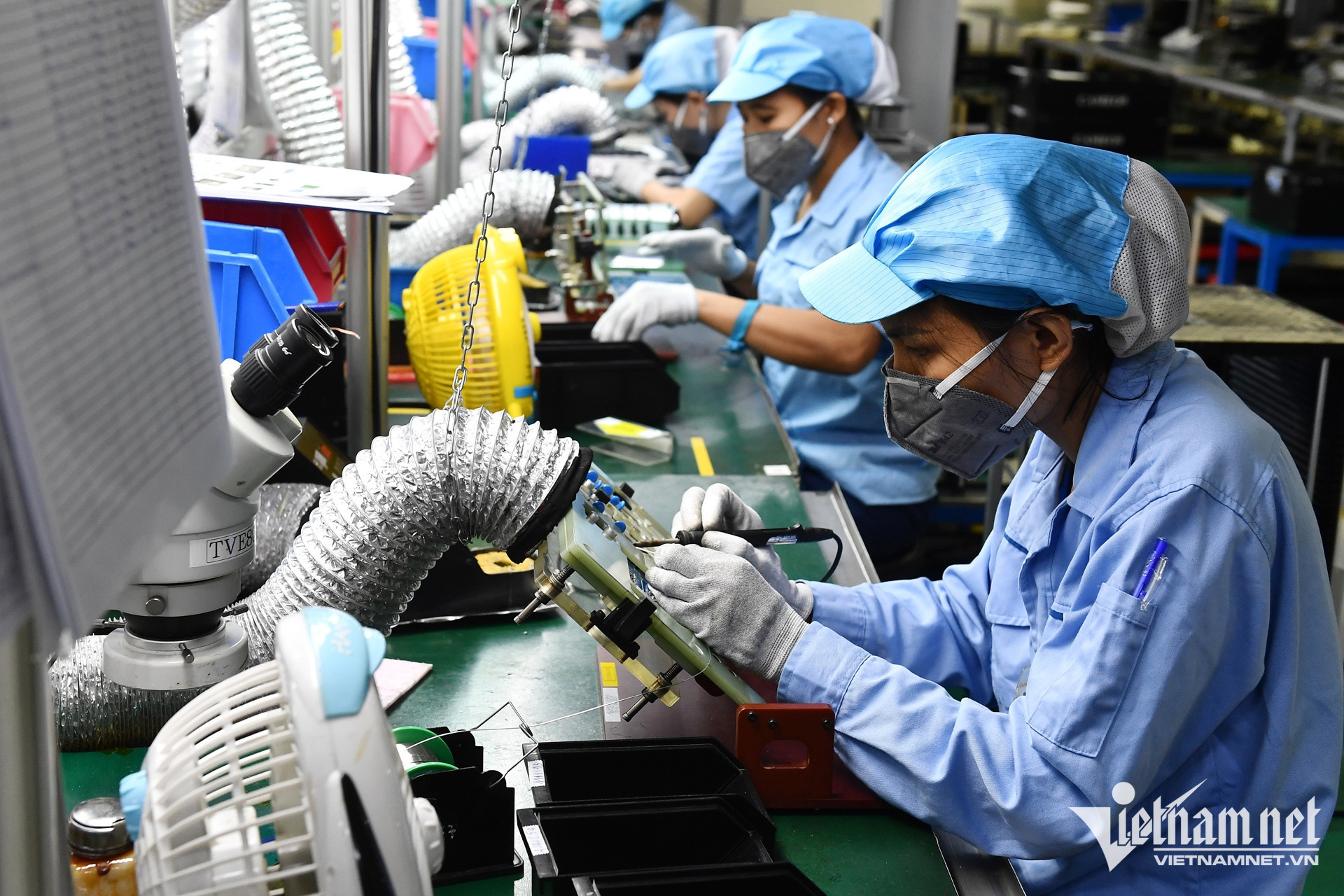
The Politburo prioritizes projects committed to advanced, environmentally friendly technologies and strong contributions to innovation, research and development, and workforce development. Photo: Hoang Ha.
Regarding institutional reform and improvements to the investment environment, the Politburo stated that priority will be given to projects committed to using advanced, environmentally friendly technologies and making substantial contributions to innovation, research and development, as well as the training and employment of Vietnamese workers.
The resolution also authorizes pilot implementation of breakthrough institutional models in selected areas, including international financial centres, free trade zones, economic zones, high-tech parks, innovation ecosystems and other emerging development spaces. These models are intended to attract next-generation, high-quality capital flows while ensuring effective risk management.
Another key priority is the development of a highly skilled workforce and the attraction of talent. The Politburo called for improved policies to attract and utilize talented individuals, experts, scientists, entrepreneurs, founders, overseas Vietnamese and highly qualified foreign professionals to work, conduct research, innovate, launch businesses and manage operations in Vietnam.
The Politburo also instructed authorities to upgrade and complete strategic infrastructure supporting investment attraction, refine foreign investment priorities by industry, sector and locality, and promote green growth, the digital economy, technology transfer and stronger linkages between foreign-invested and domestic enterprises.
Tran Thuong
.svg)
