 Vietnamnet.vn

 Podcast



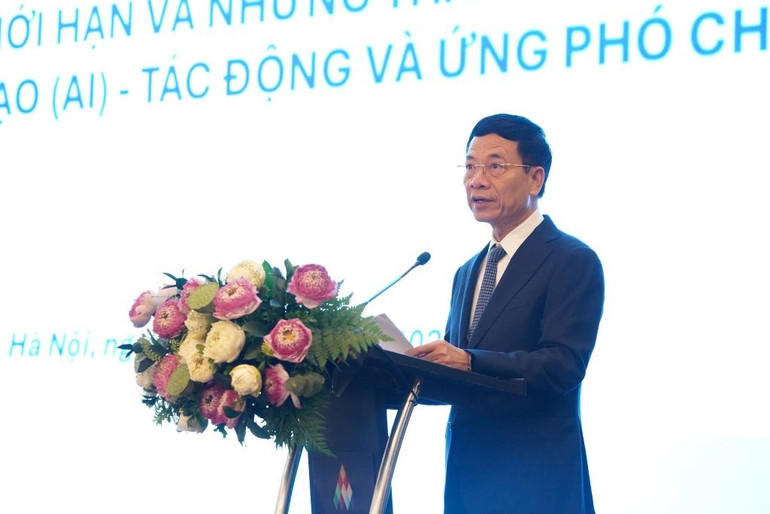
At the national scientific conference themed "The limitless power and unpredictable challenges of artificial intelligence - Impacts and policy responses," Minister of Science and Technology Nguyen Manh Hung announced that Vietnam will introduce an updated National Artificial Intelligence (AI) Strategy and enact an AI Law by the end of this year.
He emphasized, “This is not just a legal framework but a declaration of national vision. AI must become the intellectual infrastructure of the country, serving the people, ensuring sustainable development, and enhancing national competitiveness.”
On the morning of September 15 in Hanoi, the Ho Chi Minh National Academy of Politics, in coordination with the Ministry of Public Security, the Ministry of National Defense, and the Ministry of Science and Technology, organized a national scientific conference on AI.
The event was attended and chaired by Politburo members Nguyen Xuan Thang, Director of the Ho Chi Minh National Academy of Politics and Chairman of the Central Theoretical Council; General Luong Tam Quang, Minister of Public Security; Central Committee members Nguyen Manh Hung, Minister of Science and Technology; and Senior Lieutenant General Le Huy Vinh, Deputy Minister of National Defense.
AI as the new national infrastructure
During the event, Minister Nguyen Manh Hung asserted that AI should be seen as an intellectual infrastructure, not merely an applied technology. He compared AI to essential infrastructures such as electricity, telecommunications, and the internet.
“Whoever masters AI will hold superior advantages in production, business, healthcare, education, governance, and even national defense and security. Vietnam must develop its own AI infrastructure,” he stated.
Vietnam plans to rapidly build a national AI supercomputing center and shared open AI datasets. The country will pursue "AI-ization" as it once pursued electrification - only faster. AI literacy will be popularized in a manner similar to the English language education movement in previous decades. Every Vietnamese citizen will have a digital assistant. While the population remains stable, national intellect will potentially double.
On open AI technology, Minister Hung reiterated Vietnam’s commitment to developing and mastering digital technologies, including AI, based on open standards and open-source platforms.
“This is not only a commitment but also our strategic direction: openness for development, for mastering Vietnamese technology, for 'Make in Vietnam,' and to contribute to humanity. Openness allows us to harness others' knowledge and to elevate the collective standard,” he said.
Domestic market to incubate Vietnamese AI enterprises
Minister Hung emphasized that without application, there is no market, and without a market, Vietnamese AI enterprises will remain small. Promoting AI applications in businesses, government agencies, and key sectors is the fastest way to develop AI and create Vietnamese AI enterprises.
The government will increase investment in AI. The National Technology Innovation Fund (NATIF) under the Ministry of Science and Technology will allocate at least 40% of its budget to support AI applications and provide vouchers for small and medium-sized enterprises (SMEs) to adopt Vietnamese AI solutions. The domestic market will serve as a cradle for developing Vietnamese AI companies.
With a population of 100 million - young, dynamic, and tech-savvy - Vietnam has the potential to both rapidly adopt and create AI products for itself and the world. As a developing country facing significant challenges and aiming for ambitious goals, Vietnam presents many opportunities and "problems" that AI can help solve.
Prime Minister Pham Minh Chinh has issued a list of strategic technologies, with AI identified as a key priority. Vietnam can accelerate development through its national AI computing infrastructure, data ecosystems, "Make in Vietnam" digital tech enterprises, and a growing community of researchers, startups, and tech enthusiasts. AI startups are set to become a key driver of Vietnam's AI development.
AI supports but does not replace human thinking, values, and responsibility
AI offers great opportunities but also raises ethical concerns, employment challenges, and issues of social trust. Thus, AI development in Vietnam must be fast, safe, and humane. AI is meant to serve - not replace - humans. It is a powerful tool, but humans must remain the ultimate decision-makers. AI should support, not replace, human thought, values, and responsibility.
Minister Hung revealed that a national AI ethics code will be introduced, aligned with international standards but tailored to Vietnam’s context. The upcoming AI Law and national AI strategy will follow six core principles:
First, risk-based governance.
Second, transparency and accountability.
Third, putting humans at the center.
Fourth, promoting domestic AI development and self-reliance.
Fifth, using AI as a driver for fast and sustainable growth.
Sixth, protecting digital sovereignty - anchored in data, infrastructure, and AI technology.
He noted a critical feature of the Fourth Industrial Revolution: a balance between the power of big techs - who own core technologies - and the advantage of local companies and nations who understand contextual language, culture, and have domain-specific data to build tailored applications.
In the digital transformation era, while technology can be global, data must be local. Specialized applications must operate on Vietnam’s AI infrastructure. There should be global and national AI infrastructures, global and national platforms, global apps (like ChatGPT), and countless national-level applications.
Such synergy between the global and national levels will foster sustainable development, providing opportunities for developing nations like Vietnam. The competitive edge of Vietnamese firms lies in Vietnamese data, problems, open-source AI, and most importantly, the ingenuity, flexibility, and adaptability of the Vietnamese people and culture - qualities essential in an era marked by rapid and disruptive technological change.
Vietnam's AI development path based on “and”
Minister Hung emphasized that Vietnam’s AI development strategy should be based on the word “and.”
“Global and local. Collaboration and autonomy. Big Tech and startups. Technology and application. Use and mastery. Innovation and control. Global infrastructure and national infrastructure. Open data and protected data. Foundational, multi-purpose AI and task-specific, customized AI. Large-scale AI and small, specialized AI. Open and closed technologies - both integrated to learn and contribute, and autonomous to safeguard national interests.”
Sustainable and rapid AI development must be rooted in the philosophy of “and.” While humanity has historically operated with an “either-or” mindset, today’s challenges require embracing “and.” The level of civilization is now reflected in our ability to choose “and” over “or.”
Vietnam’s AI development will rest on four pillars - each a vital “and”: AI policy, AI infrastructure, AI talent, and AI culture. These must be: transparent policies, modern infrastructure, high-quality human resources, and a human-centered AI culture.
One more “and” is AI and AI-related issues. AI's power may even surpass nuclear energy, making its risks equally profound. But like yin and yang, AI and its problems coexist and evolve together. Problems caused by AI can also be solved using AI - for example, using AI to train AI talent or to detect ethical violations. AI will mature alongside the challenges it creates. We must coexist with these issues and manage them wisely.
Vietnam’s AI Manifesto is: Humane - Safe - Autonomous - Collaborative - Inclusive - and Sustainable.
AI offers Vietnam a historic opportunity to leap forward and become a high-income, developed nation. Every country that has "risen" has capitalized on the opportunities of industrial revolutions. While war caused Vietnam to miss past opportunities, peace, prosperity, and global integration now allow the country to seize this moment - to double national intelligence, boost labor productivity, achieve double-digit economic growth, enhance national competitiveness, improve governance, and strengthen national security.
“Vietnam’s AI Manifesto is: Humane - Safe - Autonomous - Collaborative - Inclusive - and Sustainable,” Minister Nguyen Manh Hung concluded.
“And finally, I wish to reiterate a point made earlier: AI is a powerful tool, but humans must always be the final decision-makers. Let AI support - not replace - human thought, values, and responsibility. AI should free humans from repetitive labor, allowing us to focus on creativity and more meaningful pursuits,” he said.
Nhan Dan
.svg)
