 Vietnamnet.vn

 Podcast



“Vietnam’s 14th National Party Congress identified an urgent need to renew the growth model and accelerate industrialization and modernization, with science, technology, innovation and digital transformation serving as key drivers; improve productivity, quality, efficiency, added value and economic competitiveness; and properly balance domestic production autonomy with participation in global production networks and value chains.
“The high growth targets for 2026-2030 require the country to rapidly improve its manufacturing and technological capabilities. In this process, supporting industries are not a secondary component of the industrial sector, but one of the foundations for building national industrial capacity.”
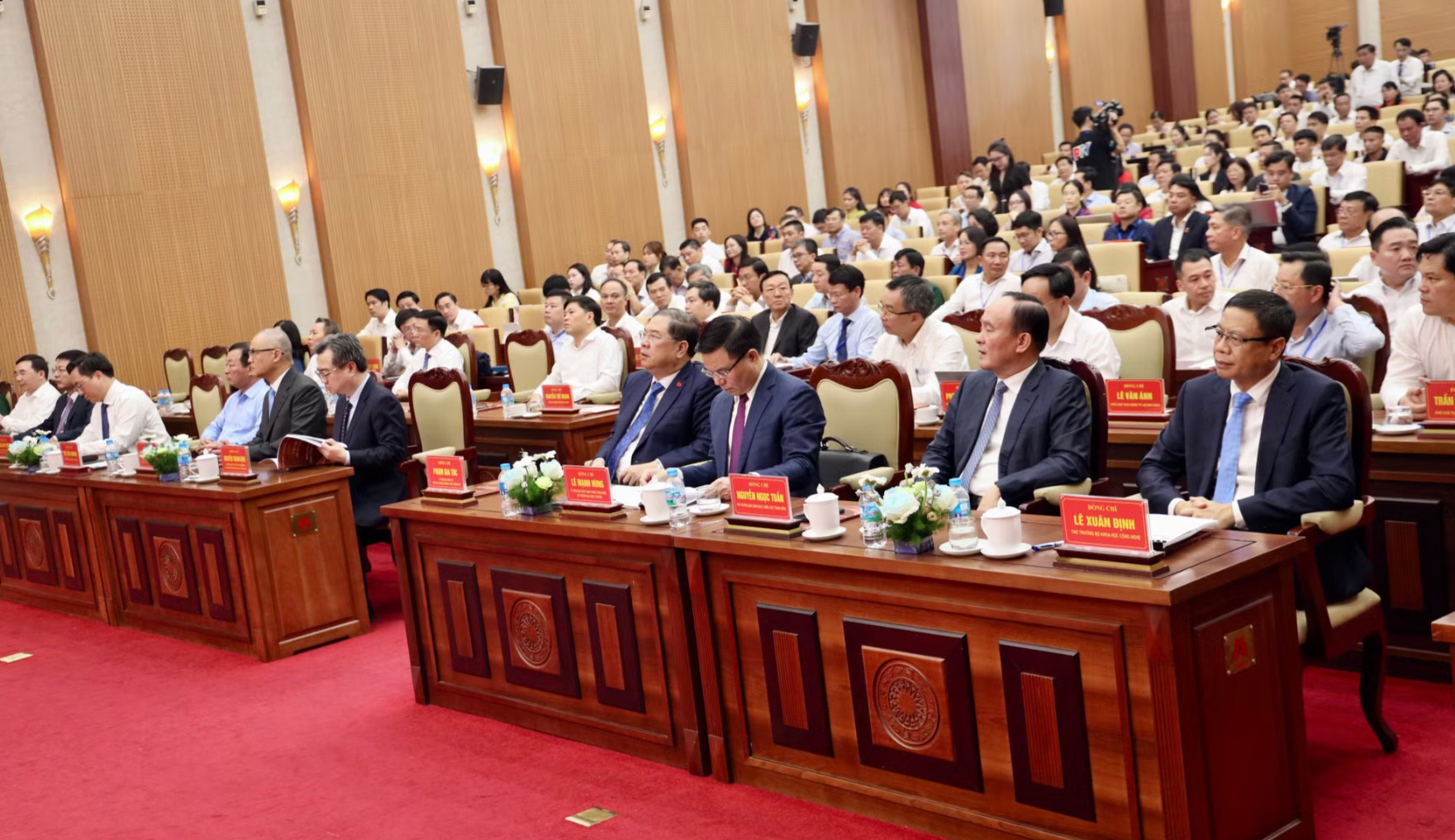
Nguyen Thanh Nghi, Politburo member, Secretary of the Party Central Committee and head of the Central Commission for Policy and Strategy, made the remarks at a national scientific conference titled “Development orientations for Vietnam’s supporting industries,” jointly organized by the commission, the Ministry of Industry and Trade and the Phu Tho Provincial Party Committee on Sept. 30.
From ‘having products’ to ‘having capabilities’

According to Nghi, a strong industrial sector is measured not only by the scale of production and exports of finished products, but more importantly by its ability to master materials, components, equipment, technology, design, standards, technical services and other high-value-added stages.
The stronger supporting industries become, the greater the economy’s domestic capabilities, the more value that can be created and retained within the country, and the greater its resilience to external shocks.
In the new environment, Vietnam faces a strategic imperative not merely to follow established value chains, but to proactively build the capabilities needed to participate in and gradually establish its position within emerging value chains.
Alongside new policies, Nghi said that while policies must continue to be reviewed and supplemented in a timely manner, the focus now needs to shift decisively toward targeted implementation that delivers measurable results. On that basis, he outlined seven major strategic priorities.
First, supporting industries should be treated as an integral component of the national industrial development strategy. Each key industry needs to clearly identify the materials, components, subsystems, equipment, technologies and technical services that Vietnam needs to master; the links in the value chain that could become competitive advantages; and the capabilities needed to strengthen autonomy and improve the country’s position in supply chains.
Second, the focus should shift from “having products” to “having capabilities.” The objective is to develop capabilities in design, technology, materials, quality management, testing, certification and continuous improvement.
To achieve this, Vietnam needs to gradually develop a group of domestic companies capable of becoming tier-one suppliers and system integrators, while also being able to work with customers on research, design and product development.
Third, businesses should be placed at the center of the supporting-industry development ecosystem. The State should focus on creating institutions, markets and infrastructure; businesses should take the lead in identifying demand, standards and supplier-development roadmaps; supporting-industry companies should invest in upgrading their capabilities; while research institutes, universities and technical centers should help address technology, testing, certification and capability requirements.
“We need to make a decisive shift from support based on lists of eligible products toward support based on supply chains, orders and outcomes,” Nghi said.
Targeted priorities
Fourth, Nghi said Vietnam should make greater use of the private sector, domestic businesses and foreign direct investment in building national industrial capacity.
Politburo Resolution No. 68-NQ/TW previously called for developing the private economy, strengthening domestic capabilities and helping businesses advance technologically, improve productivity and participate more deeply in value chains.
In supporting industries, businesses are the actors directly responsible for investment, technological innovation and the development of supply capabilities. Vietnam’s approach to attracting FDI should therefore shift more strongly toward improving quality, efficiency and spillover effects, with greater emphasis on technology, research and development, high-quality human resources and linkages with Vietnamese businesses.
Fifth, Vietnam should selectively prioritize industries and technologies with strong potential to generate broader spillover effects.
The country should continue upgrading supporting-industry chains in existing industries while proactively building capabilities in emerging fields such as semiconductors, artificial intelligence, robotics and automation, advanced materials, batteries and energy storage, unmanned aerial vehicles, aerospace, new industrial sectors and smart manufacturing systems.
However, Vietnam needs to carefully select the stages, products and subsystems in which it can build capabilities, secure markets and participate more deeply in regional and global value chains.
“This is also consistent with the direction set by the 14th National Party Congress Resolution to prioritize the development of several strategic industries and technologies,” Nghi said.
Sixth, Vietnam should develop industrial and shared technical infrastructure that meets international standards.
This includes establishing a network of shared technical centers with substantive capabilities and reforming workforce training to meet the needs of businesses and supply chains, particularly in precision engineering, materials, electronics, automation, semiconductors, quality management and product design.
Seventh, the State should reform its support mechanisms to make them more focused, conditional and results-based.
Public resources should genuinely serve as “seed capital,” concentrating on areas where businesses find it difficult to overcome initial barriers on their own, including research and development, design, prototyping, testing, certification, technological innovation, workforce training and digital transformation.

Support should be tied to verifiable outcomes, such as higher productivity, compliance with international standards, lower defect rates, the acquisition of new customers, participation in supply chains, greater domestic added value or the development of new technological capabilities.
At the local level, Pham Dai Duong, Secretary of the Phu Tho Provincial Party Committee, said that amid the requirements of the new development period, supporting industries provide a foundation for developing strategic technologies and key industries, nurturing new development capabilities and advancing the goals of self-reliance, resilience, strategic autonomy and deeper international integration in line with Resolution No. 19.
Following the consolidation of provincial-level administrative units and the introduction of the two-tier local government model, every province and city now has new potential, advantages, development space and growth drivers.
The question, Duong said, is which sectors and breakthrough areas localities — particularly provinces and cities with advantages in supporting-industry development, including Phu Tho — should prioritize to capitalize on their distinctive strengths while generating the greatest synergies and spillover effects for other localities and regions nationwide.
Another issue is what mechanisms are needed to strengthen the central government’s coordinating, supporting and guiding role, as well as cooperation and linkages among localities, to ensure consistency and connectivity in planning, investment, infrastructure development, data and resource allocation.
Duong therefore emphasized the State’s enabling role in fostering linkages, building a national supporting-industry business ecosystem and organizing development spaces that capitalize on local advantages.
TTXVN
.svg)
