 Vietnamnet.vn

 Podcast



According to Minister Vu Hai Quan, Resolution 20 on building and developing Vietnam into a strong maritime nation sets new strategic requirements for science, technology, innovation and digital transformation.
Vietnam must go beyond simply conducting research or developing its marine economy. It needs to progressively gain greater command of its maritime domain through knowledge, data, technology and innovation.
Science and technology, therefore, should no longer merely support individual sectors of the marine economy. They must become the foundation for integrated governance of the country’s maritime space, the development of a modern, sustainable blue economy, environmental protection, national defense and security, and a stronger Vietnamese role in ocean governance.
Three bottlenecks holding back Vietnam’s marine research capacity
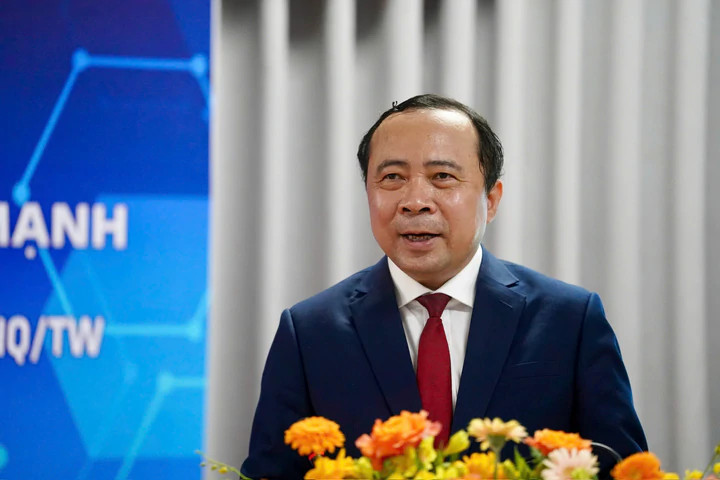
Minister of Science and Technology Vu Hai Quan says science and technology should not merely support individual sectors of the marine economy, but become the foundation for integrated governance of Vietnam’s maritime space, the development of a modern and sustainable blue economy, environmental protection, and national defense.
Minister Vu Hai Quan identified three major bottlenecks affecting Vietnam’s capabilities in marine science and technology.
The first is human resources. Citing the oceanography program at the University of Science under Vietnam National University Ho Chi Minh City, the minister said the program often struggles to fill its enrollment quota and has admission scores among the lower end of the spectrum, a situation also seen in some environmental and related disciplines.
If the pipeline of future scientists remains limited, he said, Vietnam will struggle to build a sufficiently strong national maritime strategy.
The second bottleneck involves laboratories, equipment and research infrastructure. The Institute of Oceanography has a history spanning more than a century and has been at the forefront of marine and ocean research, but much of its equipment and laboratory infrastructure was installed years ago, with some facilities now deteriorating.
The third problem lies in the way scientific and technological projects are organized and managed.
The minister cited a research project in Nha Trang aimed at producing lobster seedstock that has received repeated extensions without achieving its objective. In his view, this does not reflect a lack of ability among scientists, but rather shortcomings in how research missions are structured.
With funding of around VND10 billion (roughly US$380,000), coupled with limited infrastructure and human resources, it is extremely difficult to expect a single research project to solve a challenge as complex as mastering lobster seed production technology within a short period.
By comparison, the University of Tasmania in Australia invested tens of millions of US dollars in a similar challenge, with research lasting 10 to 15 years before delivering results.
The minister said this illustrates why marine science and technology programs need to be reorganized around greater concentration of resources, larger scale and investment periods that realistically reflect the objectives being pursued.
Treat marine data as strategic infrastructure and move toward technology mastery
According to the minister, the tasks assigned by the Government to the Ministry of Science and Technology should not be viewed as isolated assignments. Together, they form an interconnected system spanning scientific research, baseline surveys, data, technology, innovation, human resources, infrastructure and international cooperation.
Through 2030, the first priority is to build strong, focused marine research capacity capable of providing national leadership.
The target of developing two to three marine research organizations capable of reaching the level of ASEAN’s leading countries should not be viewed simply as a numerical goal. It should serve as a measure of national capability.
These organizations need to bring together strong teams of experts, possess modern research infrastructure, master data and technologies, tackle major national challenges and participate in international research networks.
They should become the core of Vietnam’s marine science, technology and innovation ecosystem rather than simply institutions receiving additional research projects.
Another important requirement is the creation of an integrated, interconnected, continuously updated and secure marine data system. Modern ocean governance, the minister said, must first and foremost be grounded in data and scientific evidence.
The system should connect information from baseline surveys, monitoring activities, environmental and natural-resource data, infrastructure and socioeconomic activities at sea.
Building on this foundation, Vietnam can develop digital maps of its seas and oceans, along with modeling, forecasting and artificial intelligence tools to support management, planning, early warning systems and decision-making.
Alongside data integration, sharing and utilization, the system must ensure appropriate access controls, cybersecurity, safety and data sovereignty.
The minister also stressed the need for a fundamental shift in thinking: from applying technologies developed elsewhere to mastering technologies itself.
Vietnam needs to clearly identify strategic marine, ocean and dual-use technologies and concentrate resources on researching, acquiring, absorbing, transferring and developing them.
Priority areas include marine observation, monitoring and forecasting; seabed and deep-sea exploration; underwater equipment, marine robotics and unmanned vehicles; offshore structures and energy; marine environmental technologies; marine aquaculture and biotechnology; and dual-use technologies serving economic development, environmental protection, search and rescue, national defense and security.
“The ultimate goal is not how many more research projects or scientific papers we produce, but which technologies we can master, what products we can create and in which areas we can build national capabilities,” the minister said.
For research results to move beyond laboratories and into real-world use, businesses must be involved from the beginning - helping identify problems, commissioning projects, providing co-funding, conducting trials and validation, and ultimately bringing technologies to market.
The State, meanwhile, needs mechanisms to encourage businesses to invest in high-risk fields of strategic importance.
Vietnam’s coastal localities should also play a more proactive role in identifying needs, organizing pilot projects and creating markets for marine technology products.
According to the minister, research missions must increasingly focus on major interdisciplinary and interregional challenges with clearly defined outputs. Basic research should be linked with baseline surveys, data, technology, workforce training, business demand and the requirements of national governance.
Thai Khang
.svg)
