 Vietnamnet.vn

 Podcast



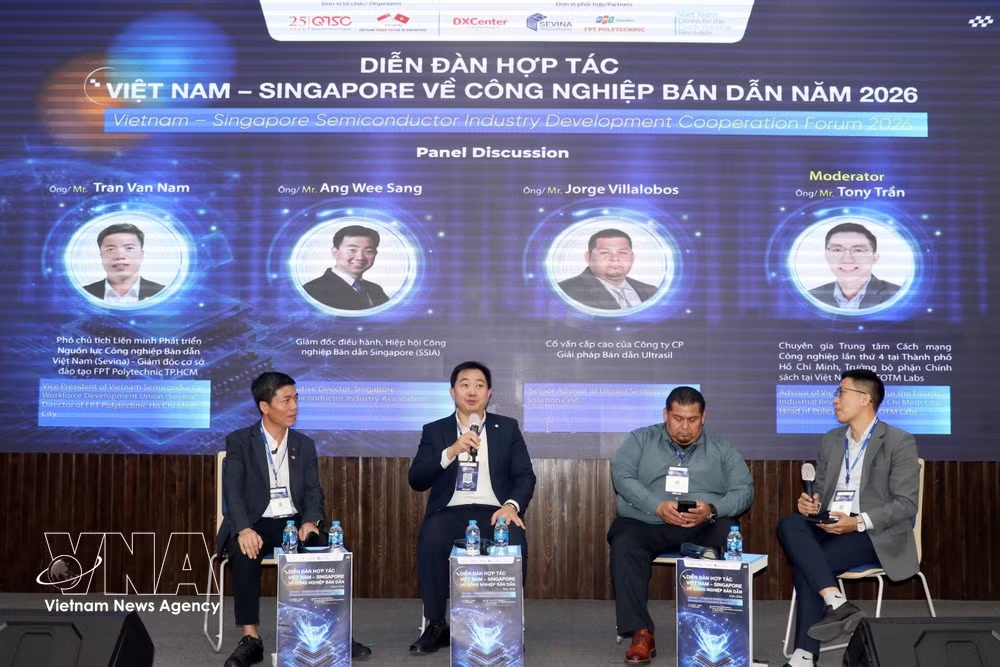
The forum was co-organised by the Quang Trung Software City Development Company Limited (QTSC) and the Vietnam Trade Office in Singapore.
At the event, QTSC and the Singapore Semiconductor Industry Association (SSIA) signed a memorandum of understanding (MoU) to connect Vietnam's semiconductor ecosystem with Singapore's semiconductor business network and the wider region. Under the agreement, the two sides will cooperate in investment promotion, business matchmaking, research and development (R&D), technology transfer, workforce training and the expansion of international cooperation in the sector.
The SSIA, the Vietnam Semiconductor Workforce Development Union (SEVINA), and FPT Polytechnic College also signed a cooperation agreement to step up training programmes and develop engineers and specialists to meet the growing needs of the semiconductor industry.
Tran Huu Dung, Director of the QTSC, said the company hopes the forum will help position it as a gateway connecting global semiconductor enterprises with the Vietnamese market and the Asian region, contributing to the development of Ho Chi Minh City's semiconductor ecosystem. This would enhance innovation capacity, foster a highly skilled workforce and enable Vietnam to participate more deeply in the global semiconductor value chain, he said.
Singapore has remained one of Vietnam's largest foreign investors for many years, with more than 4,500 valid investment projects. In the first five months of 2026, bilateral trade reached 23.3 billion SGD, an increase of more than 43% compared with the same period in 2025. These achievements provide a strong foundation for expanding bilateral cooperation into high-tech sectors, with semiconductors regarded as one of the most promising industries for the coming decade.
Cao Xuan Thang, Vietnam's Trade Counsellor in Singapore, said many Singaporean companies are not only interested in expanding their operations in Vietnam but are also seeking capable local partners in integrated circuit (IC) design, chip packaging and testing, research and development, workforce training, and the development of regional and global supply chains.
The 2026–2030 period is widely regarded as a pivotal stage for Vietnam's transition from participating in global semiconductor supply chains to gradually establishing a comprehensive domestic semiconductor ecosystem. The country has already attracted major semiconductor companies, including Marvell, Renesas, Infineon, Qualcomm, NVIDIA and Hana Micron, alongside numerous firms specialising in IC design, chip packaging and testing.
According to Research and Markets, Vietnam's semiconductor market is projected to expand by 2.22 billion USD between 2025 and 2030, with a compound annual growth rate (CAGR) of around 7.1%.
As the country's leading centre for innovation and high technology, Ho Chi Minh City enjoys significant advantages in developing the industry, supported by its ecosystem of technology enterprises, high-tech parks, universities, research institutes and innovation centres./. VNA
.svg)
