 Vietnamnet.vn

 Podcast



The final of the second leg of the SEA V.League on August 10 at Ninh Binh Gymnasium began in a way Vietnamese fans had feared. Against Thailand’s powerful squad, Vietnam’s back-row defense lacked cohesion, and unstable first passes disrupted their fast-attack formation, normally their greatest strength.
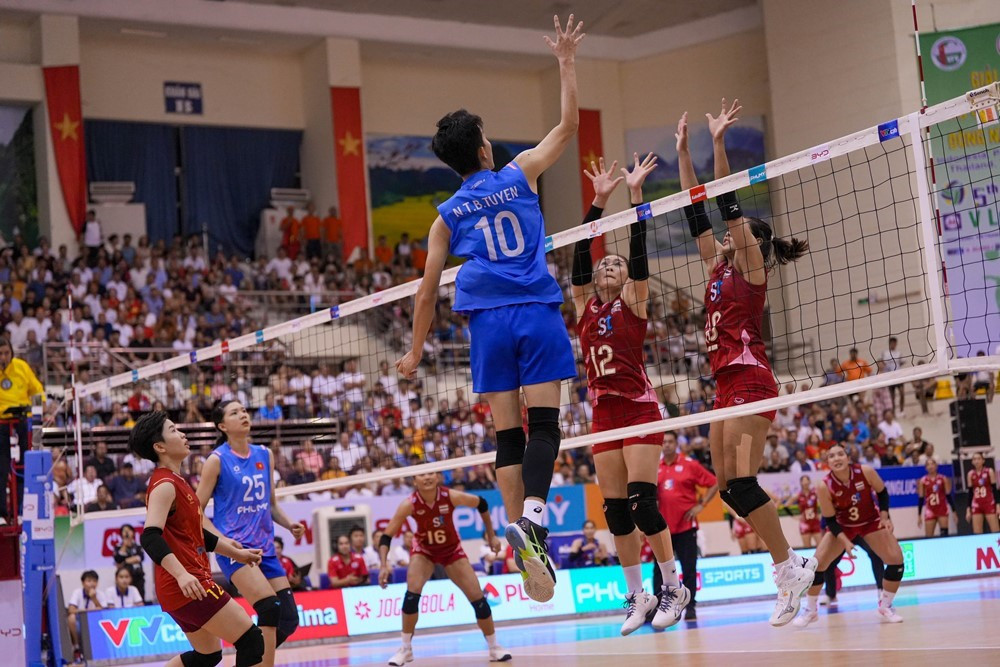
Thailand, quick to exploit open spaces, dictated the pace and used difficult serves to force the hosts into repeated errors. The first two sets ended swiftly at 25-17 and 26-24 in favor of Thailand, largely because Vietnam could not generate enough pressure to disrupt their opponent’s passing and attacking structure.
The turning point came when head coach Nguyen Tuan Kiet replaced Nguyen Thi Uyen with Nhu Quynh. This was more than just a personnel change – it marked a complete shift in strategy. Vietnam began attacking more from positions 2 and 4 with medium-speed wing plays, avoiding direct clashes with Thailand’s tall blockers.
Nhu Quynh, working with Bich Tuyen and Bich Thuy, continuously pressured Thailand’s flanks, forcing their blockers to spread out and opening space for quick attacks from position 3. Thanh Thuy shone both as an outside hitter and as a secondary libero, using her anticipation and reflexes to neutralize many of Thailand’s trademark left-wing attacks.
Equally important, Vietnam’s defense tightened, laying the foundation for scoring counterattacks. These adjustments paid off as Vietnam won sets 3 and 4 with scores of 25-17 and 25-22, gaining not only points but also psychological momentum.
The fifth set was a tense battle of tactics. Thailand tried to change the rhythm, but Vietnam maintained a strategic serving style, forcing their rivals into off-the-net passes and weakening their central attacks. In turn, Vietnam adjusted their hitting force and direction, targeting the space between Thailand’s positions 5 and 6. A 16-14 victory broke a losing streak spanning more than three decades, including 11 SEA Games finals.
International media quickly acknowledged the significance of the win. Thailand’s leading daily Matichon reported that their national team was “shocked” by Vietnam’s comeback, while also recognizing “clear improvements in tactical organization and competitive mentality” under coach Tuan Kiet. The Asian Volleyball Confederation also praised Vietnam’s victory over the eight-time consecutive champions as a “masterpiece scenario,” proof that Vietnam had moved beyond being dominated to confidently and flexibly dethroning a long-standing regional powerhouse.
Behind this dramatic triumph lies years of methodical preparation. The Vietnam Sports Administration, the Vietnam Volleyball Federation, and generations of coaching staff have persistently pursued a roadmap to elevate the team. The squad has been selectively rejuvenated, with rising talents like Nhu Quynh, Luu Thi Hue, and Kim Thanh joining seasoned stalwarts Thanh Thuy, Bich Thuy, and Bich Tuyen.
Training methods have diversified, balancing technique, tactics, and adaptability. Overseas training and competition have improved back-row defense – a crucial element against fast-attacking teams like Thailand.
Reforms in the national championship system have allowed Vietnamese players to face high-quality foreign athletes, gaining valuable experience. Equally vital is the mental aspect: the coaching team has focused on building psychological resilience, especially against strong and “difficult” rivals like Thailand. Video analysis, rehearsing match scenarios, and encouraging players to make their own decisions under pressure have fostered greater confidence. The August 10 final proved it – trailing 0-2, the team did not collapse but patiently turned the match around.
This victory is more than just a title. It marks the beginning of a new era where Vietnam’s women’s volleyball asserts itself as an equal competitor to Thailand. If they maintain this momentum and continue deep investment, Vietnam can confidently aim for the top prize at future SEA Games.
Ngoc Huy
.svg)
