 Vietnamnet.vn

 Podcast



Decree No. 328/2026/ND-CP, which officially took effect on Oct. 5, 2026, establishes a comprehensive and stringent legal framework for dealing with fake news and false information in Vietnam.
Notably, the decree sets out a specific mechanism for referring case files to criminal investigation authorities, making clear that those who deliberately spread false information that harms national security or the reputation of organizations and individuals may face serious criminal penalties.
Two levels of harmful fake news in cyberspace
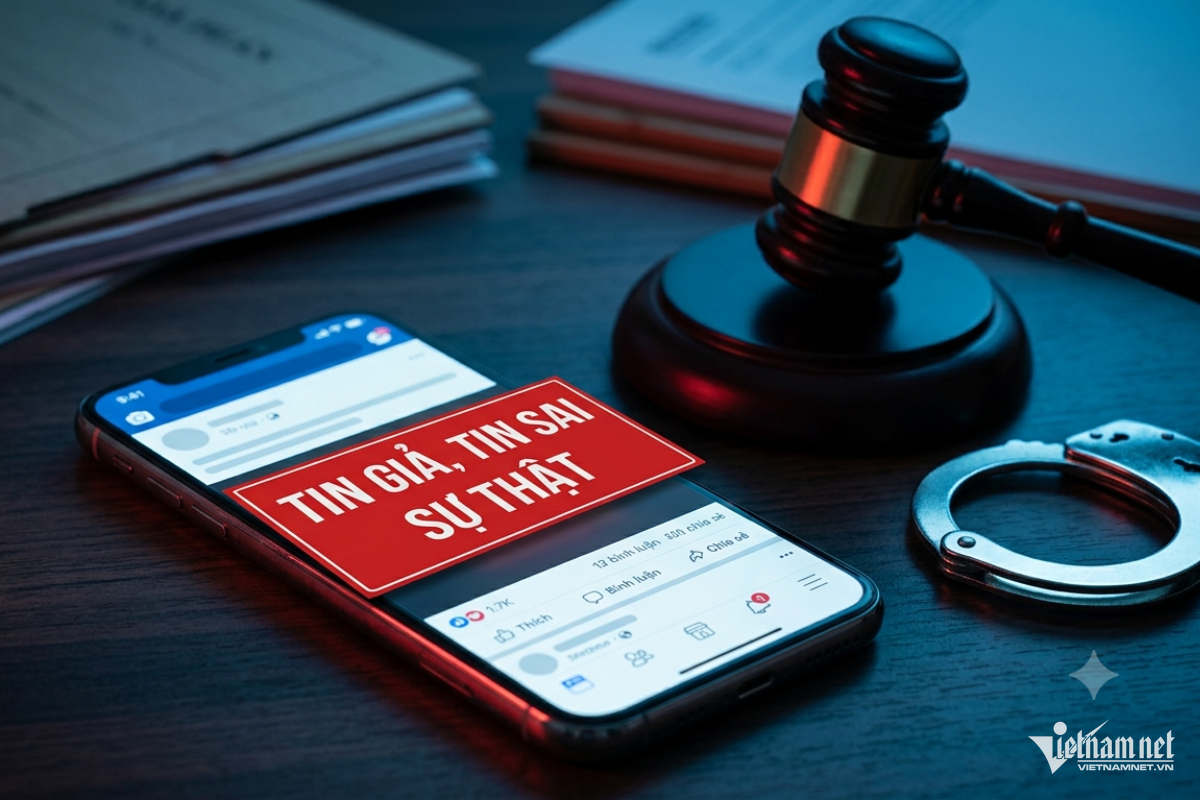
Spreading fake news and false information can potentially lead to criminal prosecution. AI-generated image. Source: Gemini.
Under Decree 328, issued by the Vietnamese government on Aug. 19, 2026 and effective from Oct. 5, fake news and false information are defined as information that is entirely untrue or only partially true and that harms national security, the country's reputation and image, public order and safety, or the lawful rights and interests of organizations and individuals.
The definition covers a broad range of content, including misleading, fabricated and falsified information, as well as defamation and distortion.
To improve the detection and handling of such content, the decree classifies fake news into two distinct categories based on the level of harm.
The first category covers fake news that causes, or poses a risk of causing, particularly serious consequences. This includes information that has a large-scale negative impact on national security, national defense, foreign affairs, or public order and safety; directly damages the reputation of the Communist Party of Vietnam and the State or the honor of senior leaders; or has the potential to incite unrest, trigger a communications crisis or cause widespread public alarm.
The second category covers harmful fake news of a more limited scope that directly infringes upon the reputation, honor, dignity or lawful rights and interests of specific agencies, organizations or individuals.
This classification provides the legal basis for authorities to determine the nature and severity of violations and, accordingly, apply urgent preventive measures or refer cases for further action under the law.
Cases showing signs of criminal offenses to be referred to investigators
One of the decree's significant new provisions is the procedure linking administrative and technical enforcement with criminal proceedings.
Under Articles 9 and 13, if authorities uncover signs of a criminal offense while verifying information or handling reports and complaints from members of the public or victims, the case file must immediately be transferred to the authorities empowered to conduct criminal proceedings.
Criminal liability will then be pursued in accordance with Vietnam's Penal Code, Criminal Procedure Code and Law on the Organization of Criminal Investigation Bodies.
This means that creating, storing, posting, sharing or commenting on fake news may not simply result in an administrative fine or the removal of the offending content.
If fabricated information seriously disrupts public order, gravely insults another person's honor or dignity, or infringes upon national security, the person responsible may face criminal prosecution and prison sentences under the Penal Code.
Decree 328 also establishes strict technical procedures for dealing with false information. Content must be labeled "FAKE NEWS, FALSE INFORMATION" within 24 hours after authorities reach their conclusion. The identities of individuals and organizations responsible for violations may also be disclosed through mass media or official information portals, while offending content can be subject to compulsory removal.
For information classified as content that citizens are not permitted to access, including state secrets and certain national security and defense information under Vietnam's Law on Access to Information, authorities will neither attach warning labels nor publicly disclose the content. Instead, they will immediately take measures to block and remove it.
Fake news and false information deemed particularly serious will be made public immediately after being labeled, while cases in the ordinary category will be publicized within 12 working hours.
The disclosure of the identities of individuals or organizations that make statements containing, create, store, retain, provide, post, disseminate, share or comment on fake news and false information after verification will comply with laws governing access to information, unless otherwise provided by relevant legislation.
Online platforms and users also face responsibilities
Decree 328 also specifies the responsibilities of internet service providers, social media companies and cross-border platforms operating in Vietnam.
These companies are required to establish round-the-clock points of contact to coordinate with the Ministry of Public Security in responding to requests to remove or block violating content and to temporarily suspend or permanently close accounts, community pages and media channels dedicated to spreading fake news.
Internet companies are also required to proactively review content and prevent the posting or dissemination of material that competent authorities have determined to be fake news. They must also cooperate in providing information about users who commit violations to support investigations.
For individual users, sharing or commenting on unverified information on social media can carry legal consequences.
Decree 328 requires citizens to comply with the law and report violations. People can report suspected fake news through the VNeID national digital identity app, hotlines or official online portals operated by competent authorities.
Le My
.svg)
