 Vietnamnet.vn

 Podcast



Amid rapid global economic shifts, Vietnam can no longer rely solely on low-cost advantages if it hopes to attract a new generation of foreign direct investment (FDI). Instead, strengthening the economy’s internal capabilities is becoming an urgent priority.
What investors are looking for
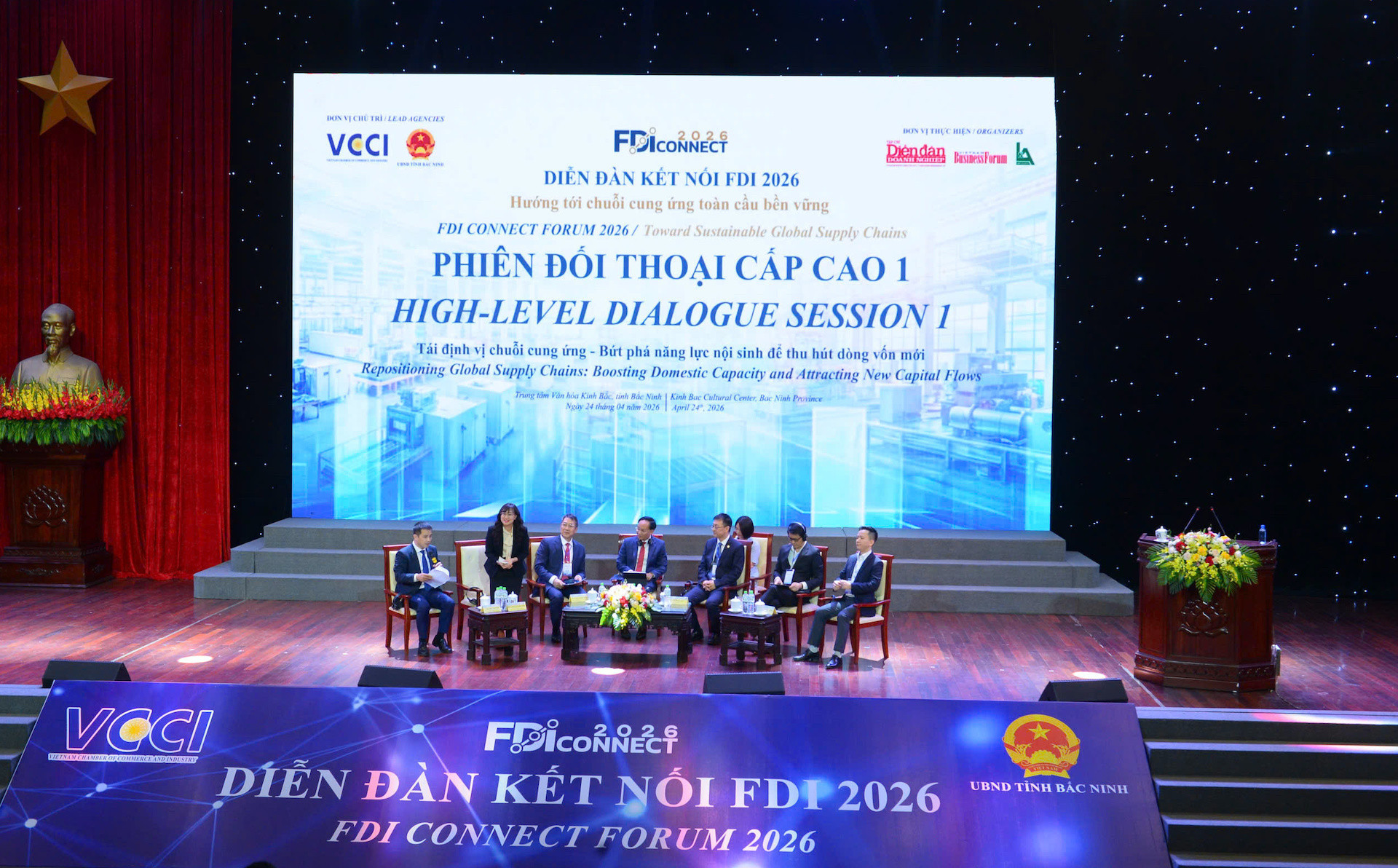
The “FDI Connect 2026” forum held on April 24. Photo: V.C
On April 24 in Bac Ninh, the provincial People’s Committee, in collaboration with the Vietnam Chamber of Commerce and Industry, hosted the “FDI Connect 2026” forum under the theme “Towards sustainable global supply chains.”
From the perspective of foreign enterprises, Kim In Woo, Vice President of the Korean Business Association in Vietnam, noted that the investment environment has undergone significant changes.
Businesses are no longer focused solely on costs. They are increasingly concerned with technological capacity, supply chain stability, workforce quality, logistics efficiency and policy predictability.
Vietnam - South Korea cooperation continues to expand, with bilateral trade reaching US$94.5 billion in 2025 and targeting US$150 billion by 2030. As of the end of February 2026, South Korea’s cumulative investment in Vietnam had surpassed US$95 billion.
However, Kim warned that relying on processing and assembly alone will make it difficult for Vietnam to maintain its competitive edge as technological competition intensifies. The country needs to enhance technological capabilities, quality management and develop a stronger base of engineers and managers.
“In the coming period, the goal is not only to attract more investment, but more importantly to clearly define priority sectors, improve technology and human resources, and gradually elevate the quality of the supply chain,” he emphasized.
From the domestic business perspective, Nguyen Trung Kien, CEO of CNCTech, said Vietnamese enterprises would struggle to break through if they continue operating in a fragmented manner and remain confined to contract manufacturing.
According to him, the key lies in building an integrated ecosystem based on three pillars: high-tech manufacturing, green infrastructure and efficient logistics.
“When these three elements come together, Vietnamese firms can move beyond being suppliers to become strategic partners in global supply chains,” he said.
From participation to higher positioning
Associate Professor Dr. Ho Sy Hung, Chairman of the VCCI, highlighted that a powerful wave of global supply chain restructuring is underway, with multinational corporations seeking production locations that offer not only competitive costs but also adaptive, transparent and sustainable ecosystems.
Vietnam is emerging as an attractive destination. However, to draw in next-generation FDI, the country must strengthen its internal economic capacity rather than depend solely on low costs. This includes developing domestic enterprises, particularly in supporting industries.
“We need to shift from the mindset of ‘participation’ to ‘upgrading our position’ in the value chain,” Hung said, stressing the importance of mastering technology and engaging in higher value-added segments such as design, research and development, and innovation.
Nguyen Duc Hien, Deputy Head of the Central Economic Commission’s Strategy and Policy Department, noted that in the first quarter of 2026, total registered FDI in Vietnam exceeded US$15 billion, marking a strong increase year-on-year and reflecting sustained investor confidence.
However, he also pointed out persistent challenges, including weak linkages between FDI firms and domestic enterprises, low localization rates, limited technology absorption capacity, and a modest share of research and development activities.
In the current context, Vietnam must shift from prioritizing the quantity of FDI inflows to building a strategic national foundation for foreign-invested economic development.
Relevant authorities are now studying proposals to submit to the Politburo a dedicated resolution on developing the foreign-invested sector in the new phase.
Key orientations include selectively attracting FDI, prioritizing high technology, innovation, renewable energy, green economy and circular economy. At the same time, incentives are expected to shift from tax-based preferences to performance-based mechanisms, such as technology transfer, innovation outcomes and digital transformation.
Hong Khanh
.svg)
