 Vietnamnet.vn

 Podcast



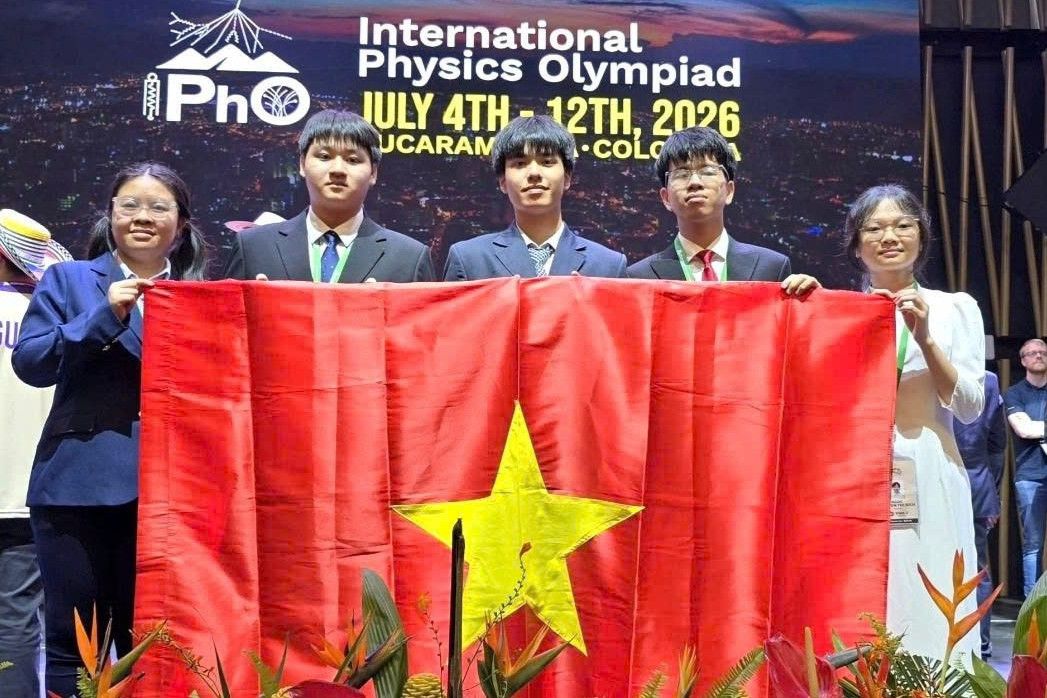
The result places Vietnam among the top seven performing teams at this year's competition and marks the country's best achievement in the history of the International Physics Olympiad.
The four gold medalists are:
Vu Nguyen Nguyen, Grade 11, Hanoi-Amsterdam High School for the Gifted, Hanoi
Nguyen Nhat Minh, Grade 11, High School for Gifted Students, University of Science, Vietnam National University, Hanoi
Ta Ngoc Minh, Grade 12, Bac Ninh High School for the Gifted, Bac Ninh Province
Nguyen Thi Bich Ngoc, Grade 12, Le Hong Phong High School for the Gifted, Ninh Binh Province
Le Duy Khanh, a Grade 11 student at Lam Son High School for the Gifted in Thanh Hoa Province, received a silver medal.
A major highlight of Vietnam's performance was that Vu Nguyen Nguyen and Nguyen Nhat Minh both earned perfect scores of 30 out of 30 in the theoretical examination - the first time Vietnamese students have achieved this feat at the International Physics Olympiad.
The ministry noted that while Vietnam also won four gold medals and one silver in 2017, this year's team achieved a higher overall quality of results thanks to the two perfect theory scores.
The 2026 outcome also represents a significant improvement over recent years. Vietnam won two golds, two silvers and one bronze in 2023, two golds and three silvers in 2024, and one gold and four silvers in 2025.
Another notable feature of this year's delegation was its diversity. Vietnam was one of the few participating teams with two female contestants, while three of the five students are in Grade 11, highlighting the country's growing pipeline of young scientific talent.
According to the Ministry of Education and Training, the achievement reflects not only the students' dedication and academic excellence but also the rigorous selection and training process carried out by teachers, university lecturers and subject specialists, supported by schools, local authorities, families and the wider community.
The 56th International Physics Olympiad was held in Colombia from July 4 to 12, bringing together 381 students from 85 countries and territories.
Contestants completed two five-hour examinations - one theoretical and one experimental - designed to assess their scientific knowledge, analytical thinking, problem-solving abilities and practical laboratory skills.
Thanh Hung
.svg)
