 Vietnamnet.vn

 Podcast


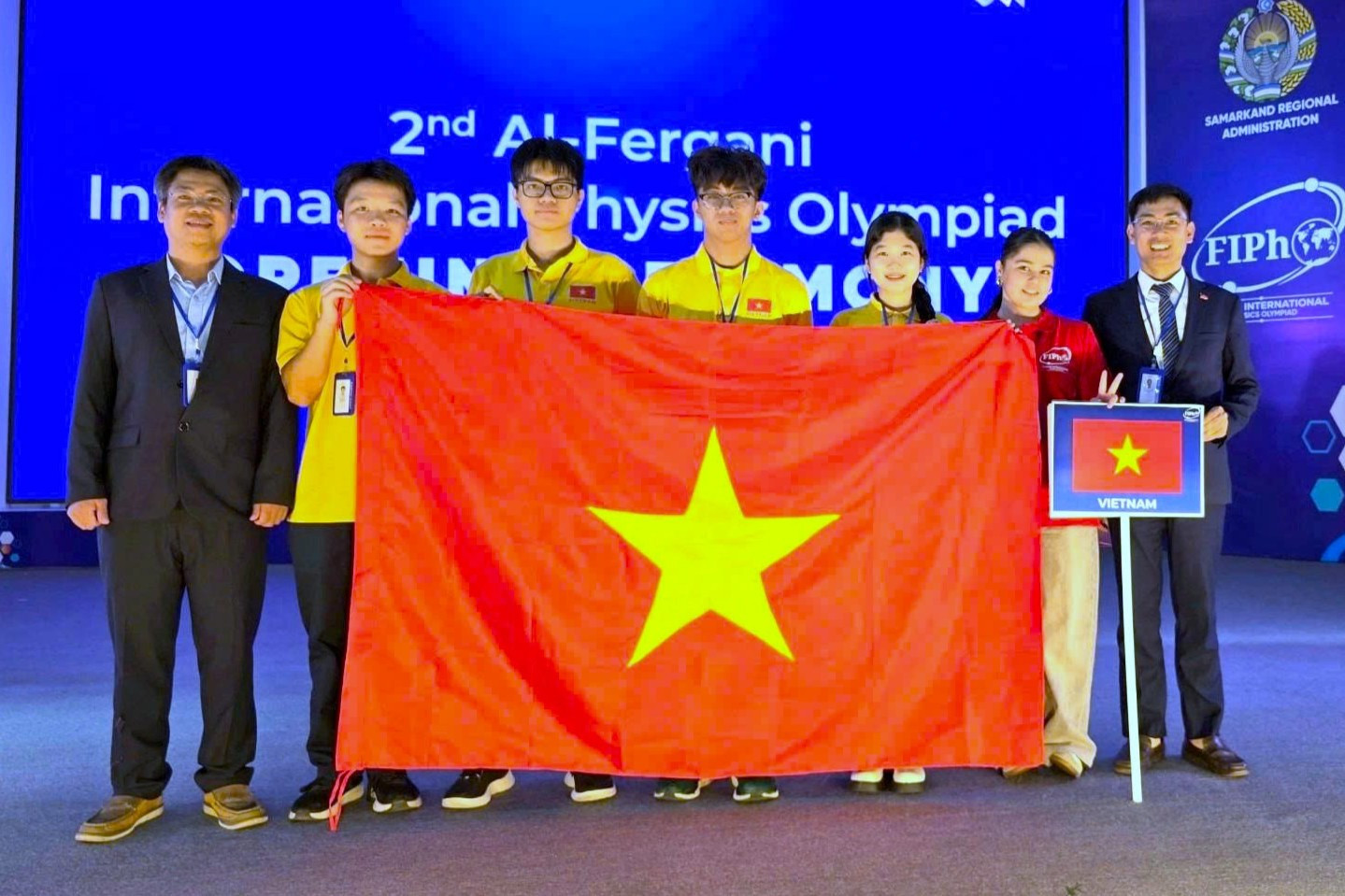
The gold medal went to Le Ba Tuan Viet, a student at the High School for Gifted Students in Natural Sciences, affiliated with the University of Science under Vietnam National University, Hanoi.
Two silver medals were awarded to Truong Ba Chi Thanh, also from the High School for Gifted Students in Natural Sciences, and Tang Hao Nhien from Quoc Hoc Hue High School for the Gifted in Hue City.
Le Hong Nhan, a student at Lam Son High School for the Gifted in Thanh Hoa province, earned the bronze medal.
The second Al-Fergani International Physics Olympiad (FIPhO 2026) took place in Uzbekistan from October 10 to 17, attracting 107 contestants from 15 countries and territories.
With all four team members winning medals, Vietnam finished fourth overall, behind Russia, China and Uzbekistan.
Vietnam's representatives were selected from students who were in Grade 11 during the 2025-2026 academic year and had participated in the Ministry of Education and Training's selection examination for the 2026 International Physics Olympiad team.
The selection was based on examination results, with candidates ranked in descending order of performance.
The Ministry of Education and Training assigned Hanoi National University of Education to lead the team's preparation and organize its participation in the competition.
The Olympiad provides an international academic platform for students to demonstrate their physics knowledge, scientific reasoning and problem-solving abilities.
It also challenges participants to apply their understanding of physics to both theoretical and experimental problems in a competitive academic environment.
This year's examination was designed to place greater emphasis on applying physics knowledge to analyze, explain and solve problems connected to real-world situations and modern scientific developments.
The competition consisted of two official components: a theoretical examination and an experimental examination.
Each component was held on a separate day, with contestants given five hours to complete the tasks.
The theoretical examination comprised three problems worth a maximum of 60 points, while the experimental examination carried a maximum of 40 points.
The examinations were highly demanding, requiring contestants not only to demonstrate a thorough understanding of fundamental physical laws and principles but also to apply logical reasoning, analytical skills and integrated scientific knowledge to complex problems.
Thanh Hung

