 Vietnamnet.vn

 Podcast



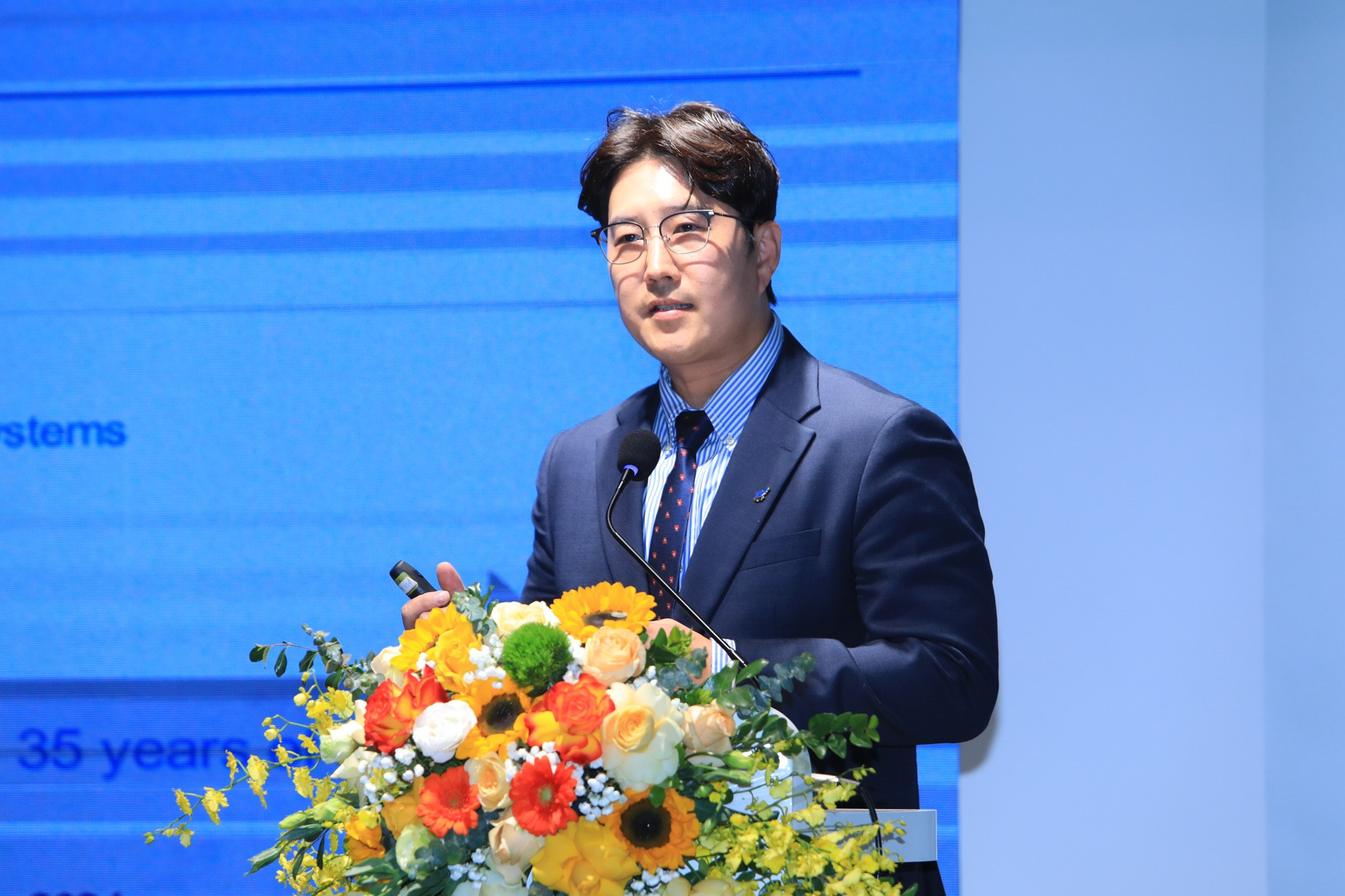
Park Jihoon, Chief Operating Officer of KPC Aerospace Vietnam, said this "miracle" from the Vietnamese people occurs when they are placed in a global-standard training and production environment.
KPC Aerospace is a South Korea-based aerospace enterprise specializing in manufacturing major aircraft components for Airbus, Boeing, and many other OEMs (original equipment manufacturer) for over 35 years. Given the industry's rapid growth, the company has expanded its global presence and looked for new markets with long-term potential.
Vietnam was chosen for its strategy implementation. In 2024, KPC Aerospace set up a factory at the Da Nang Hi-Tech Park. After eight months, the company passed the First Article Inspection test for the Boeing 787 raked wingtip assembly – a component about six meters long, the largest ever manufactured in Vietnam.
“Boeing was very surprised,” Park said, speaking at a seminar on “Innovation 57: From a digital twin platform to the development of strategic technology industries” on January 8.
“They asked us what kind of miracle have you created in Vietnam with people who have never made aircraft parts and never used CATIA before?’”
CATIA is an advanced 3D engineering design software integrating CAD/CAM/CAE functions, developed by Dassault Systemes of France.
“Vietnamese workers in our company are the proof of that miracle. They made all these parts and demonstrated that, with proper training, they can become market-leading engineers alongside global OEMs.”
Currently, at the Da Nang factory, only a small number of key experts are foreigners, while the rest of the engineering, management, sales, and procurement teams are Vietnamese.
KPC Aerospace’s goal, Park said, is to build a true aerospace hub in Vietnam, not just an outsourced manufacturing facility.
With products like the raked wingtip, and soon the winglet for the 737 MAX, Park believes that in the next few years, the Made in Vietnam mark will become increasingly prominent in the global aerospace supply chain.
From outsourcing to high-value manufacturing
While praising the workforce advantage, Park noted that low labor costs are no longer the deciding factor. “This is a different level of business, not just about using cheap labor,” he said.
To compete globally, companies must optimize processes, reduce costs, and improve efficiency through technology.
This is also the direction of the Center of Excellence (CoE) on Artificial Intelligence and Digital Twins, which Dassault Systemes inaugurated in Vietnam on January 8.
Ding Ming Chee, ASEAN Sales Director of Dassault Systemes, said the center is built around industrial pillars the group has accumulated over decades, with aerospace as a key focus over the next three to five years, aligning closely with Vietnam’s development strategy.
Other fields include semiconductors and advanced mobility, involving global automobile and component manufacturers.
The CoE’s distinctive feature, the Dassault Systemes representatives said, lies in its deep integration of industry’s best practices distilled from cooperation with Boeing, Airbus, and aerospace enterprises.
Instead of merely learning tools or features, Vietnamese engineers can gain access to industry-proven processes embedded in software from over 30 years of experience.
An increasingly important pillar is the combination of digital twins with AI and robotics to increase speed, accuracy, and production efficiency. Training certificates are also considered a key factor in affirming the capacity of Vietnamese engineers in the international market.
In the initial phase, the CoE will implement the “Targeted Co-design” program in the aerospace sector, involving businesses, academia, and international experts, aiming to help Vietnam transition from basic manufacturing to high-value production.
Deputy Prime Minister Nguyen Chi Dung, who attended the inauguration of the R&D center and the COE on AI and Digital Twin, called on Dassault Systemes to continue studying the expansion of its R&D activities in Vietnam.
He urged the group to strive to build a workforce of 1,000 high-quality engineers by 2030; to connect with companies within its global network to expand investment and business cooperation in Vietnam, with an initial focus on 11 groups of strategic technologies; and to strengthen cooperation with domestic partners for technology transfer.
Dassault Systemes will also work together with the National Innovation Center to promote the 3-party cooperation model involving the state, universities and enterprises, with the aim of accelerating human resource training and developing Vietnam’s innovation startup ecosystem.
Du Lam
.svg)
