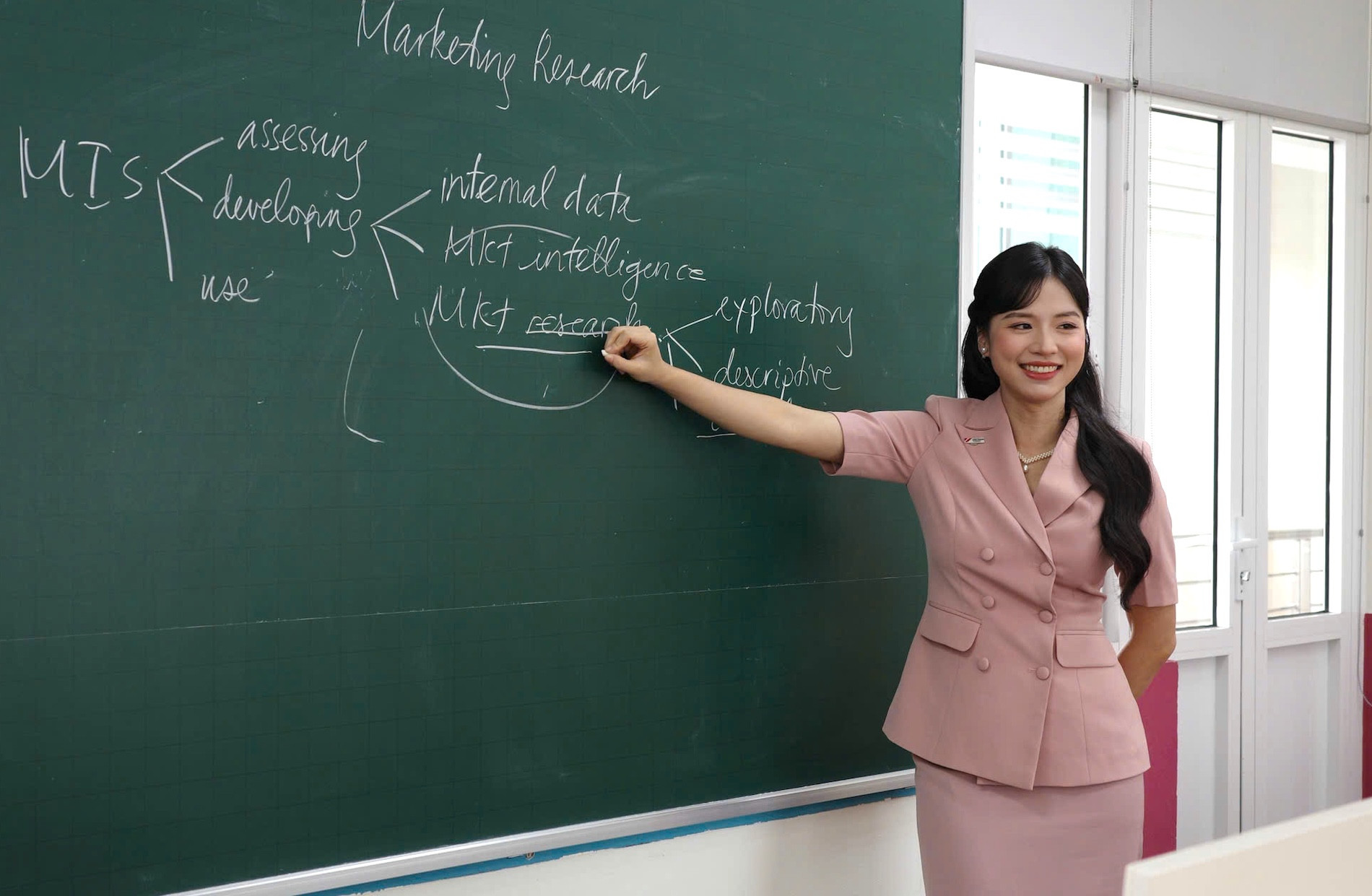
After graduating with honors from a US university, Tran Hong Nhung gave up the chance to attend her graduation ceremony to return to Vietnam and become a lecturer at 22. Now 36, she has earned a PhD while pursuing careers in teaching and television.
Skipping US graduation for a teaching career in Vietnam
Born in 1990 to a family of modest means, Tran Hong Nhung grew up believing education was her best chance to build a better future. Her mother worked as a seamstress, while her father was a driver.
While studying in an English-specialised class at the Foreign Language Specialized School in Hanoi, Nhung learned by chance about a US high school offering scholarships to Vietnamese students.
She applied and won a scholarship to Nacel International School, moving to Minnesota in the 11th grade.
Her language skills quickly stood out. By her final year of high school, she had scored 115 out of 120 on the TOEFL iBT and achieved an IELTS score of 8.5, including a perfect score in Speaking.
Her academic achievements subsequently earned her a government scholarship to study Marketing at Augsburg University in the United States.
Throughout her four undergraduate years, Nhung repeatedly received the Presidential Scholarship, the university's highest scholarship award.
She graduated with honors and ranked among Augsburg University's 30 outstanding students.
With such a strong academic record, Nhung had opportunities to remain in the United States for further study or employment. However, an unexpected piece of information changed her plans.
Dr Tran Hong Nhung is a lecturer at National Economics University in Hanoi. Photo: Courtesy of the interviewee
At the time, the Marketing Faculty at Vietnam's National Economics University was recruiting lecturers, giving preference to young candidates capable of teaching in English, including recent bachelor's degree graduates.
Recognising a rare opportunity, Nhung decided to return home immediately.
She asked her professors to allow her to complete the necessary graduation procedures ahead of schedule so she could attend the recruitment process, even though it meant missing her graduation ceremony in the United States.
"At that point, I hadn't even received my diploma. I didn't know anyone at the university. I simply went through the recruitment rounds and was fortunate enough to be selected," she recalled.
In May 2012, at just 22, Nhung officially became a lecturer at National Economics University.
During her early years, she worked as a teaching assistant while pursuing a master's degree at the university.
Her starting salary was approximately VND 5 million ($196) a month, forcing her to take on additional English teaching classes at language centres to cover her postgraduate tuition.
In 2015, she became a full lecturer. Some students in her first class were only two years younger than she was.
Covers content
Not interested
Inappropriate
Seen too often
ADBRO is the full service ad network for high impact contextual advertising with direct access to the exclusive in-image inventories across major local publishers.
We provide free creative adaptation into rich media, interactive and playable ads formats. Campaigns in our channel are delivered under guaranteed prices for actions with programmatic & managed delivery. We provide contextually segmented in-target audiences for over 60 industries with a full range of brand safety solutions.
ADBRO operates across SE Asia, including Singapore, Vietnam, Indonesia, Thailand, Philippines and Malaysia.
To test our channel for your advertising campaigns or consider partnership programs for publishers, please contact us at www.adbro.me
Nhung completed her doctoral programme at the age of 36. Photo: Courtesy of the interviewee
Her youthful appearance soon attracted attention, with students filming videos of her and posting them on TikTok. Several clips unexpectedly went viral, bringing the young lecturer wider recognition.
However, Nhung never considered appearance a lasting advantage in the classroom.
"Appearance might attract attention at first, but if the lecture isn't engaging, students will quickly lose focus. To truly win them over, you have to demonstrate your ability in every class," she said.
Instead, she focused on developing engaging lessons, drawing on the knowledge and experiences she had gained while studying in the United States.
A classroom without PowerPoint or laptops
One of the most distinctive features of Nhung's teaching approach is her refusal to use presentation slides. Instead, she writes all her lecture content on the board.
The method was inspired by her own university experience.
She particularly remembers an introductory Marketing course in which the professor taught entirely using a whiteboard rather than slides.
It was the subject she found easiest to understand and remember.
That experience convinced her to adopt a similar approach when she became a lecturer, despite knowing it would demand more effort from both herself and her students.
On the first day of class, she explains that her decision not to use slides is deliberate, not because she lacks technological skills.
According to Nhung, students who learn from slides can easily assume that photographing the screen or downloading the presentation is enough to understand the material.
In reality, she observed, many rarely revisit those files.
She also believes that presenting information one slide at a time can make it harder for students to understand the overall structure of a lesson.
Unlike many university lecturers, Nhung does not use presentation slides in her classes. Photo: Courtesy of the interviewee
"Taking notes helps students remember information and stay focused," she said.
Nhung also enforces a no-laptop rule that applies to both herself and her students during class.
She believes handwriting notes in traditional notebooks reduces distractions from Facebook notifications and other social media platforms.
Initially, some students considered her rules overly strict.
Over time, however, they adapted to the approach. Some even began bringing coloured pens to organise their notes and highlight important concepts.
Despite her strict classroom methods, Nhung encourages students to express their opinions freely, even when their views are incorrect.
"A lecturer should be a guide. I don't want teachers simply telling students what's right and what's wrong. We should provide information and different options so they can think independently and find their own direction," she explained. "Even when a student expresses an incorrect opinion, I still want to understand why they think that way."
Beyond the classroom, she spends time advising students on Marketing competitions, academic choices and personal challenges.
Earning a PhD while exploring a television career
Nhung also works as a television presenter at Vietnam Today. Photo: Courtesy of the interviewee
In February 2026, at the age of 36, Nhung completed her doctoral programme after five and a half years of study.
Eager to explore a new professional field, she applied for an editorial position at the Vietnam Today television channel and successfully passed its recruitment rounds.
Although she was offered a full-time position, she chose to work as a contributor so she could continue teaching at National Economics University.
She now helps produce three to four news programmes each week, working as both an editor and television presenter.
Alongside her teaching and broadcasting responsibilities, Nhung also conducts market research for several businesses.
These professional experiences, she believes, provide valuable real-world insights that enrich her lectures and make academic concepts more accessible to students.
For Nhung, teaching remains the career she hopes to pursue in the long term, but she is determined not to let opportunities to explore new fields pass her by.
"I want to make the most of the time when I can still do the things I want to do, so that when I look back later, I won't regret having had opportunities but never daring to try," she said.
 Vietnamnet.vn

 Podcast