 Vietnamnet.vn

 Podcast



Giang noted with satisfaction the strong development of Vietnam-Malaysia relations, highlighted by the historic elevation of bilateral ties to a comprehensive strategic partnership in November 2024. He congratulated Malaysia’s Ministry of Defence on successfully hosting ASEAN military and defence meetings during its 2025 ASEAN Chairmanship, contributing to strengthening ASEAN centrality and promoting the bloc’s goals of peace, cooperation and sustainable development in the region and the world.
He spoke highly of the growing and substantive bilateral defence cooperation, particularly in delegation exchanges and high-level contacts; maintaining effective consultation and dialogue mechanisms; defence industry; cooperation among military services and branches; human resources training; UN peacekeeping operations; and consultation and mutual support at multilateral mechanisms and forums, especially those led by ASEAN.
He called on the two defence ministries to effectively implement the shared perceptions reached by the high-level leaders of the two countries and reflected in the Action Programme to implement the Vietnam-Malaysia Comprehensive Strategic Partnership.
The Vietnamese minister proposed the two sides continue to promote high-level and all-level delegation exchanges, consultations and dialogues, exchanges of experience, cooperation among military services and branches, defence industry, training and human resources development, military medicine and UN peacekeeping. He underscored the importance of enhancing consultation and mutual support to uphold ASEAN’s common positions on regional and international security issues.
Suggesting Malaysia support English-language training for officers of the Vietnam People’s Army, Giang affirmed that Vietnam is ready to receive instructors from the Malaysian Ministry of Defence to teach at Vietnamese military training institutions and send military trainees to Malaysia to attend English-language courses.
He also invited the Malaysian ministry to continue sending officers to Vietnamese military academies and schools to attend Vietnamese-language and international defence officials’ training courses. He welcomed delegations from military academies and schools of the two countries to visit and conduct study tours in each other’s countries, saying such activities will promote mutual understanding, professional experience sharing and people-to-people links.
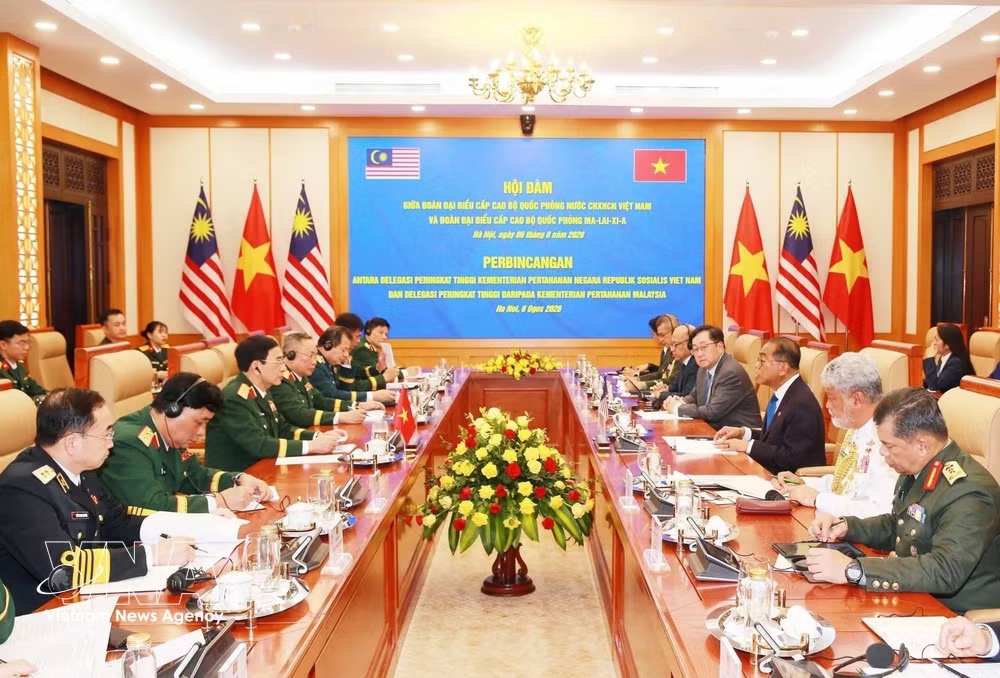
Giang expressed his belief that, building on the positive momentum of bilateral relations and the Malaysian minister’s visit, Vietnam-Malaysia defence cooperation will continue to develop substantively, contributing to the implementation of the shared understandings of the two countries’ high-ranking leaders and becoming an important pillar of bilateral ties.
He took the occasion to invite leaders of the Malaysian Ministry of Defence and military, as well as Malaysian defence enterprises, to attend and showcase their products at the third Vietnam Defence Expo, scheduled to take place in Hanoi in December.
For his part, Dato’ Seri Mohamed Khaled bin Nordin described his visit as a clear demonstration of the friendship and mutual trust between Malaysia and Vietnam and between their defence ministries. He showed his hope that the two sides will continue coordinating to advance agreed defence cooperation based on their respective needs and interests, thereby making the Vietnam-Malaysia Comprehensive Strategic Partnership increasingly effective and substantive and contributing to peace, stability and prosperity in the region and the world.
The two ministers also exchanged views on regional and international developments and issues of mutual concern, including the East Sea. Giang said Vietnam wishes to maintain regular exchanges and consultations with Malaysia and strengthen practical cooperation between maritime law enforcement forces, contributing to peace and stability in the region and beyond.
Vietnam also supports ASEAN’s position of resolving all differences and disputes in the East Sea by peaceful means in accordance with international law, including the 1982 United Nations Convention on the Law of the Sea (UNCLOS), fully and effectively implementing the Declaration on the Conduct of Parties in the East Sea (DOC), and working toward the early conclusion and signing of an effective and substantive Code of Conduct in the East Sea (COC) consistent with international law, he added./. VNA
.svg)
