 Vietnamnet.vn

 Podcast



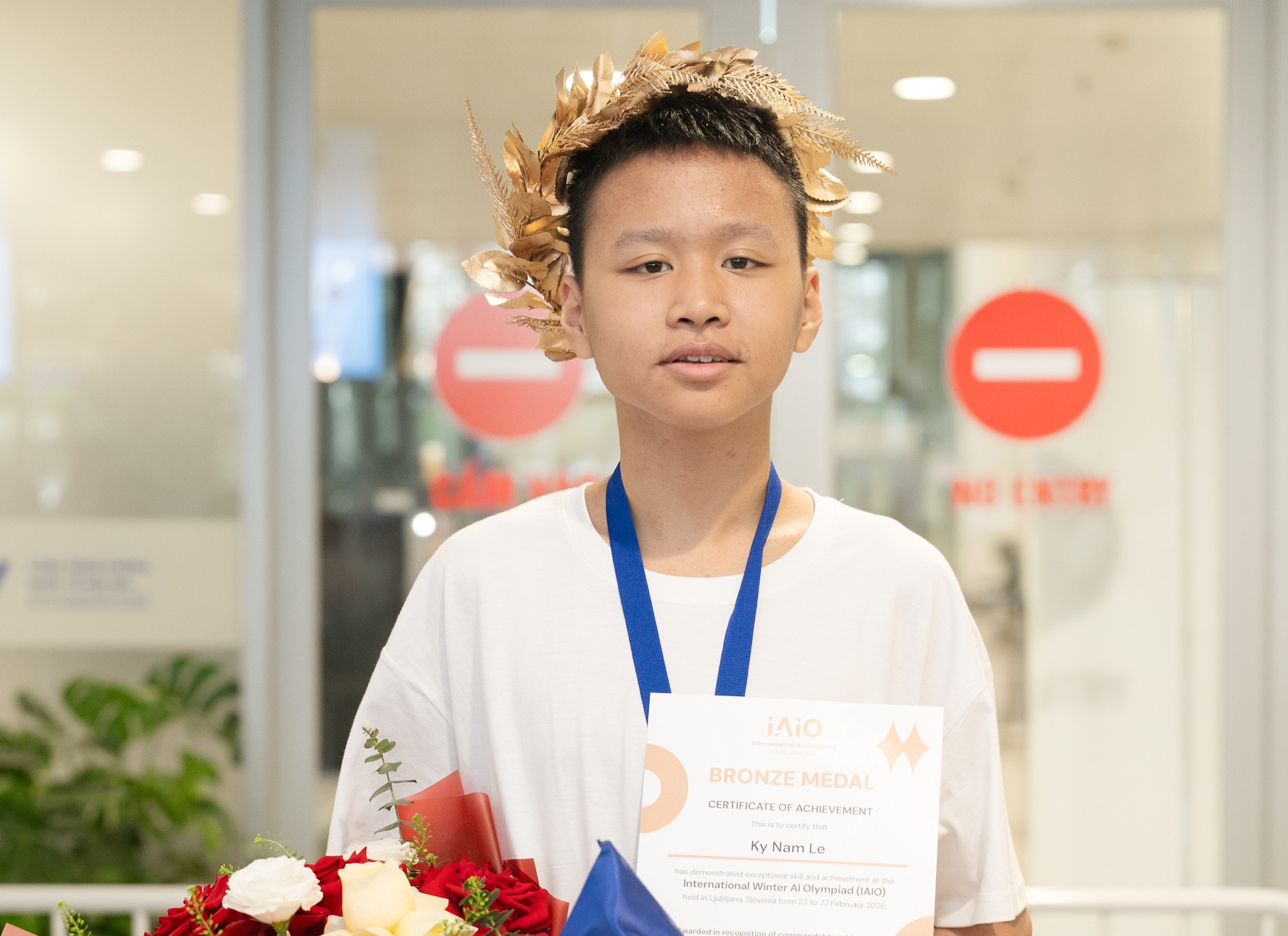
Le Ky Nam, an 8th-grade student at Newton Grammar School (Hanoi), is one of the three members of the Vietnamese team to win medals at the 2026 International Artificial Intelligence Olympiad (IAIO). Nam excellently brought home a Bronze medal, while also being the youngest person of the team as the remaining members were all high school students.
“I am very happy to win an award, though I feel a bit regretful as I narrowly missed the Silver medal,” Nam said.
This year's International Artificial Intelligence Olympiad took place in Slovenia, gathering contestants from 24 countries with strengths in technology. The Vietnamese team consisted of 4 students selected from the national competition.
Nam said the exam consisted of 2 parts, each lasting 5 hours. The theoretical part had 8 in-depth questions, while the practical part required contestants to program an AI model to solve a practical problem regarding vaccines.
“The most challenging was probably some questions in the theoretical part. I did not have enough time to write all the solutions, so I had to leave out two questions on positional encoding and kernel methods,” Nam said.
Falling in love with coding since 2nd grade
Nam’s journey with AI began very early. When he was in grade 2, his mother noticed that he had a good memory and learned quickly, so she bought him two books on basic programming with Scratch and Python. Without any expertise in the field, she let him explore on his own.
“The books guided readers to code some simple games. I followed the instructions and was surprised that it turned into a playable game. Because I could create an actual product, I became very interested,” Nam recalled.
In grade 3, after learning about the National Youth Informatics Competition, Nam decided to try it and began pursuing the subject seriously. Seeing her son’s enthusiasm, his mother enrolled him in Python and C++ courses to build a more solid programming foundation.
With a strong mathematical background and a passion for exploring new things, Nam won first prize at the National Youth Informatics Competition. He later earned a Gold medal in the non-specialized category in grade 5 and a Gold medal in the specialized category in grade 6 at the Central - Central Highlands Informatics Olympiad (which was for high school students).
Not only outstanding in Informatics, Nam also won a Gold medal in Mathematics at the International Mathematics and Science Olympiad (IMSO). For Nam, Mathematics is the most important foundation for programming and AI.
“I find that mathematical thinking helps me program much better. When studying math, I am used to reading the problem carefully, identifying what the problem is asking, and dividing it into small steps to solve. Programming is the same; you have to think clearly about the steps before writing the code,” Nam shared.
Additionally, for Nam, math also helps him see patterns and think more logically. “When working on algorithms, I often ask myself if there is a shorter way, if it can be more optimized. Thanks to studying math, I am used to finding efficient solutions rather than just correct ones,” Nam said.
Auditing with university students
Nam's decision to learn about AI was also his own choice, though always supported by his parents. At the beginning of 2025, his mother let Nam participate in a basic AI course organized by the People's Informatics Institute. Feeling interested, Nam decided to shift his focus toward AI instead of continuing to concentrate on competitions on programming as before.
Since then, Nam has won Third Prize at the Vietnam Artificial Intelligence Championship (VAIC) and many awards on international platforms.
Accompanying Nam during the preparation for the IAIO exam, Associate Prof Dr. Nguyen Phi Le, from the AI4LIFE Institute, Hanoi University of Science and Technology, highly appreciated the student's self-study ability. According to her, this is a particularly important quality when pursuing AI. Notably, Nam studies very proactively and can absorb knowledge beyond the general education curriculum.
Nam was encouraged by Le to follow advanced Mathematics modules at the university level. He audited algebra and calculus alongside university students and was able to absorb the knowledge. In addition, Nam has begun participating in formal AI research projects at the young talent club of the AI4LIFE Institute and is a co-author of a scientific paper being submitted to ICML, a leading conference in the field of AI.
Thanh Hung
.svg)
