 Vietnamnet.vn

 Podcast



The venture has helped him repay his debts and now generates more than $77,000 in annual profit.
Although his family now enjoys a stable livelihood, Pham Tien Dung, born in 1971 and living in Chu Se Commune, Gia Lai Province in Vietnam's Central Highlands, has never forgotten the years they struggled under the weight of debt.
Dung, a former chairman of the Swiftlet Nest Association in the former Chu Se District, once ran a photography and wedding dress rental business with his wife.
In 2010, when pepper prices were soaring, he invested all his savings and borrowed additional money to plant 20,000 pepper vines, hoping the venture would bring his family greater prosperity.
But just as the plantation began producing its first harvests, disease struck, wiping out the entire crop.
The devastating loss plunged the family into debt, forcing them to mortgage two houses to raise money for repayment.

In late 2013, at the height of their financial difficulties, Dung noticed large flocks of swiftlets circling behind his house.
His wife, Huynh Thi Anh Nguyet, now 49, came up with an unusual suggestion: turn the upper floor of their home into a nesting place for the birds.
"At first, I disagreed because I knew nothing about attracting and raising swiftlets. But my wife was so determined that I eventually agreed," Dung recalled.
The couple began researching swiftlet behavior online, learning how to prepare nesting facilities and create an environment that would encourage the birds to settle.
They carefully recorded useful information in notebooks, gradually building their own practical guide.
They then moved everything from the second floor downstairs, clearing out the bedrooms, bathroom and toilet to create a roughly 100-square-meter nesting area.
"Other people have to buy land and build an entire structure, which costs a great deal of money. I already had the upper floor available. Even if it failed, I wouldn't lose too much," Dung explained.
During the early days, Dung secretly crept upstairs each night without telling his wife, sitting near the staircase and listening for signs of birds.
But the house remained frustratingly silent.
"I started having doubts, but I didn't dare say anything because I was afraid of upsetting my wife," he said. "One night, I was sitting there half asleep when I suddenly heard birds chirping nearby. I woke up and saw a large flock flying around inside the house. I was so excited that I broke out in a sweat."
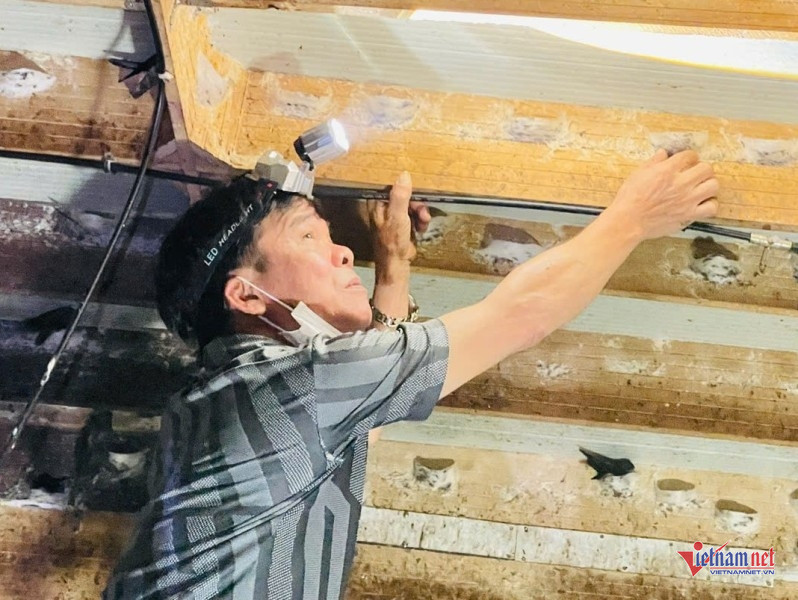
The appearance of the first nests gave the couple renewed confidence.
They continued adjusting the indoor environment, controlling ants, cockroaches and other creatures that could harm the swiftlets, while maintaining suitable conditions for nesting.
Over time, the number of birds steadily increased.
At one point, swiftlet nests fetched as much as $1,235 per kilogram, providing the family with a substantial income.
Thanks to the money earned from harvesting the nests, Dung and his wife gradually managed to repay all their debts.
Encouraged by the success of their venture, Dung built additional swiftlet houses between 2017 and 2019, expanding the total nesting area to 1,120 square meters.
However, he said the business has also faced considerable challenges.
In recent years, unpredictable weather and the use of insecticides in agricultural production have reduced the natural insect population on which swiftlets depend for food.
The situation becomes particularly difficult during the rainy and stormy seasons, when insects grow scarce and young birds struggle to find enough food.
At times, approximately half of the chicks have died in their nests because of food shortages.
When food becomes scarce, some adult swiftlets also abandon their nesting sites and move elsewhere.
Despite these setbacks, Dung has continued learning and refining his techniques.
His family now harvests approximately 300 kilograms of raw swiftlet nests each year.

With selling prices ranging from about $347 to $386 per kilogram, the business generates an annual profit of more than $77,000 after expenses.
According to Dung, approximately 15-20% of each harvest is retained for cleaning and processing, while the remainder is sold as raw nests.
In 2022, his family's processed bird's nest products received a three-star certification under Vietnam's One Commune One Product (OCOP) program.
"When the pepper plantation failed, I thought there was no way I could recover," Dung said. "Fortunately, the swiftlets came along and helped our family repay its debts."
Huynh Ngoc Chuong, chairman of the Chu Se Commune Farmers' Association, described Dung as one of the pioneers and most successful swiftlet farmers in the area.
With extensive experience in building swiftlet houses, attracting birds and managing nesting colonies, Dung is frequently invited to share his knowledge with other local residents.
Chuong said the area's climate and natural food sources were generally favorable for swiftlets.
Local authorities are reviewing and proposing suitable areas where residents could develop similar operations in accordance with regulations, aiming to avoid uncontrolled expansion.
Tran Hoan
.svg)
