 Vietnamnet.vn

 Podcast



On October 23, Intel Corporation officially announced the winners of the Intel® AI Global Impact Festival 2025. The international competition annually celebrates AI innovations for community good and attracted participants from 32 countries.
According to Intel, six teams emerged as global winners after surpassing hundreds of entries, including two projects from Vietnam.
Winning projects were rigorously evaluated for creativity, responsible AI implementation, and social impact. All submissions underwent an AI ethics review by Intel experts to ensure compliance with the principles of Responsible AI.
Kimberly Mayes, Vice President of Intel’s Center for Talent Strategy and Corporate Social Impact, stated:
“A new generation of tech leaders is emerging, driving transformation through artificial intelligence. With fresh thinking, adaptability, and a commitment to ethical values, they are advancing progress in many fields. The future of innovation depends on the curiosity and courage of these young minds.”
Vietnam was one of the few countries with projects recognized at both global and regional levels, marking a significant milestone for its youth in the fields of technology and STEM education.
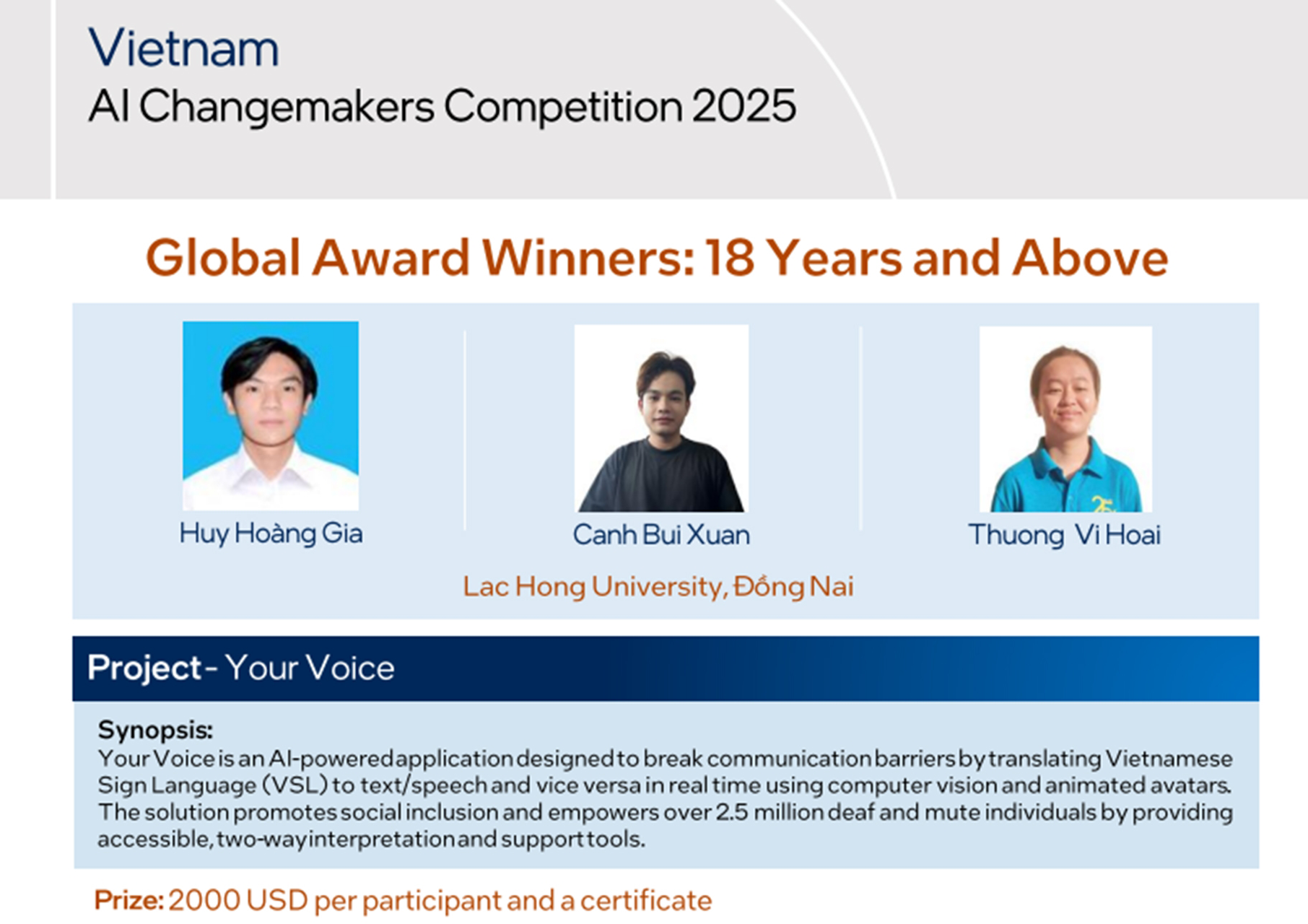
In the 18+ age group, Hoang Gia Huy, Bui Xuan Canh, and Vi Hoai Thuong from Lac Hong University (Dong Nai) won the Global Award for their project Your Voice – an AI-powered app that bridges communication gaps between the deaf community and society.
The app uses computer vision, machine learning, and animated avatars to translate between Vietnamese Sign Language (VSL) and real-time speech or text. The solution targets more than 2.5 million people in Vietnam with hearing or speech impairments, helping them learn, find jobs, and integrate into society.
Each student received a prize of USD 2,000 from Intel.
In the 13–17 age group, Ha Ngo (Lam Son High School for the Gifted, Thanh Hoa) and Phuc Phan (Le Hong Phong High School for the Gifted, Ho Chi Minh City) won a Regional Award for their project Hap – an AI-based navigation device for the visually impaired that uses haptic feedback.
The device employs YOLOv8 and Intel’s OpenVINO toolkit for object detection and delivers directional signals through vibration, enabling safe navigation without relying on audio.
Designed to function offline, the device offers a low-cost solution aimed at rural users. Each student received USD 1,000 from Intel.
Intel noted that it has trained over 8 million people worldwide in AI skills through partnerships with 29 governments and 27,000 educational institutions. The company emphasized its commitment to promoting ethical and human-centered AI.
The Vietnamese projects not only reflect strong innovation capacity but also highlight the effectiveness of Intel’s digital literacy and STEM education programs across the Asia-Pacific region.
Thai Khang
.svg)
