 Vietnamnet.vn

 Podcast



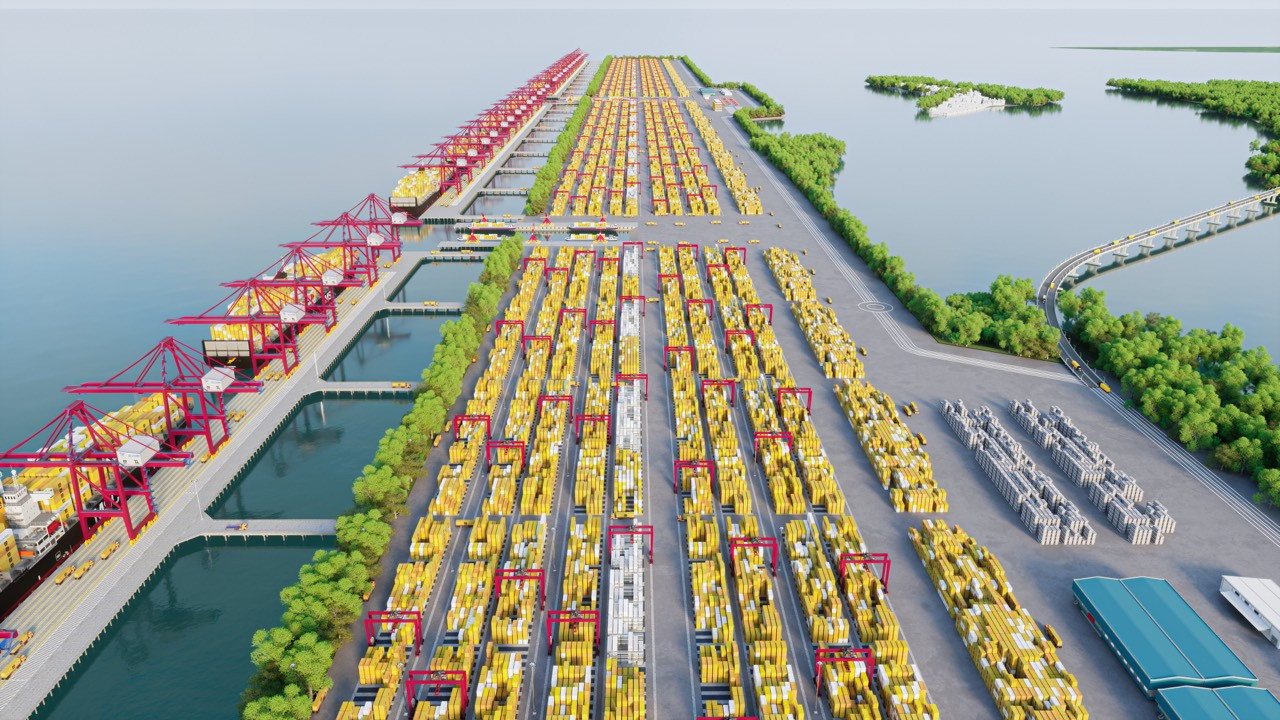
The Can Gio international transshipment port will focus primarily on global container transshipment, while the Cai Mep – Thi Vai port complex will serve as a gateway port combined with partial transshipment functions.
This strategic division aims to leverage each port’s advantages and avoid overlapping operations, according to Vu Anh Dung, Deputy Head of Urban Development under the Ho Chi Minh City Department of Construction, at a city economic–social briefing on December 25.
Specifically, Can Gio port will handle 75–80% international transshipment containers, with only 20–25% dedicated to Vietnam’s export–import cargo.
In contrast, Cai Mep – Thi Vai will function as a regional gateway and central transshipment port, targeting 20–25% transshipment cargo and 75–80% domestic import–export goods by 2050.
After 2050, once Can Gio reaches maximum capacity, Cai Mep – Thi Vai will continue to attract international transshipment cargo, aiming for a 50% international share.
Together, the two ports will form a large-scale, world-class port complex, capable of competing with major seaports across Asia and beyond.
According to the Department of Construction, once operational, the Can Gio port will significantly enhance Ho Chi Minh City’s logistics capabilities, attract investment, and elevate Vietnam’s international maritime standing.
For the city, the port represents a massive capital draw for developing modern seaport infrastructure. When operational, it could contribute 34,000–40,000 billion VND (approximately 1.3–1.6 billion USD) per year to the state budget and create 6,000–8,000 jobs.
Beyond economics, the port will drive regional infrastructure development, serving as a foundation for logistics centers and free-trade zones connected to the transshipment hub.
At the national level, the project reinforces Vietnam’s role as a regional maritime center, integrating deeply into global supply chains and strengthening the country’s economic and trade competitiveness by reducing intermediary logistics costs.
Regarding implementation, the Can Gio project has already received government investment approval, and the Ho Chi Minh City People’s Committee has issued an implementation roadmap.
The project is currently in the investor selection phase, involving four steps:
Approval of investor selection methods.
Submission of investment proposals by interested developers.
Evaluation of proposals and qualification of investors.
Final approval of the selected investor.
The proposed project is a joint initiative by the Saigon Port Corporation and Terminal Investment Limited Holding S.A. (TIL).
According to the proposal, the port will feature a 7.2-kilometer-long wharf system, accommodating the world’s largest container ships (up to 24,000 TEU), with a total capacity of 10–15 million TEU per year.
Investment will be carried out over seven phases within 22 years, with total capital estimated at 113.531 trillion VND (about 4.8 billion USD).
The “super port” project, approved by the government in January 2025, is expected to become one of Vietnam’s most strategic logistics infrastructures, enabling Ho Chi Minh City to emerge as a global maritime and transshipment hub.
Tran Chung
.svg)
