 Vietnamnet.vn

 Podcast



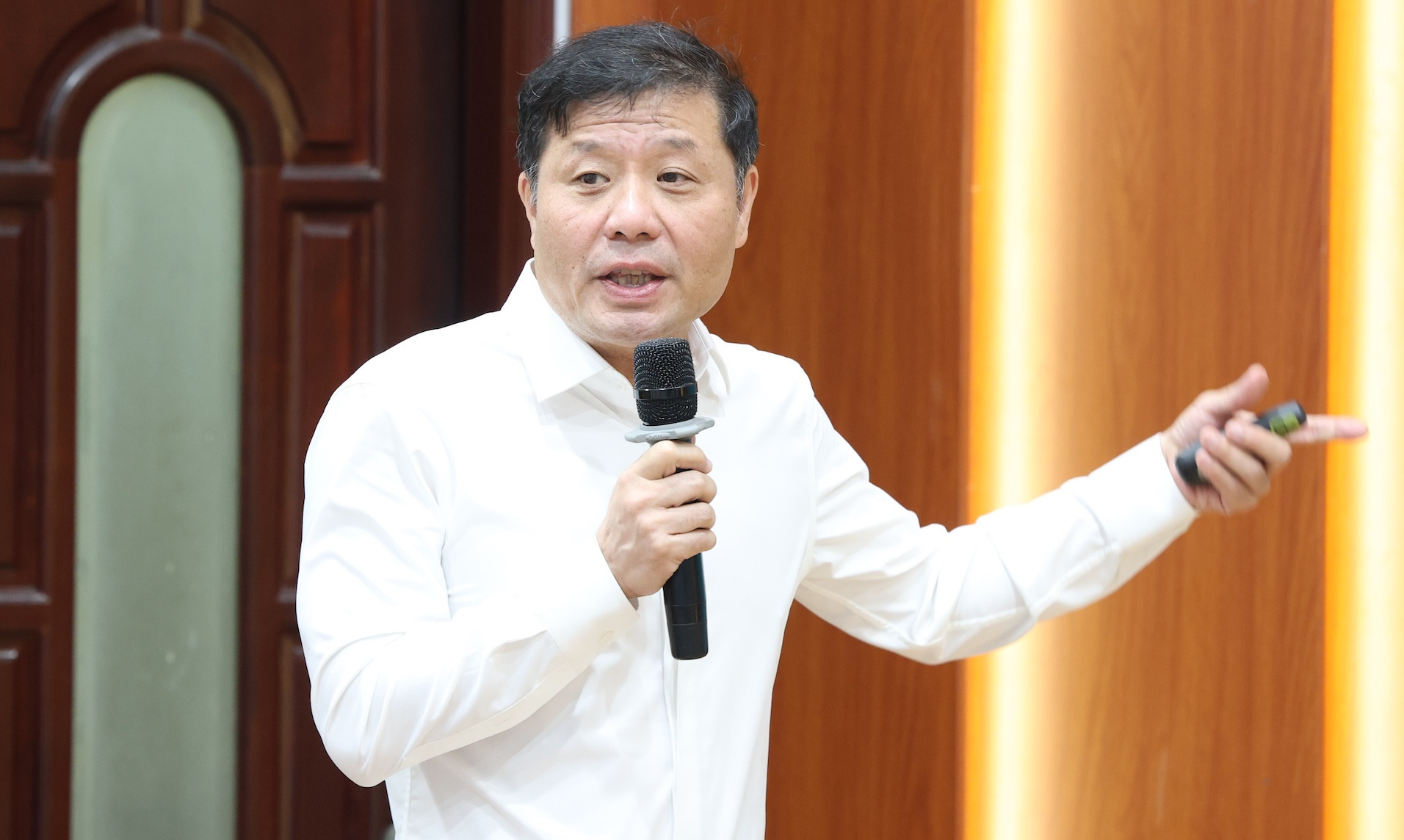
The workshop “Teaching and learning mathematics in the technology era” on April 13, organized by Vietnam National University HCMC, focused on clarifying the role of mathematics in the modern science and technology ecosystem. Questions raised at the event included: What is math for? How does math contribute to other fields? And how should teaching content and methods be reformed to keep up with global trends?
Students with high math GPA need retraining
Prof Vu Ha Van of the University of Hong Kong said that in the era of AI and big data, mathematics plays a foundational role and is a core field for developing technology, science, and high-quality human resources.
However, current approaches to learning math have many problems. Most students study to pass exams rather than to understand concepts, leading to a situation where even those with high scores still need retraining when entering fields such as AI or data science.
The root cause lies in training programs that lag behind technological needs, along with teaching methods that are overly theoretical and lack real-world connection. Specifically, the math curricula aligned with industrial development 30–50 years ago are no longer relevant to today’s industrial and technological demands.
He cited an example from the VinIF AI engineer training program: many candidates with high math GPAs still have to relearn foundational subjects such as probability and statistics and linear algebra when entering AI and data science research.
According to Van, mathematics should be viewed as a thinking tool that helps people understand and solve problems, rather than just a collection of formulas. Therefore, reforming math teaching and learning is urgent, especially in redefining core content for the modern era and changing teaching methods to adapt to the digital environment and the rise of AI.
Prof Nguyen Hoai Minh of Sorbonne University (France) said AI is profoundly changing how math is taught and learned, making learning more accessible, personalized, and effective for both research and teaching. However, learners cannot rely on AI and must develop the ability to ask questions and evaluate solutions independently.
He stressed the need to update curricula in line with technological demands and strengthen certain areas such as probability, linear algebra, and optimization, while maintaining a solid foundation to ensure long-term adaptability.
Prof Dang Duc Trong of University of Natural Sciences HCMC focused on teaching philosophy and methods, with the core idea of empowering learners.
He proposed a “four no’s” model: no traditional teaching style, no passive learning, no isolated working, and no rushing into applications too early. Instead, lecturers should use systems of questions to push students to explore on their own, developing thinking through open problems and even states of “impasse.”
The learning process should be organized in groups, encouraging discussion, criticism, and solving major problems together.
Lack of practical applications
Prof Nguyen Thi Thanh Mai, director of Vietnam National University HCMC (VNU-HCMC), stated that despite having high-quality mathematicians and many students who are good at math, connecting math with technology and practical applications in training programs remains limited.
Meanwhile, international trends are shifting strongly toward strengthening modeling thinking, computational thinking, interdisciplinarity, and the ability to apply knowledge to solve practical problems.
According to Mai, the challenge is not just helping learners see math as useful but redesigning the entire math learning path. From high school to postgraduate, learners need to clearly develop capacities such as modeling, probability - statistics, optimization, algorithms, scientific computing, data analysis, and interdisciplinary work.
Mathematics, therefore, cannot just be a foundational subject in the traditional sense, but must become the design language of technology, the tool to solve business problems, and the knowledge infrastructure of innovation.
Educational institutions need to redesign math teaching programs according to social requirements, implementing them quickly and decisively so as not to miss development opportunities. Feasible solutions include: multu-level research-teaching groups; integrated modules between high school and university; interdisciplinary and inter-school programs; and early research experiences for students.
VNU-HCM orients the development of mathematics toward interdisciplinarity, linked with technology and reality, while expanding international cooperation. The goal is to step-by-step bring this field closer to the top 100 universities in the world.
Thanh Hung
.svg)
