 Vietnamnet.vn

 Podcast


Over 18,000 apartments caught in building violations
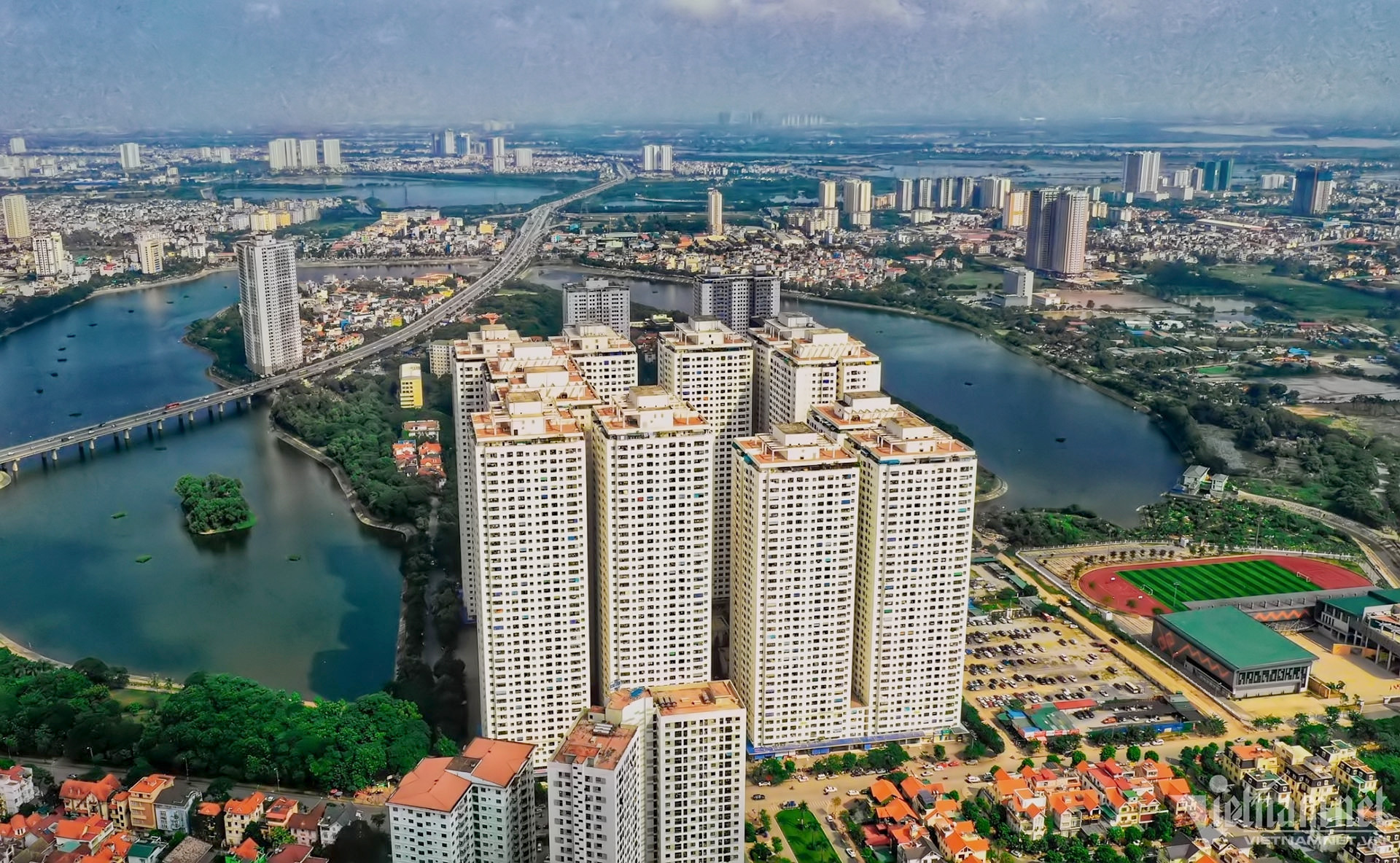
Nguyen Do Hai has lived in the HH1A apartment building in Hanoi's Linh Dam residential complex for about a decade. His family was among the first residents to sign a purchase contract and move in.
When he heard that relocation might be necessary, his thoughts immediately turned to the everyday realities of family life: the adults' jobs, the children's schools and the routines they had built around their home.
Moving to another apartment in a different neighborhood, even one of the same size, would not mean taking all those things with them.
There would be rent to pay while waiting for a permanent solution, children might have to change schools, and daily commutes could become longer.
These are also costs of relocation, even if they never appear in official calculations of how many apartments must be demolished.
On October 28, the Hanoi People's Council approved a mechanism to address violations at 12 property developments linked to Muong Thanh Group.
Municipal authorities concluded that the 12 projects contain 18,184 apartments affected by violations.
The city will review the developments to determine which structures can be retained under certain conditions and which must be demolished.
At HH Linh Dam alone, buildings approved for 27 floors were actually constructed with between 36 and 41 floors.
If the upper floors are demolished, how will thousands of residents on the lower floors continue their daily lives during construction?
They still share elevators, electricity, water supplies and fire safety systems.
Bui Trung Dung, former director of the Construction Activities Management Agency, has suggested examining whether some floors could be converted into emergency refuge areas or communal spaces, provided they meet technical requirements.
Such an approach could reduce residential density while minimizing the number of households forced to relocate.
He has also recommended prioritizing solutions that allow existing residents to remain in their homes.
Should Vietnam conduct a nationwide review of housing violations?
The HH Linh Dam case raises a broader question: Should Vietnam conduct a nationwide inspection of completed and occupied housing developments with serious violations involving land use, urban planning, construction or fire safety?
Such a review should begin without delay.
Authorities need to identify which developments can be brought into compliance and issued ownership certificates, which cannot be remedied, and which structures must be demolished.
Waiting until residents have spent years filing complaints or buildings have deteriorated will only make these problems harder to resolve.
Consider a building constructed with numerous unauthorized floors, sold to thousands of buyers and subsequently occupied.
Throughout those years, who was responsible for inspections? Were the violations detected, and if so, what action was taken?
How could developers continue construction and sell apartments when the violations were so obvious?
This was hardly something small enough to conceal. It was the proverbial elephant in the room.
If evidence shows that organizations or individuals entrusted with regulatory oversight neglected their duties, acted improperly or even facilitated or colluded in violations, they too must be held accountable.
Construction, inspection and property sale regulations exist precisely to prevent such violations before buyers hand over their money.
Where a building is unsafe, cannot be brought into compliance and must legally be demolished, authorities have to act, even if large numbers of people already live there.
But the moment relocation is ordered, there must also be clarity about alternative accommodation, the developer's compensation obligations and how those obligations will be enforced.
Simply refunding the amount stated in a purchase contract signed many years earlier may not adequately compensate homeowners for their losses.
Compensation must take into account contractual terms, applicable laws and actual losses that can be demonstrated.
What Aqua City reveals about protecting homebuyers' rights
The Linh Dam controversy brought me back to an interview with Phan Chanh Duong, a prominent economic adviser and a key member of the Friday Group, an influential circle of economic reform thinkers in Vietnam.
He previously served on the advisory team of former Prime Minister Vo Van Kiet.
Duong helped propose and implement major development projects, including the Tan Thuan Export Processing Zone, Nguyen Van Linh Boulevard and the Phu My Hung urban area, which transformed a vast stretch of marshland in southern Ho Chi Minh City.
His argument was straightforward.
Had violations been disclosed when developers first began selling properties, buyers would hardly have dared to purchase them.
Instead, problems often emerge only after people have paid.
Their ownership paperwork then becomes blocked because of the developer's violations.
They have bought homes but cannot obtain ownership certificates. Their money is tied up, leaving them in an extremely difficult position.
Duong posed a question: Suppose it takes another five or seven years to resolve a developer's violations. Would the authorities then confiscate the homes from innocent buyers?
His answer was unequivocal: "Absolutely not!"
He then raised another question: If buyers will ultimately be allowed to keep their homes, why not find a way to issue their ownership documents now?
He compared the situation to a child born to parents who had not yet married.
The child must still receive a birth certificate.
If the authorities wait until the parents' circumstances are resolved, the child might already be 10 years old and still unable to attend school.
Duong noted that hundreds of thousands of homes in Ho Chi Minh City were facing documentation problems.
Resolving those difficulties, he argued, would not only stimulate economic activity but, more importantly, help restore public confidence.
His argument has found a practical illustration in the Aqua City development in Dong Nai Province.
The project also encountered legal complications, which the previous government moved urgently to address.
By April 2026, Aqua City had handed over more than 1,100 townhouses and villas.
As the project's legal obstacles were gradually resolved, the first residents received their property ownership certificates, commonly known in Vietnam as pink books, on July 23.
Under a plan announced in April, approximately 752 certificates were expected to be issued during 2026 to residents of the Sun Harbor 2 and EverGreen 1 subdivisions.
With ownership certificates in hand, buyers can finally consider transferring their properties or using their homes as collateral when they need financing.
Duong's proposal, together with the experience at Aqua City, offers a practical example of how authorities might resolve legal problems affecting residential developments in other localities, including Hanoi.
Nguyen Do Hai and his family have lived at Linh Dam for roughly 10 years.
He is growing older, and his wish remains simple: that his family's established life, along with the lives of more than 18,000 other affected households, will not be thrown into turmoil.
Tu Giang

