 Vietnamnet.vn

 Podcast



According to one broker, the house covers an area of 90 sqm with nine stories and a lift. The land plot was previously vacant, has been built by the new owner, and can be put into immediate use. This is a rare case in the Ha Trung street real estate market.
Unlike many other central streets where frontage houses are commonly listed for sale, properties on Ha Trung Street appear only sporadically on transaction channels.
A review of data from real estate platforms shows that the number of listings for frontage houses on Ha Trung Street is currently very limited. Prices typically range from VND30–60 billion for properties with areas of 40–70 sqm, while larger properties are usually offered at higher prices. Notably, there are almost no houses displaying “for rent” signs on this street.
According to real estate brokers, most property owners on Ha Trung Street are individuals or businesses directly engaged in gold trading and foreign currency exchange, with a tendency to hold properties long term.
In addition, Ha Trung is a short street with a limited number of houses, making an already small supply even scarcer and sustaining high price levels over a long period.
Gold and foreign currency
Tran Nhan Tong is an area where hundreds of stores trading gold, silver, gemstones, and high-end jewelry are concentrated.
According to the 2025 land price list, land prices on the street front of Tran Nhan Tong are regulated at VND352 million/sqm, wide alleys over 5m are VND170 million/sqm, and narrow alleys under 3m are VND111 million/sqm. However, the actual price ranges from VND700 million to VND850 million/sqm.
While Tran Nhan Tong Street is positioned as Hanoi’s official center for gold and gemstone trading, Ha Trung Street is densely concentrated with private gold trading and foreign currency exchange businesses, featuring their own distinctive transaction characteristics.
This specialization makes the street unsuitable for many other types of businesses, while creating a unique customer ecosystem.
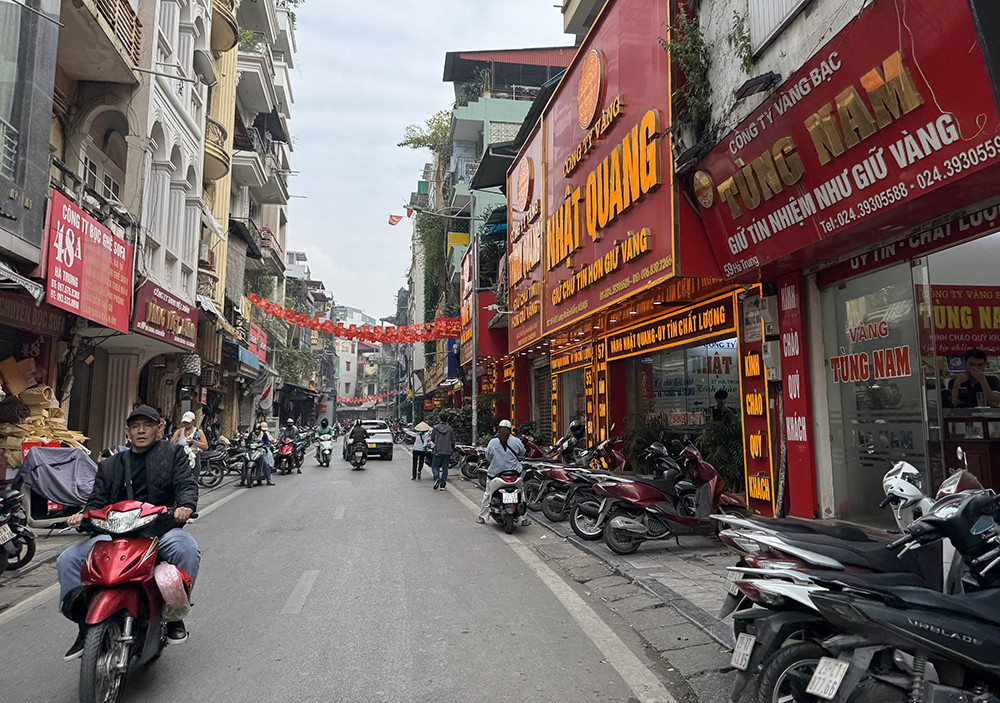
Ha Trung Street is about 206 meters long and is one of Hanoi’s long-standing Old Quarter streets. Historically, it was a hub for the leather trade, with activities ranging from trading and manufacturing to repairing shoes, suitcases and leather bags.
In the late 1990s, business activities on Ha Trung Street began to shift markedly as gold shops and foreign currency exchange services appeared in increasing numbers, gradually forming the reputation of a “gold street” and “foreign currency street”.
Today, most premises on Ha Trung Street are used for trading gold bars, jewelry, and major foreign currencies. Due to the specialized nature of these businesses, the main customers and investors here are enterprises and major players in the jewelry and monetary sectors, which has helped maintain high real estate prices over a long period.
According to Hoang Kim (Vua Mat Pho real estate information channel), land prices on Ha Trung Street are currently recorded at an average of about VND800 million per sqm, excluding the value of buildings.
This is among the streets with the highest price levels compared to surrounding areas, explained by the specialized business nature and the concentration of large-scale gold and foreign currency trading hubs.
Ha Trung is a short street with a narrow cross-section, limited traffic capacity, and frequent congestion. Historically, it functioned as a craft street associated with leather trading, production, and repair, later expanding into small manual services such as clothing alterations and motorcycle seat covering. Over time, however, these traditional trades gradually declined as their business efficiency diminished.
To date, the business structure on Ha Trung Street has clearly shifted, becoming primarily suited to gold trading and foreign currency exchange.
Although many properties are being offered for sale, high prices make the market relatively selective. Buyers are mainly individuals and enterprises directly operating in the foreign currency sector, with some major owners holding as many as 4–5 properties on the same street.
The core value of Ha Trung Street lies in its well-established industry ecosystem, with a distinctive customer base and cash flow that are less dependent on general consumer fluctuations.
This is why, despite unremarkable infrastructure and limited business diversity, real estate prices on Ha Trung Street have remained high for a long time, forming a specialized and rare real estate segment in Hanoi’s Old Quarter.
Duy Anh
.svg)
