 Vietnamnet.vn

 Podcast



Ngo Quynh Huong, 22, has just become the valedictorian of the Psychology major at the University of Social Sciences and Humanities, Vietnam National University, Hanoi, with a GPA of 3.87.
"I am proud of this result, but what I cherish most is not that the title makes me who I am, but that it reminds me of the efforts that have contributed to shaping who I am today," Huong shared.
Four years ago, despite securing early admission to several other universities, Huong still decided to study Psychology. For Huong, this is a field with many humanistic values, especially in the context where mental health is increasingly becoming a major concern of society.
Upon entering university, rather than setting a goal to become an outstanding student or valedictorian, Huong devoted substantial time to exploring different niches within her discipline.
Starting in her second year, Huong engaged in scientific research and interned at school psychology offices as well as psycho-educational research institutes and centers.
"Each of those experiences helped me understand more clearly what I truly wanted to pursue," Huong said.
That journey was not always smooth. Huong recalled her final two years, when she simultaneously managed coursework, scientific research, internships, and various competitions. The dense schedule left her feeling exhausted at times, doubting her abilities and wondering whether she was on the right path.
"Trying to pursue perfection made me feel pressurized," Huong admitted.
Looking back, Huong noted that the first change she made was how she treated herself. Instead of striving to complete everything flawlessly, Huong learned to accept that certain tasks could be accomplished more simply. She also cultivated the habit of focusing on the value of the experience rather than solely on the final outcome.
"Even if I don't reach the intended destination, I still can learn lessons and experience to go further on subsequent journeys," Huong said.
That shift in mindset helped Huong regain balance, sustain motivation, and keep moving forward with a lighter frame of mind.
Reflecting on four years of university, Huong believes that what sustained her academic performance was not absolute discipline, but curiosity.
For every subject, she sought to approach the material from different angles. Some courses required extensive reading, while others demanded real-world observation or conversations with experienced professionals.
"Curiosity constantly drove me to try, to learn, and to step out of my comfort zone," Huong said.
Consequently, from interdisciplinary research and diverse internships to international exchange programs, Huong proactively seized every opportunity. Among them, two academic exchange trips to China and Singapore proved to be where she "learned the most."
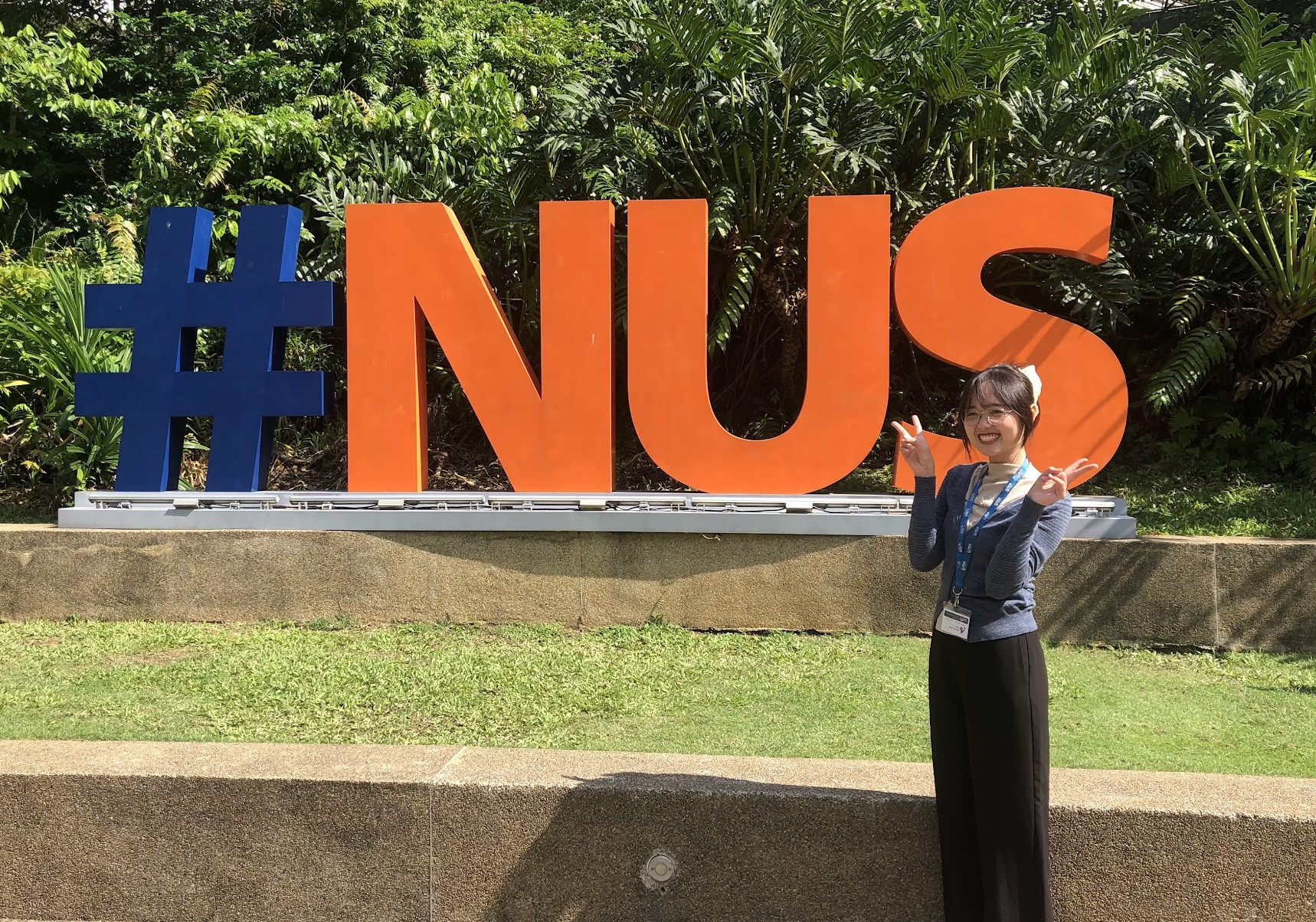
At the end of her second year, Huong was selected as a student representative to attend an international summer camp at Ocean University of China, followed by an exchange program under a scholarship from the National University of Singapore during the summer of her third year. There, Huong visited laboratories and met professors and students from numerous countries.
"I realized science has no borders. Despite coming from different cultures, everyone shares a common goal: to continuously learn and create meaningful value for the community," Huong shared.
Despite her wealth of experiences, on graduation day, while speaking before peers and teachers, Huong admitted that after four years of university, the hardest question she faces now is: "What are you going to do after graduation?"
"Honestly, current data remains insufficient for me to reach a conclusion. But university is not a place that gives us all the answers; it is a place that teaches us how to live with increasingly bigger questions," Huong said.
For Huong, lacking a complete answer for the future is not frightening. What matters more is to keep moving forward and accumulating experiences to understand herself better day by day.
After graduation, she plans to pursue a master's degree at the University of Macau in China, focusing on cognitive psychology and neuroscience, with a particular emphasis on aging.
Huong expects the new academic environment to grant her access to modern research methodologies while offering opportunities to participate in projects with both academic and practical value.
Thuy Nga
.svg)
