 Vietnamnet.vn

 Podcast



Vietnamese businesses remain on the sidelines of global supply chains
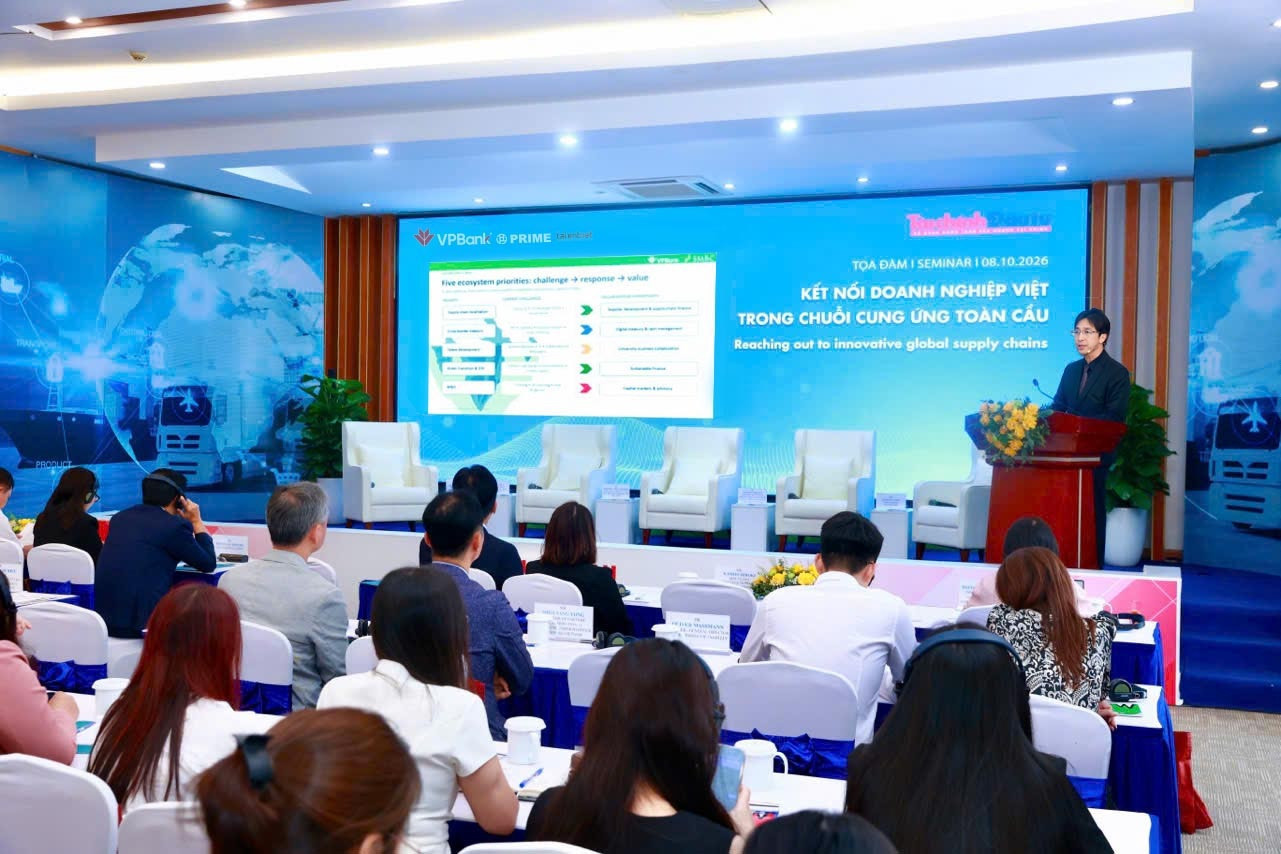
Links between domestic enterprises and foreign-invested companies remain weak, while technology transfer and research and development have fallen short of expectations, Deputy Minister of Finance Tran Quoc Phuong said at a forum on connecting businesses to global supply chains on October 8.
Speaking at the event, organized by Finance and Investment Newspaper, Phuong noted that the proportion of Vietnamese enterprises participating in global supply chains remains relatively low.
This was also among the reasons behind the Politburo's issuance of Resolution No. 10-NQ/TW on June 8, 2026, concerning the development of the foreign-invested economic sector.
The resolution marks a strategic turning point, signaling a fundamental shift in Vietnam's approach to attracting foreign direct investment (FDI) in the new development phase.
Under the new direction, the country is expected to make significant changes in how it mobilizes foreign resources.
"Vietnam will no longer attract FDI at any cost. Instead, we will select investment partners that can help strengthen our position in global value chains," Phuong emphasized. "We attract FDI to reinforce our domestic capabilities, improve productivity, enhance technological capacity and increase the competitiveness of the economy."
From the perspective of a foreign-invested enterprise, Jackson Woo, General Director of SGS Vietnam, said Vietnam needs to use FDI as a catalyst for developing the capabilities of its domestic supply chains.
He described this as an important pathway for helping local small and medium-sized suppliers become part of international production networks.
"Vietnam has a population of more than 100 million and a relatively large domestic consumer market. However, developing the domestic market and participating in global supply chains are two different things," Woo said.
"Alongside stimulating domestic consumption, Vietnam needs to support local suppliers in becoming more deeply integrated into international supply chains by building an innovation ecosystem founded on trust."
Offering the perspective of a Japanese financial investor, Kamudo Hiroki, Deputy General Director and Head of the FDI-TB Division at VPBank, said Vietnam has emerged as one of Asia's most attractive investment destinations.
In the past, many foreign investors chose Vietnam because of its competitive labor costs and favorable manufacturing environment.
Those advantages remain important, he said, but they are no longer sufficient on their own.
"An increasing number of investors now view Vietnam as a long-term platform for resilient supply chains, capital, talent, innovation and sustainable growth," Hiroki said.
'Vietnamese manufacturers would have become rich investing in real estate'
Truong Thi Chi Binh, Vice Chairwoman and Secretary General of the Vietnam Association for Supporting Industries (VASI), said Vietnamese manufacturing enterprises face challenges in both numbers and capabilities, making it difficult for them to become deeply integrated into the supply chains of foreign-invested corporations.
Meanwhile, many FDI companies entering Vietnam already have established global supplier networks.
According to Binh, high industrial land rental costs represent another major obstacle for domestic manufacturers.
In some provinces surrounding Hanoi, industrial park land rents have reached $90-100 per square meter per year, she said.
Combined with high bank interest rates, these costs make manufacturing a particularly challenging business.
Binh noted that companies could potentially earn returns of 10% a year simply by depositing their money in banks, while manufacturing operations do not necessarily offer comparable profit margins.
"If Vietnamese manufacturing and engineering businesses had invested their money in real estate or services, they would have become very wealthy long ago," she said.
"Yet they continue to pursue manufacturing, even though profit margins are low, capital requirements are substantial and the industry demands deep technological expertise. They do so because of their conviction and passion. If profit were the only consideration, nobody would choose this industry."
Binh also pointed to the difficulties Vietnam has faced in increasing localization rates across manufacturing industries involving foreign-invested enterprises.
Although the country had previously expected to achieve higher levels of domestic sourcing in several sectors, these ambitions have proved difficult to realize without sufficient production volumes.
Supporting industries, she explained, depend heavily on economies of scale.
A market must reach a certain size before local production becomes commercially viable. Otherwise, manufacturers have little choice but to source components and materials from external suppliers.
Nevertheless, Binh argued that Vietnam should still welcome foreign-invested companies even when their operations are limited to assembly.
As long as Vietnam can retain assembly operations, she said, domestic businesses will continue to have opportunities to work their way into those companies' supply chains.
Bui Thu Thuy, Deputy Director General of the Foreign Investment Agency under the Ministry of Finance, stressed that the challenge extends beyond attracting additional FDI capital.
Equally important is ensuring that foreign investment generates meaningful spillover benefits for domestic enterprises.
Tuan Nguyen
.svg)
