 Vietnamnet.vn

 Podcast



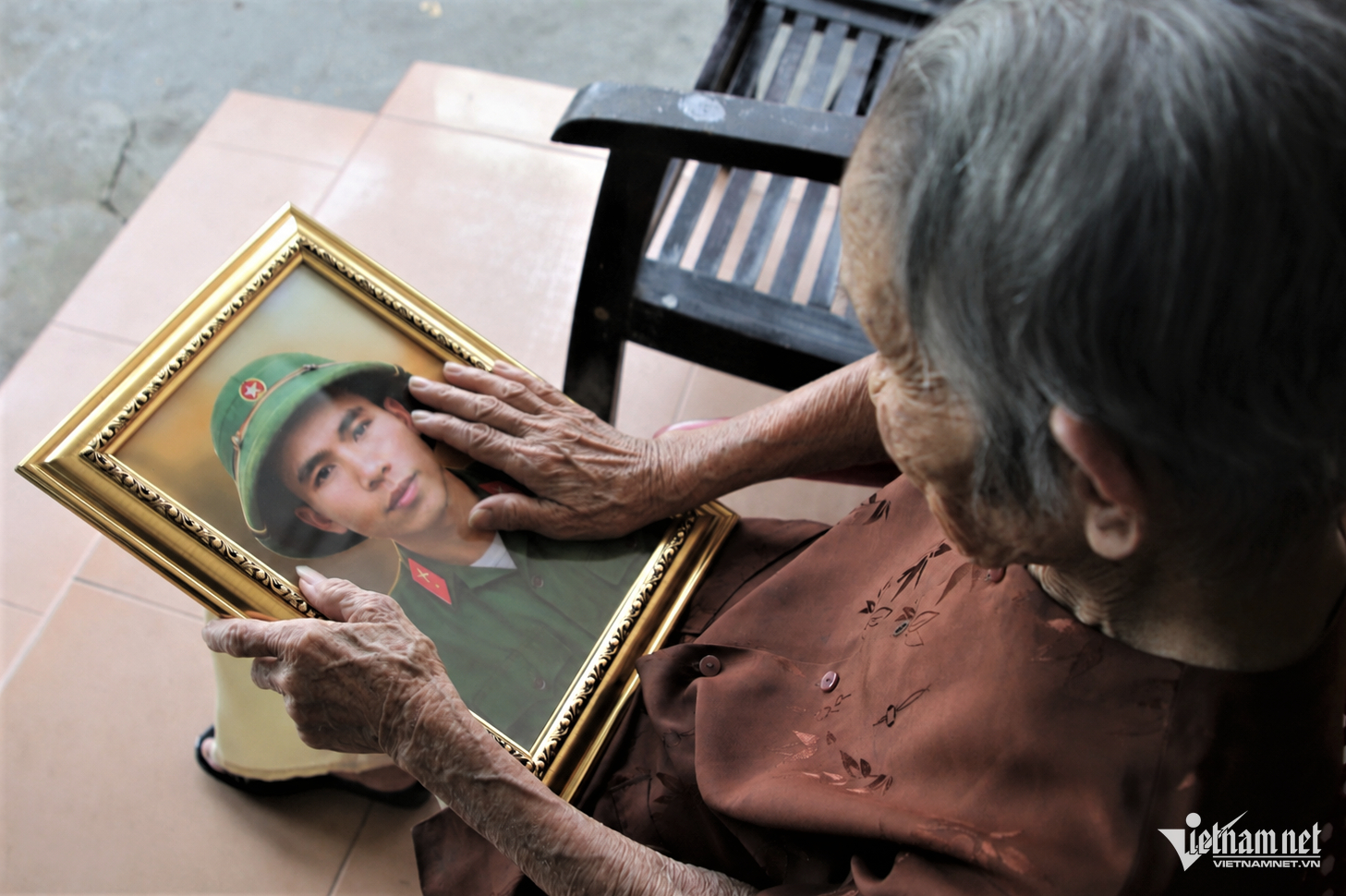
At the age of 105, she still waits for the day his remains are found and brought back to their hometown.
On July 15, in her house in Hoi An Tay ward, Da Nang city, Heroic Vietnamese Mother Ngo Thi Lang tremblingly received the portrait of martyr Huynh Quang Tho.
She brought the photo closer, looking for a long time at the face of the young man with fair skin and round eyes. That was the son who had left home to fight the enemy when he was only 17 years old and never returned.
Since the day martyr Huynh Quang Tho sacrificed his life, the family had not had a photo of him to keep and worship. On the altar, there was only the Fatherland Merit Certificate, with no portrait and no keepsakes. Whenever she missed her son, Lang could only call his name in her memory.
The portrait was presented to her by a representative of the Da Nang City Department of Home Affairs on the occasion of the War Invalids and Martyrs Day on July 27. The artwork was supported and created by Duong Cao Thanh, 35, who lives in Phu Tho province and has spent many years restoring photos of martyrs.
Huynh Quang Thuyen (born in 1948, a 3/4-class war invalid), the younger brother of Tho, could not hide his emotion: “My family has waited for a photo of my brother for too long. Now my mother can see her son's face every day. This photo has a very special meaning.”
“I was afraid of losing my son, but keeping him meant losing the country’
The life of Ngo Thi Lang went through two resistance wars with losses that nothing can compensate for. She is a relative of two martyrs and one war invalid. Her husband and son sacrificed their lives in the resistance war against French colonialism and the resistance war against American imperialism, respectively.
Her husband, martyr Huynh Kinh Nhi, born in 1918, was a native of Hoi An. During the years when the French colonialists devastated their hometown, the family evacuated to Binh Duong commune, Thang Binh district, former Quang Nam province, to live and engage in revolutionary activities.
In 1950, Huynh Kinh Nhi sacrificed his life. Lang raised her three children alone, working hard while continuing her revolutionary activities.
When Tho was only about 17 years old, he hid it from his mother and wrote a voluntary application to enlist in the army. Only when his unit notified her did she know her son had quietly departed.
“I was afraid of losing my son, of course, but keeping him meant losing the country. He was determined to go, and I could not stop him,” she recalled.
In 1965, soldier Huynh Quang Tho sacrificed his life on the battlefield of Nui Thanh, former Quang Nam province, when he was only 19 years old.
Deep yearning
When the war ended, the remains of her husband, Huynh Kinh Nhi, were found and brought back to their hometown for burial. Meanwhile, her son still lay somewhere in the land of Nui Thanh.
For many years, Huynh Quang Thuyen and his family followed the meager pieces of information about his older brother's grave. Through several sources of information, the family learned that martyr Huynh Quang Tho might have been buried at the Tam Nghia Martyrs Cemetery (Nui Thanh district, former Quang Nam province).
However, there are many unidentified graves there, and the family lacked photos, keepsakes, or complete data to verify.
The family established an empty grave (cenotaph) for martyr Huynh Quang Tho in their hometown to have a place for worship. Not knowing the exact day he died, his relatives took July 27 of each year as his death anniversary.
In 2024, Lang's DNA sample was taken for comparison with the data of unidentified martyrs' remains. The family has gained more hope as the State is currently implementing the “500 Days and Nights Campaign,” accelerating the search, collection, and identity verification of martyrs' remains.
“We hope the DNA comparison will yield results soon so that while my mother is still alive, we can welcome Tho back home. Her last wish in life is to find his remains and bring him to rest in Hoi An. Only then can she be at peace,” Thuyen said.
Ha Nam
.svg)
