 Vietnamnet.vn

 Podcast



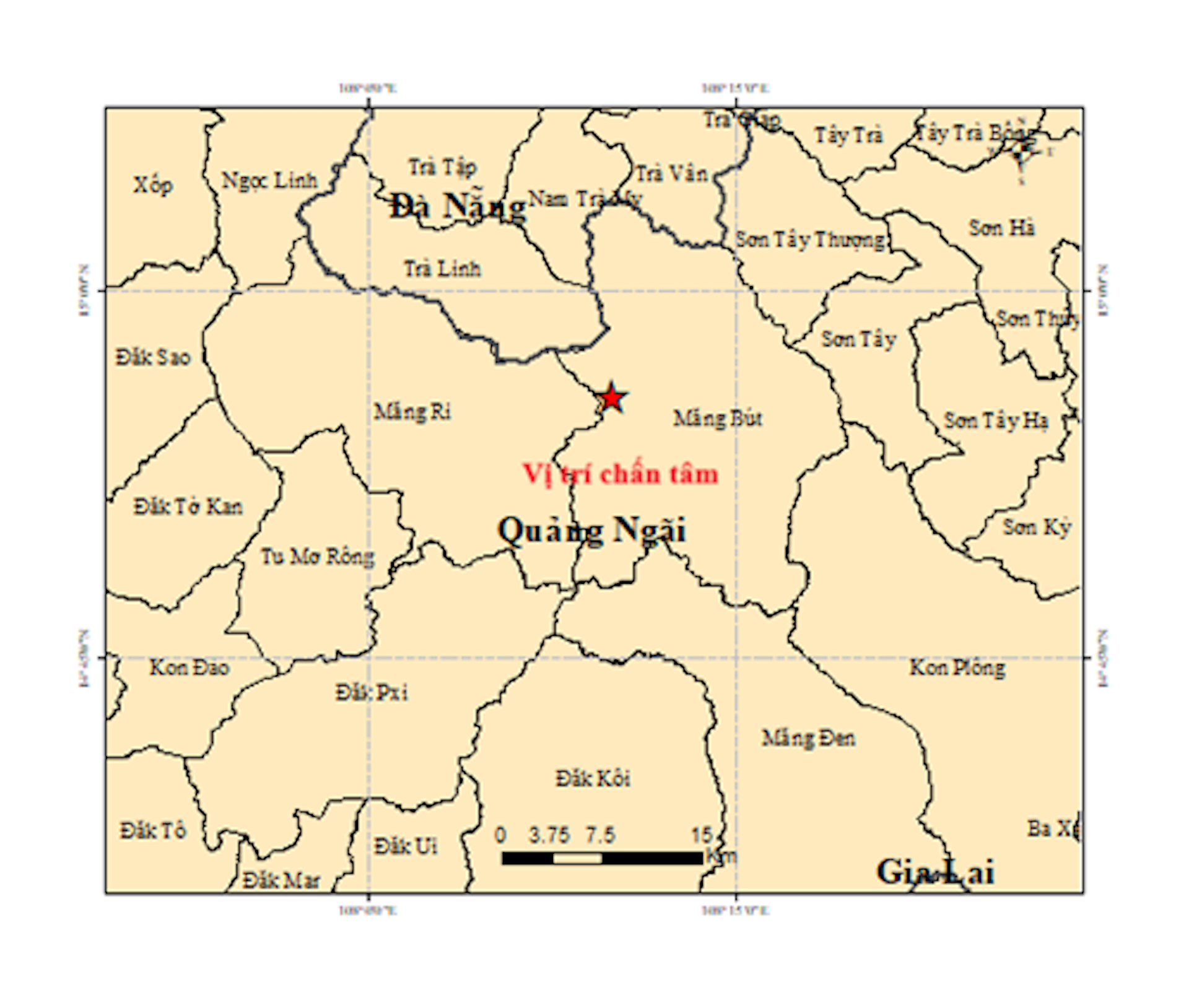
The Earthquake Information and Tsunami Warning Center under Vietnam’s Institute of Earth Sciences has issued a notice on the latest earthquake in Quang Ngai Province.
At 2:06:41 a.m. on Sept. 22, a magnitude-3.2 earthquake occurred at 14.928 degrees north latitude and 108.167 degrees east longitude, with a focal depth of about 8.3 kilometers. The earthquake struck the Mang But Commune area of Quang Ngai.
A second earthquake was recorded in the same commune at 2:12 p.m., with a magnitude of 3.0 and a focal depth of approximately 8.1 kilometers.
A day earlier, on Sept. 21, authorities recorded seven earthquakes with magnitudes ranging from 2.6 to 3.0 in Quang Ngai and Da Nang, at focal depths of approximately 8.1-8.3 kilometers.
Five of those earthquakes occurred in quick succession in Mang But Commune, Quang Ngai, while the other two struck Tra Tan and Tra Linh communes in Da Nang.
On Sept. 20, another four earthquakes with magnitudes ranging from 2.5 to 2.8 were recorded across the two localities, at focal depths of around 8.1-8.3 kilometers.
In total, Quang Ngai and Da Nang recorded 13 earthquakes over the three-day period.
All of the earthquakes were assessed at disaster risk level 0.
Induced earthquakes
Nguyen Xuan Anh, director of the Institute of Earth Sciences, identified the events as induced earthquakes.
According to scientists and geologists, induced earthquakes can be associated with activities including open-pit and underground mining, oil and gas extraction, the injection or withdrawal of water in geothermal operations, and the construction of large reservoirs.
Key factors that can induce seismic activity include changes in stress, pore pressure and reservoir volume.
When a reservoir is filled, water can seep deep underground and increase pore pressure along fault surfaces. This can reduce the faults’ resistance to shear stress and potentially trigger earthquakes.
Most induced earthquakes that respond rapidly to reservoir filling occur within the first five years after impoundment. However, earthquakes of this type can also occur decades after a reservoir is filled.
Kieu Oanh
.svg)
