 Vietnamnet.vn

 Podcast



Before becoming Vietnam’s representative at the International Artificial Intelligence Olympiad, Ky Nam had already attended advanced mathematics lectures alongside university students.
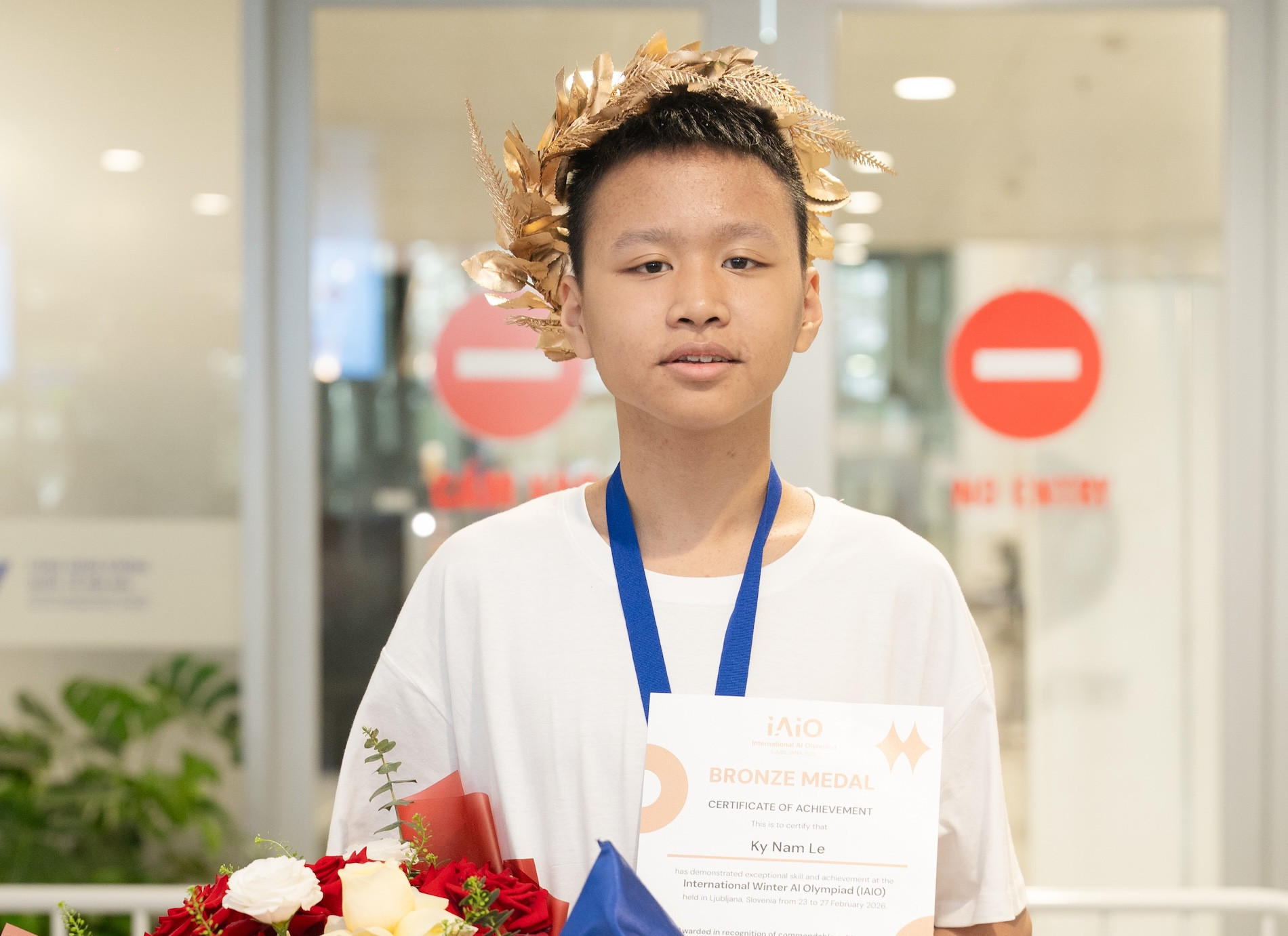
Le Ky Nam, an eighth-grade student at Newton Secondary and High School in Hanoi, is one of three members of Vietnam’s team who won medals at the International Artificial Intelligence Olympiad (IAIO) 2026. Nam secured a bronze medal and was also the youngest member of the team, while the other participants were high school students.
“I’m very happy to win a medal, though I also feel a little regret because I was very close to getting a silver,” Nam said.
This year’s International Artificial Intelligence Olympiad took place in Slovenia, bringing together contestants from 24 countries known for their strengths in technology. Vietnam’s team consisted of four students selected through a national competition.
Nam explained that the exam had two sections, each lasting five hours. The theoretical section included eight in-depth questions, while the practical section required contestants to program an AI model to solve a real-world problem related to vaccines.
“The most challenging part was probably some questions in the theory section. I didn’t have enough time to finish writing all the solutions, so I had to leave two questions about positional encoding and kernel methods,” he said.
Discovering programming from grade two
Nam’s journey into artificial intelligence began very early.
When he was in second grade, his mother noticed that he had a strong memory and learned quickly, so she bought him two introductory programming books about Scratch and Python. Without a background in the field, she simply let him explore them on his own.
“The books showed how to code several games. I tried following the instructions and was surprised when it actually produced a playable game. Because I created something tangible, I found it really exciting,” Nam recalled.
In third grade, after learning about the National Youth Informatics Contest, Nam decided to try competing and began pursuing the field more seriously.
Seeing her son’s enthusiasm, Nam’s mother later enrolled him in programming courses on Python and C++ so he could build a more structured foundation in computer science.
With strong mathematical abilities and a passion for exploring new ideas, Nam went on to win first prize at the National Youth Informatics Contest. He later earned a gold medal in the non-specialized category in grade five and another gold medal in the specialized category in grade six at the Central Highlands Informatics Olympiad, a competition originally designed for high school students.
Nam has also achieved impressive results beyond computer science. He previously won a gold medal in mathematics at the International Mathematics and Science Olympiad (IMSO).
For Nam, mathematics is the most important foundation for programming and artificial intelligence.
“I feel mathematical thinking helps me program much better. When studying math, I’m used to reading problems carefully, identifying what the question asks and breaking it into smaller steps to solve. Programming is the same - you have to think clearly about each step before writing the code,” he said.
Mathematics also helps him recognize patterns and think more logically.
“When working on algorithms, I often ask whether there is a shorter or more optimized solution. Thanks to mathematics, I’m used to looking for the most efficient solution, not just a correct one,” Nam explained.
Attending university-level classes
Nam’s exploration of artificial intelligence was also a personal choice, though his parents have consistently supported his interests.
At the beginning of 2025, his mother enrolled him in an introductory AI course organized by the Institute of Information Technology for the People. After discovering a strong interest in the field, Nam decided to focus on AI instead of continuing competitive programming as his main pursuit.
Since then, he has won third prize at the Vietnam Artificial Intelligence Championship (VAIC) and received several awards on international platforms.
Associate Professor Nguyen Phi Le from the AI4LIFE Institute at Hanoi University of Science and Technology, who guided Nam during preparations for the IAIO competition, highly praised his ability to learn independently. According to her, this is a crucial quality for anyone pursuing artificial intelligence.
She noted that Nam studies very proactively and can absorb knowledge beyond the standard school curriculum.
To build a stronger foundation in AI, Le encouraged Nam to attend university-level mathematics courses. He has audited classes in algebra and calculus alongside university students and has been able to follow the material.
In addition, Nam has begun participating in formal AI research projects at the AIstein young talent club of the AI4LIFE Institute. He is also a co-author of a scientific paper currently under submission to ICML, one of the world’s leading conferences in artificial intelligence.
“Nam’s achievements are very rare for someone his age. He can certainly be considered a young talent in artificial intelligence,” Le said.
Another aspect that impressed Le was Nam’s maturity and discipline.
Although he was the youngest member of the delegation, Nam was always the earliest to arrive and the most punctual. His theoretical answers also left a positive impression on judges because of his neat handwriting.
“Young people who combine strong thinking skills, diligence, and careful attention to detail will have many opportunities to go far in the future,” she said.
Following this achievement, Nam plans to continue strengthening his knowledge in order to participate in both domestic and international competitions in computer science while further pursuing artificial intelligence.
Thuy Nga
.svg)
