 Vietnamnet.vn

 Podcast



The year 2026 is viewed as a pivotal milestone as Ho Chi Minh City stands on the verge of a significant transformation, with a series of large-scale transport and urban environmental projects approaching completion.
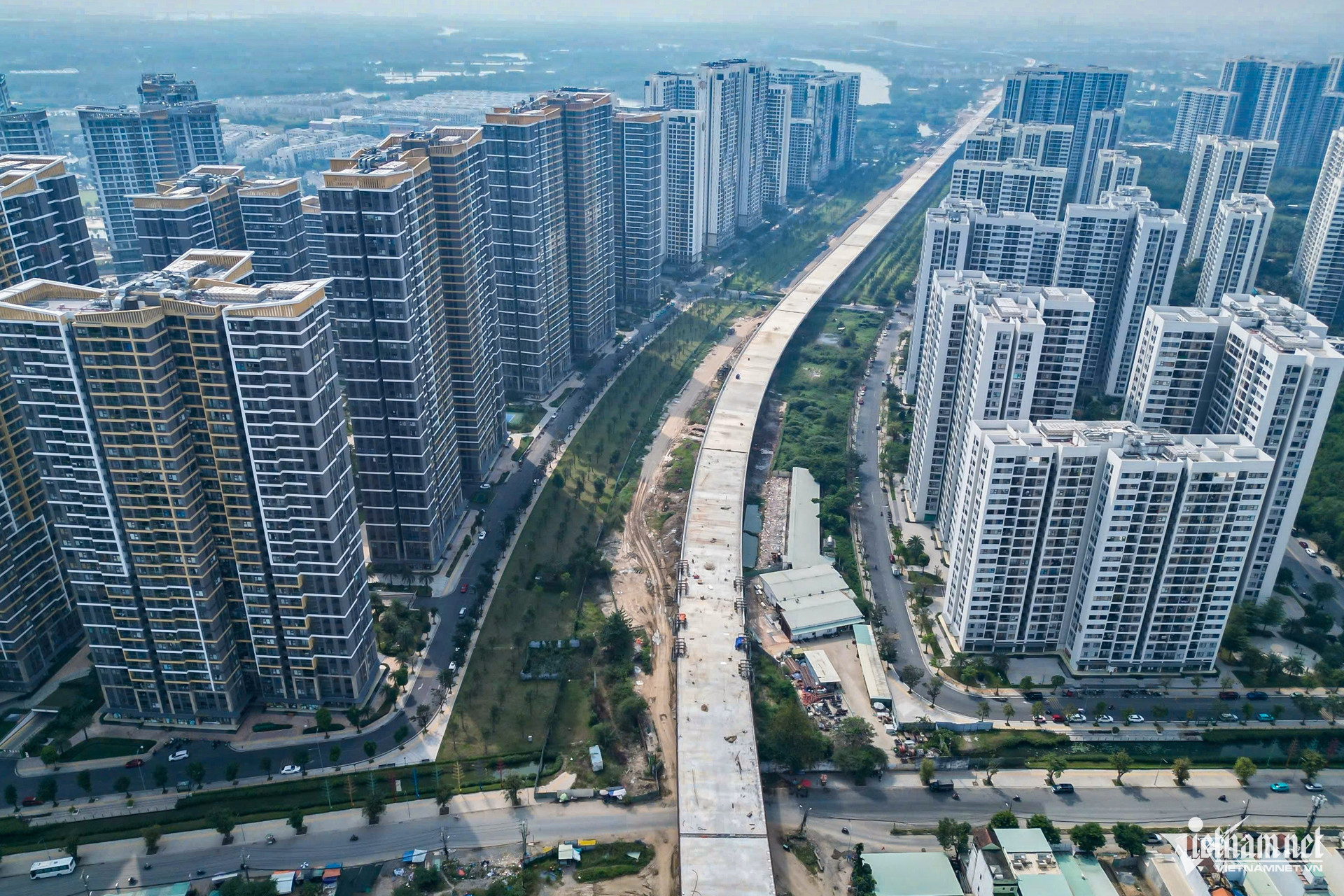
The city is entering a crucial phase as four strategic infrastructure works prepare to reach the finish line, promising visible changes to its urban landscape. These include Ring Road 3 connecting the region, the An Phu interchange, the nearly VND10 trillion flood control project and the Tham Luong - Ben Cat - Nuoc Len canal corridor.
Residents are placing high hopes on a greener, more open Ho Chi Minh City, worthy of its status as the country’s leading super metropolis, once these projects come into operation.
Ring Road 3: A regional connector gradually taking shape
Nearly three years ago, in June 2023, the Prime Minister personally launched construction of the Ring Road 3 project, marking a significant turning point. Just one year after the National Assembly approved the investment policy, Ho Chi Minh City had completed an enormous volume of preparatory work to mobilize machinery and manpower to the site.
Considered the largest transport infrastructure project ever undertaken by the city as investor, Ring Road 3 carries a total investment of more than VND75.3 trillion (US$3.01 billion), and stretches 76.3km. Once completed, it will not only ease pressure on inner-city traffic but also establish a strategic connection axis between Ho Chi Minh City and provinces in the southern key economic region.
Designed to expressway Class A standards with a speed of 100km per hour, the project in its first phase includes four expressway lanes along with parallel roads on both sides. Notably, sections passing through Ho Chi Minh City are largely elevated, optimizing land use while minimizing urban fragmentation.
The project has now entered an acceleration phase. Following the technical opening of several eastern elevated sections at the end of 2025, the entire main route is scheduled to be fully connected by mid-2026.
Across construction sites in Ho Chi Minh City, Dong Nai and Tay Ninh, contractors are working through holidays and Tet to stay on schedule.
When completed, Ring Road 3 will serve as a strategic beltway - a large-scale bypass diverting heavy trucks to the outskirts while opening new industrial and logistics corridors across the Southeast region.
An Phu interchange: From congestion hotspot to architectural landmark
At the eastern gateway, the An Phu interchange project broke ground in December 2022. With a total investment of more than VND3.4 trillion (US$136 million), it is the largest and most complex multi-level interchange ever built in Ho Chi Minh City.
The project is expected to eliminate chronic congestion that has plagued the area for years, while reshaping the gateway connecting the Ho Chi Minh City - Long Thanh - Dau Giay Expressway and Mai Chi Tho Avenue.
The three-level design includes a two-way underpass linking the expressway with Mai Chi Tho, surface-level traffic organization and elevated overpasses. A 36-meter symbolic tower at the central island will serve as an architectural highlight.
After more than three years of construction amid one of the city’s busiest traffic nodes, the project has faced numerous challenges in site management and traffic regulation.
In early 2026, the HC1-02 underpass was officially opened to traffic. Remaining components, including the Y-shaped overpass and the symbolic tower, are being expedited and are expected to be completed in the second quarter of 2026.
The VND10 trillion flood control project: A long-awaited solution
Nearly a decade after groundbreaking and following multiple suspensions due to procedural obstacles, the large-scale tidal control project valued at nearly VND10 trillion (US$400 million), has been restarted.
With special mechanisms under Resolution 98, city authorities are determined to complete the remaining components in 2026, gradually addressing the long-standing problem of tidal flooding.
On February 2, the entire project was officially resumed with the operation of the Ben Nghe sluice gate. To date, more than 92 percent of the construction volume has been completed.
Upon completion, the system of six major tidal gates - Ben Nghe, Tan Thuan, Phu Xuan, Muong Chuoi, Cay Kho and Phu Dinh - will form a “steel shield” protecting about 570 square kilometers of central areas, reducing flood risks for more than 6.5 million residents.
Tham Luong - Ben Cat - Nuoc Len canal: The second “green corridor”
Beyond road infrastructure, the 32km strategic drainage corridor running across multiple wards and communes is also nearing completion.
Once finished, the canal is expected to enhance drainage capacity, improve environmental conditions and create new green spaces, contributing to a renewed urban landscape along its banks.
The Tham Luong - Ben Cat - Nuoc Len canal renovation project, with total investment exceeding VND9 trillion (US$360 million), is accelerating the completion of roads along both banks and riverside parks.
The city expects the entire route to don a “new coat” in 2026, transforming what was once a polluted waterway into a continuous green corridor along the North - South axis.
The project will not only help reduce flooding in the northwestern area but also establish a new combined water and road transport axis, creating momentum for urban renewal similar to the transformation once witnessed along the Nhieu Loc - Thi Nghe canal.
Tuan Kiet
.svg)
