 Vietnamnet.vn

 Podcast



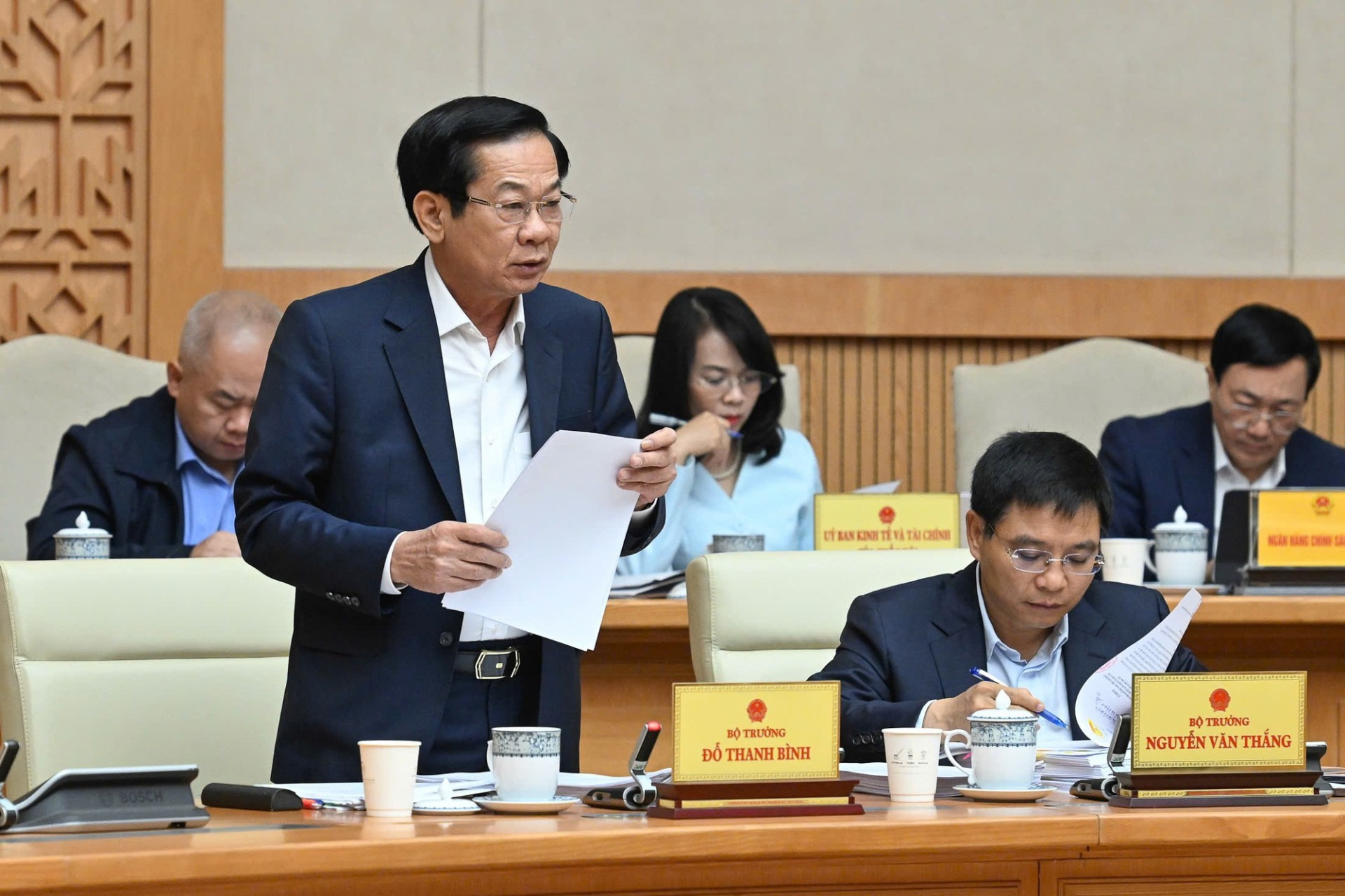
At the government's November regular monthly meeting on December 5 reviewing the new two-tier local government model, Minister of Home Affairs Do Thanh Binh stated that from June 1 to December 3 the government had issued more than 170 legal documents on the new government structure.
In November, it issued Resolution 374 approving the budget of VND2,615 billion to support 27 localities (phase 2) in repairing and upgrading headquarters, purchasing equipment, and improving working facilities for commune-level administrative units.
The government's steering committee and ministries have issued guidance, conducted training, and resolved issues in localities to ensure unified operation of the two tier local government model.
Binh said most localities have completed leadership positions for the people's committee and people's council; only five localities still lack cadres and are urgently completing assignments.
A total of 466 provincial level specialized agencies and 9,916 commune level professional offices have come into operation.
Localities have assigned commune level officials and civil servants, achieving positive results. Several localities have implemented large scale transfers such as Hanoi, An Giang, Can Tho, Bac Ninh, and Phu Tho.
Hanoi alone reassigned about 1,200 officials. Local authorities are also strengthening training to ensure the workforce meets practical needs and can promptly address arising issues.
Regarding finance, budget, offices, and public assets, according to the Ministry of Finance, 178 commune level units across four provinces lacking equipment have now been fully supplied. All commune level units have opened treasury accounts and received necessary equipment.
For public asset management, 17,496 housing and land facilities have been processed; 9,056 facilities are still under review. Only 89 communes (2.68 percent) in three provinces have no operational vehicles; localities have arranged budgets for procurement. Localities are also allocating public housing based on actual needs.
Despite positive results, Binh noted that the two tier local government model still faces challenges. Regarding institutions and policies, 355 tasks require guidance documents, and 10 tasks need adjustments in authority.
Some regulations remain inconsistent with the two tier model, such as: licensing of medical activities after restructuring, organization of industrial zone management boards; public service units under provincial people's committees; the authority to recruit education sector employees at commune level units; and administrative fines related to religious activities.
Regarding administrative procedures, the government office reported that 29 citizen- related procedures and documents on population management, along with 42 procedures related to judicial record certificates, have not met requirements and must be simplified.
Many procedures are not suitable for full online public services. Databases remain inconsistent, and telecommunications and electricity coverage, despite improvements, remain slow in some areas.
Underperforming officers to be replaced
To improve the effectiveness of the two tier local government model, the minister of home affairs requested ministries to resolve issues following conclusions from the central government and the steering committee.
Ministries must urgently issue guidance for 355 tasks; propose adjustments in authority; and give orientations for amendments of related laws and regulations.
The minister also called for stronger cuts in administrative procedures as mandated by resolution 66/NQ-CP; expansion of digital transformation; and data connectivity across national and local systems.
Localities must quickly consolidate agricultural extension offices and land registration offices; arrange public employees at commune level; establish general service public units; complete organizational structures; and replace officials who are underperforming.
Based on reports from 30 out of 34 localities and input from 12 ministries, the Ministry of Home Affairs has submitted its assessment to the PM on the feasibility of 949 delegated tasks. Of these, 584 tasks (61.54 percent) are feasible; 355 tasks (37.41 percent) need legal documents or guidance; and 10 tasks (1.05 percent) require adjustments in authority between central and local levels or between different levels of local government.
From July 1 to November 30, 34 localities received 21.8 million administrative procedure applications, an increase of 5.9 million from the previous month, including 18.4 million online submissions. Commune level alone received 13.4 million online applications. The on-time or early processing rate reached 92.78 percent.
As of December 1, 47 out of 129 remote villages without electricity have been connected with the national grid, an increase of 11 villages. However, 82 villages still lack electricity.
Tran Thuong
.svg)
