 Vietnamnet.vn

 Podcast



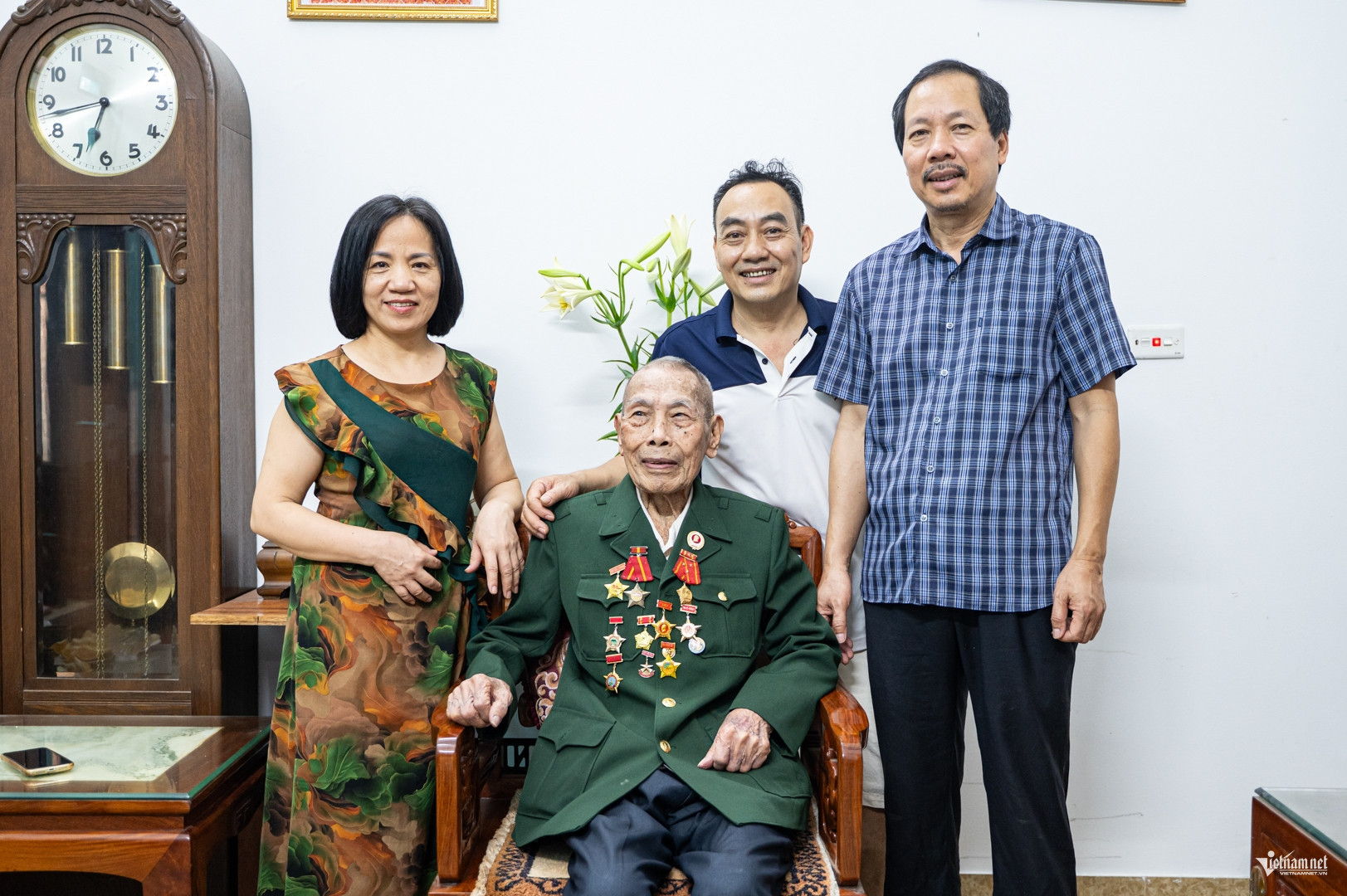
At nearly a century old, Binh still has bright eyes, a sharp memory, and a deep love for recounting wartime stories to his children and grandchildren.
“For the past three years, my father has undergone dialysis at the hospital three times a week. Despite that, he remains optimistic, maintains a disciplined routine, and regularly follows domestic and international news through books, newspapers, and television,” said Le Thanh Ha, 54, his youngest son.
Inside the small room, Binh keeps numerous photos, books, and newspapers about Ho Chi Minh and General Vo Nguyen Giap. He treasures family photo albums, pictures with former comrades, and memories from reunions of the retired officers’ club under the High Command of Guard – Ministry of Public Security.
A time to remember
Le Binh was born in 1927 in Nghe An into a family with a tradition of scholarly pursuit and patriotism. In the autumn of 1945, the 18-year-old youth participated in the local power seizure, joining the struggle for autonomy.
In 1949, following President Ho Chi Minh's call, the young man bid farewell to his elderly parents, young wife, and small child to volunteer for the National Guard to fight against the French. Binh directly participated in the fierce Dien Bien Phu Campaign, straining alongside his comrades for 56 days and nights on the front line.
He has always been proud to be a member of the unit under Regiment 57, Division 304, commanded by General Hoang Minh Thao. In 1954, following the strategy of “steady attack, certain victory,” the regiment completed key missions including building artillery positions, command posts, and field hospitals.
On October 9, 1954, he was among the soldiers of the Vietnam People’s Army who marched from the outskirts into Hanoi to take over the capital.
“Along the way, despite heavy rain, people of all ages lined both sides of the road, cheering and waving to welcome the troops. There were not many flags or decorations, but there were countless smiles and tears of happiness,” he remembered.
In 1955, the young soldier was assigned an important responsibility: joining Regiment 600 under the High Command of Guard. This unit protected the security of the Presidential Palace, participated in securing rallies, and escorted foreign guests and high-ranking leaders. Guards had to undergo clear background checks and ensure moral quality and health.
Binh was awarded the Third-Class Glorious Soldier Medal by President Ho Chi Minh in 1963, and the First-Class Victory Medalby General Vo Nguyen Giap in 1958, among other honors.
A filial son, an exemplary father
Binh’s childhood was marked by hardship after his mother passed away when he was just five. His father later remarried Nguyen Thi Em, a kind stepmother who devotedly raised him and his brother.
In 1963, when his stepmother grew old and fell ill, he left military service to work as a mechanic so he could bring her from Nghe An to Hanoi and care for her.
His sons still remember those final years vividly: “Our grandmother became increasingly frail and mentally unwell. Every day, our father bathed her, cooked for her, and took care of her attentively. Even on cold nights, when she asked to be carried outside for a walk, he would patiently fulfill her wish. Everyone in the neighborhood was deeply moved.”
His quiet devotion became a powerful lesson for his children.
“Our father never told us to be filial. But through his actions, we learned naturally. Now that he needs dialysis, we take turns accompanying him, staying overnight, and caring for him. Our spouses and children all share the responsibility,” said Ha.
After losing his first wife during the war, Binh remarried in 1965 to Tran Thi Chanh (1937–2012). Together they had three sons.
“Our father was gentle and deeply devoted to his family. After work, he even sold ice cream and drinks to support our education. At night, he read us poetry from our ancestors, teaching us about love for our homeland and filial piety. With our mother, he was always kind and attentive,” said Son, his second son.
Six years before her passing, his second wife became paralyzed. Binh cared for her daily with patience and tenderness.
“He mashed food and cooled each spoonful of milk before feeding her. Every action showed deep love. He spoke little but did much, setting an example for us. We simply followed his way, loving and caring for our own families,” Son shared.
Thanh Minh
.svg)
