 Vietnamnet.vn

 Podcast



According to the National Center for Hydro-Meteorological Forecasting, 2025 was an exceptionally abnormal year of natural disasters in Vietnam, with extreme phenomena causing widespread destruction across the country.

On December 4, Deputy Minister of Agriculture and Environment Phung Duc Tien reported that updated data estimates the economic damage caused by natural disasters in 2025 at approximately USD 3.97 billion. The disasters also claimed the lives of or led to the disappearance of 419 people.
By the end of November 2025, there had been 21 storms and tropical depressions (15 storms and 6 depressions) in the East Sea, making 2025 the year with the highest number of such events since monitoring began in 1961. The previous record was 20 in 2017.
In addition to setting records in quantity, the storm season of 2025 was marked by highly unusual, extreme events. Notably, Storm No. 1 (Wutip) formed over the East Sea in June-a phenomenon not seen in over 40 years.
Storm No. 9 (Ragasa) reached intensity level 17 with gusts exceeding level 17, becoming the most powerful storm ever recorded in the East Sea.
Another unusual event occurred in late November when a tropical depression originating from Storm Senyar moved from the Indian Ocean into the Northwestern Pacific-an unprecedented westward path in meteorological history.
One of the most significant events of 2025 was the severe, widespread flooding, with peak water levels surpassing historical records on rivers throughout the North, Central, Central Highlands, and downstream Mekong Delta regions.
Meteorologists noted that never before had historic floods simultaneously occurred on 20 rivers in a single year. In the North, such floods were recorded on the Cau (Thai Nguyen, Bac Ninh), Thuong (Bac Ninh), Chung (Lang Son), Bang Giang (Cao Bang), Lo (Tuyen Quang), Ngoi Hut, and Ngoi Thia (Lao Cai) rivers.
In Central Vietnam, floods were observed on the Ma, Buoi, and Yen Rivers (Thanh Hoa), the upper Ca River (Nghe An), Bo River (Hue), Vu Gia–Thu Bon Rivers (Da Nang), Ky Lo and Ba Rivers (Dak Lak), Dinh Ninh Hoa River (Khanh Hoa), and the Luy River (Lam Dong).
In the South, major flooding occurred on the lower Tien River (Vinh Long, Dong Thap) and the lower Hau River (An Giang, Can Tho).
The historic flood in Phu Yen (now the eastern part of Dak Lak) was part of a larger disaster in the Central–Central Highlands region and surpassed the legendary 1993 flood levels on the Ba River basin.
Throughout the year, many storms followed fast-moving, intense, and irregular paths, causing severe loss of life and property.
According to the Department of Dike Management and Natural Disaster Prevention (Ministry of Agriculture and Environment), storms impacted the Central region early on (storms No. 3 and 5) and later struck the North (storms No. 9 and 11). When three particularly strong storms (No. 5, 10, and 13) hit the Central region, the Prime Minister ordered the establishment of frontline command centers for urgent response.
Storm Bualoi (No. 10) was considered highly unusual in terms of speed, intensity, and prolonged landfall.
Mai Van Khiem, Director of the National Center for Hydro-Meteorological Forecasting, stated that Bualoi moved at 30–35 km/h-almost twice the average storm speed. It remained over land for more than 12 hours, from 10–11 PM on September 28 to 10 AM on September 29, after making landfall between Nghe An and northern Quang Tri. This rare occurrence significantly increased its destructive impact.
The storm’s circulation brought heavy rain across the North and from Thanh Hoa to Hue, with some areas recording over 500mm.
Dr. Nguyen Ngoc Huy, a climate change and disaster expert, noted: “Some houses were reduced to just foundations and broken walls after the storm. It will take people a long time to recover.”
On September 29 alone, eight tornadoes formed within the storm’s circulation and edge, striking eight provinces and cities.
Storms No. 10 and 11 (Matmo) brought two rounds of heavy rain to Hanoi, flooding streets on September 30 and October 7. Later, from late October to early November, cold air combined with the circulation of Storm No. 13 (Kalmaegi) caused flooding of 0.5–0.8 meters on multiple central streets in Hanoi.
Heavy rains also caused major flooding in Thai Nguyen, where the water level at the Gia Bay station on the Cau River reached 29.9 meters at 5 AM on October 8-2.9 meters above alarm level 3 and 1.09 meters higher than the record level during Storm Yagi in 2024. This resulted in widespread inundation of neighborhoods and communes.
In Ho Chi Minh City, heavy rain combined with high tides caused deep flooding in many low-lying areas. According to Le Dinh Quyet of the Southern Hydro-Meteorological Station, tide levels at the Phu An station (Saigon River) reached 1.78 meters on the morning of November 6, surpassing the 2019 record (1.77 meters)-an extreme event, albeit within expected tidal cycles.
Most recently, from November 16 to 22, historic flooding in the South Central region caused severe damage and left many people in dire circumstances.
A striking feature of the 2025 floods was the rapid water rise, large amplitude, and slow drainage-unlike the “slow floods” of past years.
Meteorologists described the November 15–21 floods in the South Central region as an extreme event that broke historical records. According to the World Meteorological Organization (WMO), such rare events are nearly impossible to predict with precision.
This episode involved multiple simultaneous extreme weather phenomena, exacerbated by the Central region’s steep, short rivers that accelerated water flow, increasing the risk of flash floods and landslides. High tides further hindered drainage.
Experts believe climate change is the root cause of these disasters. Global warming raises sea surface temperatures, fueling stronger storms.
In 2025, multiple strong cold air outbreaks coincided with storms or depressions, creating prolonged rainfall and increasing risks of floods, flash floods, and landslides-especially in Central and mountainous areas.
Many cities, particularly low-lying ones, still lack adequate drainage systems to cope with extreme rainfall. Rapid urbanization further reduced natural flood control, worsening disaster impacts.
Although early forecasting efforts improved, some “abnormal” phenomena remained unpredictable. Evacuation and relocation efforts were sometimes delayed, especially in remote areas.
Meanwhile, the management of reservoirs-especially hydropower dams-once again became a public concern amid repeated Central region floods.
Despite the harsh conditions, one of the most remarkable aspects of 2025 was the spirit of solidarity among the Vietnamese people.
Images of submerged homes, flooded roads, and cries for help from the North to the Central region moved the entire country. When the North suffered, the Central and South reached out; when the Central region flooded, people from the North and South rushed in to help. In adversity, the spirit of “the good leaves protect the torn ones” shone stronger than ever.
Across provinces, convoys loaded with rice, instant noodles, clean water, life jackets, and medicine-donated by individuals, organizations, and benefactors-quietly set off toward flood zones.
In the flood-prone commune of Hoa Thinh, Dak Lak (formerly Phu Yen), 51-year-old Tran Cong Thanh from Phu Huu hamlet risked his life to row a boat and rescue over 40 people, bringing them to safety in a two-story house. He was awarded a certificate of merit by the provincial government.
During the November floods in Gia Lai, Major Nguyen Khac Thinh of the Border Guard Squadron 2 received a commendation from the Border Guard Command for his bravery. He and his team made eight trips into deep floodwaters, rescuing 55 people and providing food, water, and medicine to 75 isolated households.
Phung Ngoc Dong, a 37-year-old from Hon Ro 1, Nam Nha Trang Ward (Khanh Hoa), quickly organized nearly 100 locals, dozens of boats, and around 40 basket boats to carry out rescue operations when floodwaters surged in western Nha Trang.
At that time, residents and businesses in Lo Village, Phu Tho Street, Hoa Hiep Ward (Dak Lak) opened their homes to flood victims and rescue teams free of charge, directly donating and transporting essential supplies to severely flooded areas.
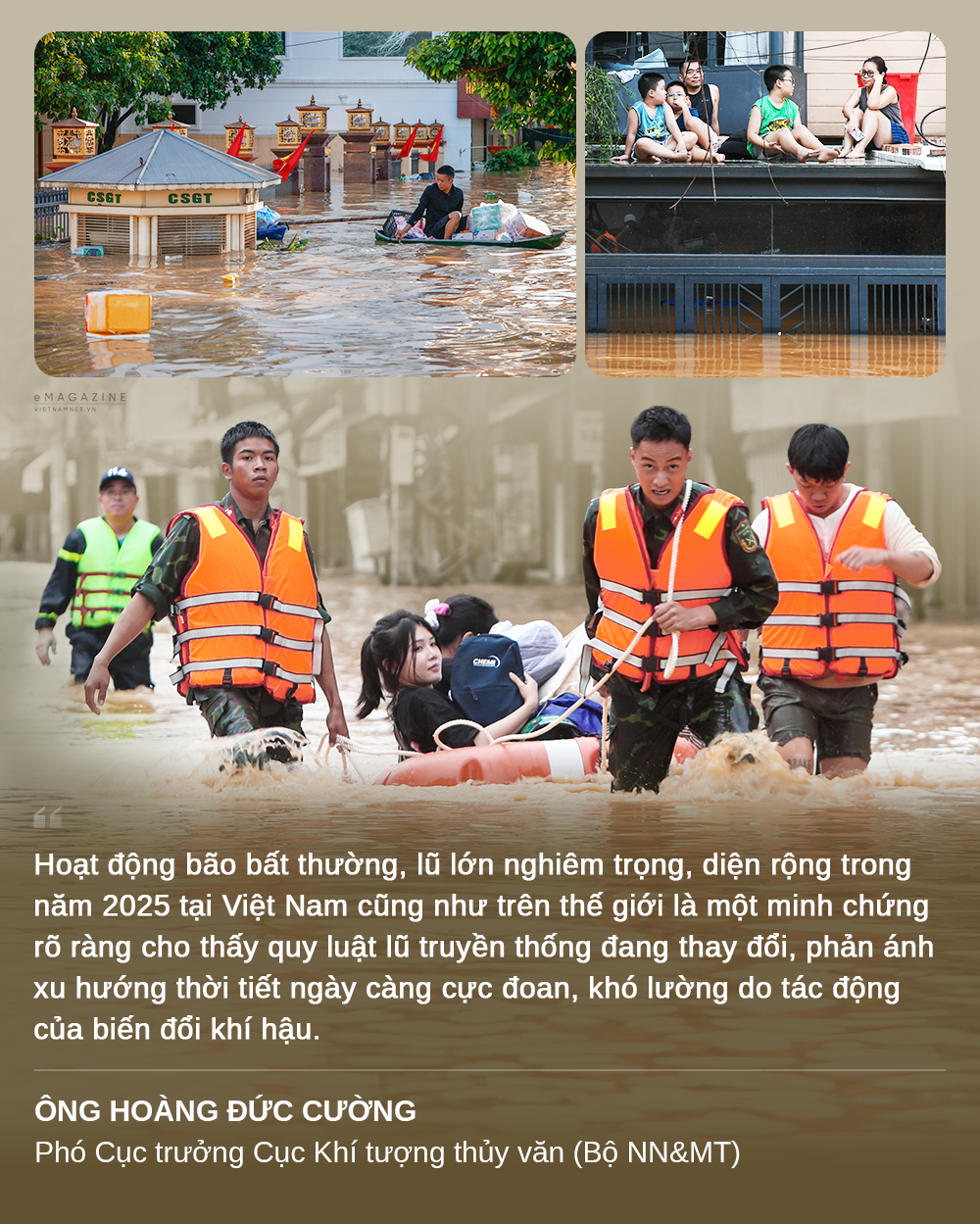
According to Hoang Duc Cuong, Deputy Director of the Department of Meteorology and Hydrology (Ministry of Agriculture and Environment), the abnormal storm activity and widespread, severe floods in 2025 in both Vietnam and around the world demonstrate a clear shift in traditional flood patterns. It reflects a growing trend of extreme, unpredictable weather due to climate change.
Experts emphasize that climate change continues to intensify the frequency and severity of extreme weather events.
Bao Anh
.svg)
