 Vietnamnet.vn

 Podcast



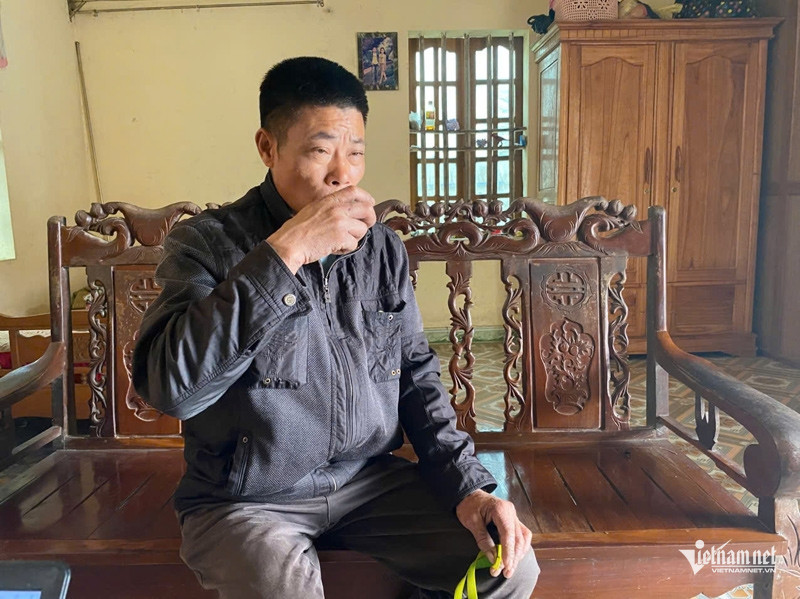
Nguyen Van Dan, born 1968, from Van Phu commune, Thai Nguyen province, has spent the past ten years working in grave exhumation, a job that makes many people's "blood run cold" just hearing about it.
Dan came to the profession by chance. On one occasion when he helped exhume a grave for a relative, his careful working style, quick hands, and professional manner surprised many people. Notably, throughout the process, his hands never trembled.
His dedication satisfied the family. Word spread from one person to another, and before he realized it, Dan had become attached to the profession.
The early days for the man from the "tea land" were not easy. With no team or assistants, Dan handled every stage alone: digging the grave, exhuming the remains, washing the bones, and arranging the skeleton.
At one point, he exhumed three graves in a single night in a neighboring village, working entirely by himself.
"I wanted to find a co-worker, but everyone was afraid, so for several years, I worked alone. Since the work happens late at night, there were moments when I felt a bit uneasy," he said.
Later, he found two "compatible" people to join him. However, for difficult cases or the most grueling tasks, he still proactively takes the lead.
Dan notes that the end of the year is the peak season. In some months, he handles over 30 graves, sometimes working 4-5 consecutive cases through the night. Many families choose the same auspicious hour, so his team has to split up to meet the scheduled times.
Special rules of the profession
According to Dan, timing is an element that must be strictly observed in grave exhumation. Families choose an auspicious date and hour, and whether it is midnight or early dawn, the practitioner must be present on time.
“This is a ritual for the deceased and also respect for the family. There is a spiritual element to this work, so getting the timing wrong is unacceptable,” he said.
Another crucial rule is the order of collecting and arranging the remains, which must never be done arbitrarily. The remains must be arranged from top to bottom: head, neck, shoulders, arms, ribs, spine, hips, thighs, and legs. The ribs must be arranged in correct pairs and on the correct sides; even small bone fragments must not be missed.
Another principle that Dan especially emphasizes is the posture used when arranging the remains in the burial jar, commonly known as “knees higher than the ears.” According to folk belief, when arranging the bones, the knee bones must rise higher than the ears, while the thigh bones are placed lower to achieve the correct posture.
“This is what our ancestors passed down. It has to be done properly for the family to feel at ease,” he said.
Before placing the remains into the burial jar, Dan usually washes them with a mixture of ginger water, lemongrass, and star anise to clean them and reduce odor. This is a traditional method he learned from earlier practitioners.
Once completed, the remains are wrapped in paper and shrouding cloth, placed into the burial jar, then put into an outer coffin and handed over to the family for reburial at a new location.
Over the past decade, Dan has carried out exhumations in many localities. According to him, each region has its own customs related to grave exhumation, and practitioners must study them carefully.
In some ethnic minority areas of Phu Thinh commune, the exhumation order is completely reversed. The practitioner must collect the bones from the feet upward to the head; the skull is taken last and placed on top of the jar. The arrangement of the remains in the burial jar also follows a procedure unique to the local community. Dan must understand this thoroughly before proceeding.
For Dan, the most important principle of the grave exhumation trade is “to see it through to the end, never leave it unfinished.” Even in difficult cases, patience is required to complete the work.
Once, he had to toil alone in a cemetery for three straight hours because he encountered a particularly challenging case. His teammates were afraid to continue, and family members fled in fear, leaving only him working diligently, using his sincerity to comfort the deceased.
As for me, I am not afraid of anything. I just do my job. If I were afraid, I would never have chosen this profession. This is a charitable calling - leaving it unfinished would be a moral failing,” he said.
Nguyen Hanh - Thanh Minh
.svg)
