 Vietnamnet.vn

 Podcast



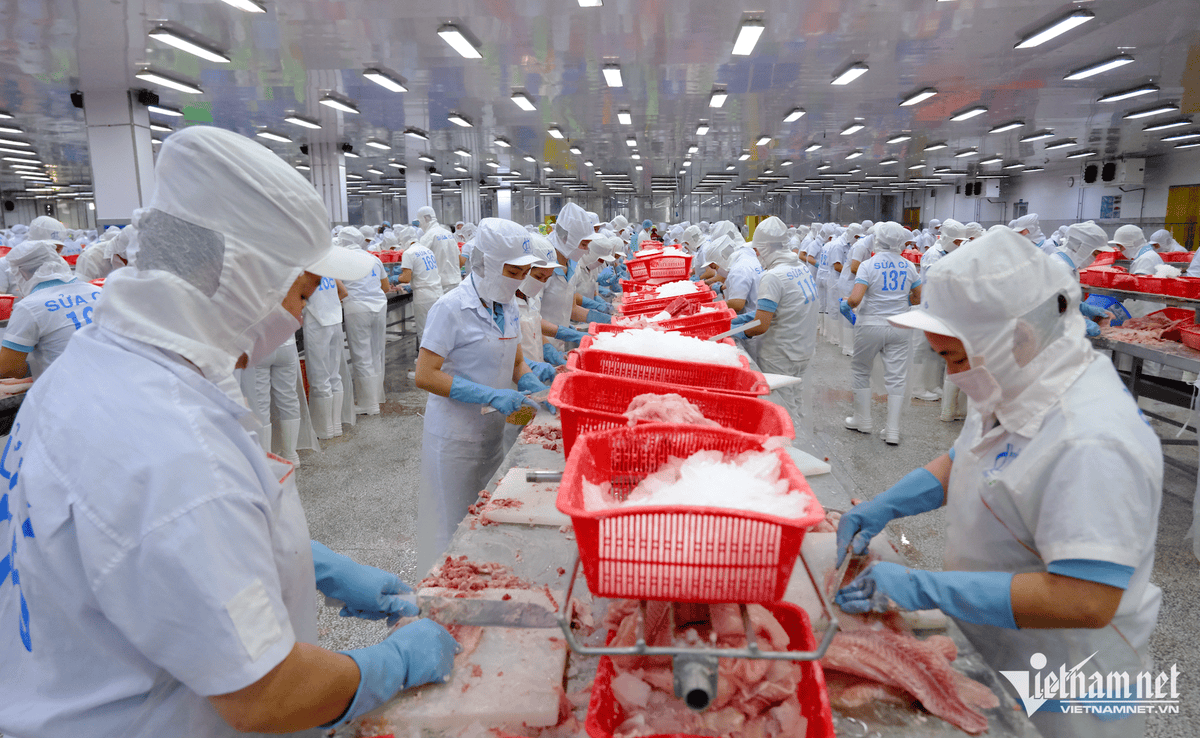
China has successively overtaken Japan and the US to become Vietnam’s largest seafood export market.
As a neighboring country, China has for many years been one of Vietnam's three largest key seafood export markets. However, the COVID-19 pandemic severely affected Vietnam's seafood export activities. Seafood enterprises were left reeling due to broken supply chains, causing exports to China to drop sharply, and at times, even "freeze."
Nguyen Hoai Nam, General Secretary of the Vietnam Association of Seafood Exporters and Producers (VASEP), recalled the early months of 2021 when production and exports were stagnant. At that time, there was a massive inventory of raw materials and seafood products, yet businesses had to continue purchasing fish and shrimp from farmers and fishermen for processing and cold storage.
The association then petitioned the Government and relevant ministries to consider electricity bill reductions for seafood enterprises, as they had to increase the volume of freezing and cold storage for their goods.
The General Department of Customs then reported that seafood exports to China (including Hong Kong) fell from $1.37 billion in 2020 to $1.14 billion in 2021. Even so, China remained among Vietnam’s top three seafood export markets, ranking just behind the US and Japan.
In 2022, seafood exports to the market of more than one billion people recovered strongly, reaching $1.57 billion, a historical record at the time.
In the following year, export turnover of shrimp and fish to China declined again to just $1.34 billion, due to post-pandemic impacts, tighter consumer spending, and still-high inventory levels in that market.
By 2024, Vietnamese enterprises seized new opportunities to accelerate seafood exports to China as the country’s trade with the world fully normalized after Covid-19. Economic signals turned more positive and seafood demand began to recover.
In addition, many Vietnamese companies identified China as a continued key destination for seafood exports, especially amid geopolitical volatility, inflation, and energy crises that caused seafood consumption in major markets such as the US, the EU, and Japan to decline sharply.
As a result, seafood export turnover to China surged in 2024, reaching $1.9 billion.
In the first 11 months of 2025, Vietnam’s seafood exporters brought in $2.26 billion from the Chinese market, up 36 percent year on year, setting a new all-time record. China also successively surpassed Japan and the US to become the largest buyer of Vietnamese seafood.
Notably, Vietnam has emerged as the biggest beneficiary as China stepped up lobster imports. In just 10 months, lobster exports to China reached $702 million, up 135 percent compared to the same period of 2024, accounting for as much as 98.6 percent of the sector’s total export value.
According to VASEP, tariffs are a decisive factor that makes Vietnamese lobster more price-competitive than products from Canada and the US. In addition, close geographic proximity provides a major advantage in transporting live seafood, helping reduce losses and costs.
In particular, Chinese consumers are shifting strongly toward green lobster, a segment where Vietnam has abundant supply. This trend has contributed significantly to the surge in lobster exports and to Vietnam’s overall seafood exports to this market.
China is also the fastest-recovering market thanks to strong purchasing power and more flexible import policies in 2025, contributing to Vietnam’s total seafood export turnover surpassing the $11 billion mark.
However, warnings from Chinese authorities about tighter inspection procedures, along with higher requirements for traceability, could create new bottlenecks. If these regulations are strictly enforced, leading to longer inspection times or higher costs, lobster exports could be affected immediately.
This reality highlights that growing dependence on the Chinese market also creates an urgent need for market diversification and stronger standardization across the seafood supply chain.
Ha Giang
.svg)
