 Vietnamnet.vn

 Podcast



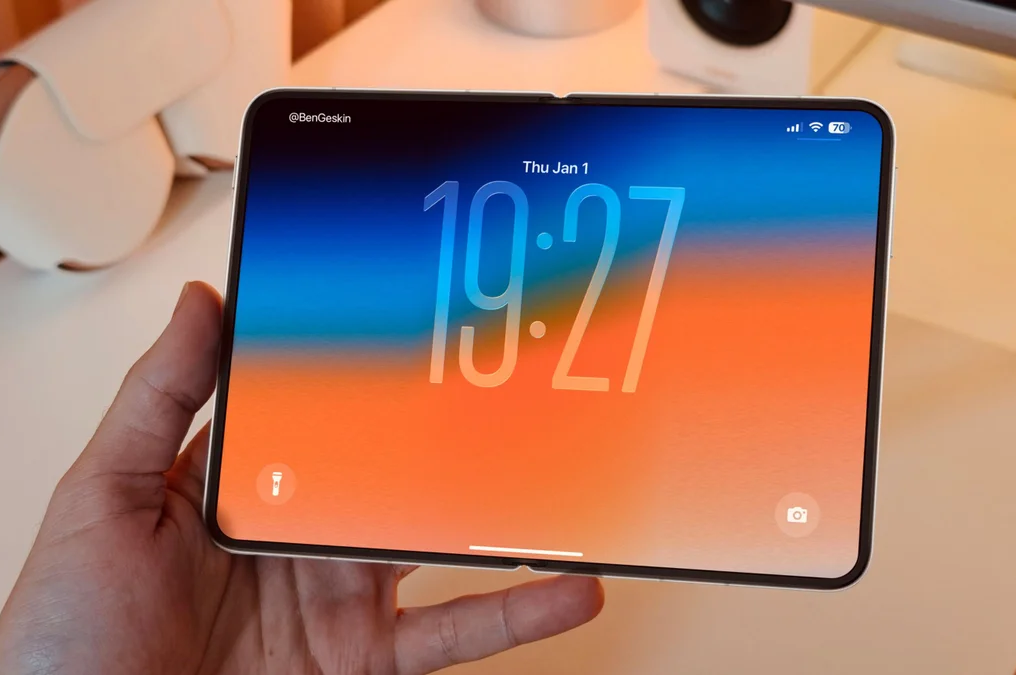
Apple is said to be finalizing the last details of its first-ever foldable iPhone, expected to debut later this year alongside the iPhone 18 lineup.
After years of standing on the sidelines of the foldable phone race, the company now seems ready to unveil what many consider its strategic ace.
It is not only Samsung, with its rumored Galaxy Z Wide Fold, that appears influenced by this new direction. Another major brand is reportedly developing a foldable device built around a similar philosophy.
Even before its official debut, Apple’s foldable iPhone seems capable of creating a ripple effect across the industry - a familiar pattern for those who have followed Apple’s trajectory over the years.
What makes Apple’s foldable different?
What exactly about Apple’s foldable device has prompted at least two major manufacturers to design lookalike versions of their own? The answer lies in Apple’s unconventional approach.
This would not be the world’s first foldable smartphone with a similar layout, yet Apple’s version is unlikely to follow the traditional vertical book-style of the Galaxy Z Fold series or the clamshell format popularized in recent years.
Instead, Apple is rumored to be pursuing a wider horizontal folding design, creating a distinctive display ratio when fully opened. This broader format is expected to enhance multitasking, document viewing and media consumption.
Such divergence opens the door to a new user experience, something both Samsung and Huawei appear to have noticed. Whenever Apple chooses a different path, the rest of the industry tends to watch closely.
Huawei may be developing a similar foldable
According to a recent leak, Huawei is quietly developing an entirely new foldable smartphone line. While details remain limited, accompanying commentary strongly suggests a wide-opening horizontal fold similar to what is rumored for Apple’s foldable and Samsung’s Galaxy Z Wide Fold.
The upcoming Huawei device is expected to offer bold color options, including blue-tinted black, white, green and orange. This aligns with Huawei’s recent strategy of emphasizing distinctive design and color variations to stand out in its domestic market.
If launched, the device is unlikely to compete directly on the global stage due to ongoing restrictions affecting Huawei. It will almost certainly run the company’s proprietary HarmonyOS rather than Android.
Still, that does not mean Huawei cannot challenge Apple. In recent years, Huawei has gradually regained momentum in China, where it maintains a vast and loyal user base.
Ironically, China remains one of Apple’s most critical revenue sources, to the point that iPhone models frequently require price adjustments to stimulate demand.
Should Huawei release its wide-format foldable ahead of, or alongside, Apple’s device, competition in China could intensify significantly. With home-ground advantage and strong domestic support, Huawei could place considerable pressure on Apple.
In truth, Huawei’s quick alignment with this emerging design trend surprises few observers. The company has long been recognized as an innovation leader, adept at identifying potential in competitors’ new ideas.
Despite setbacks in international markets, Huawei has continued to make bold moves, from its triple-fold Mate XT to building an increasingly independent HarmonyOS ecosystem. These steps underscore its resilience and adaptability, particularly within China.
If Huawei indeed launches a flagship foldable with this novel screen ratio, it stands a strong chance of achieving notable success domestically.
Yet the broader question remains unanswered: will the wide-fold ratio become the dominant direction for foldable smartphones? For now, it is too early to tell.
A broader fold could improve multitasking but also presents ergonomic, durability and software optimization challenges.
However, with Apple placing its bet and both Samsung and Huawei signaling readiness to follow, the industry appears poised for a significant experiment.
The success or failure of Apple’s first foldable may ultimately determine whether the wide-fold concept becomes merely a bold trial or the next defining chapter of the foldable smartphone era.
Hai Phong
.svg)
