 Vietnamnet.vn

 Podcast


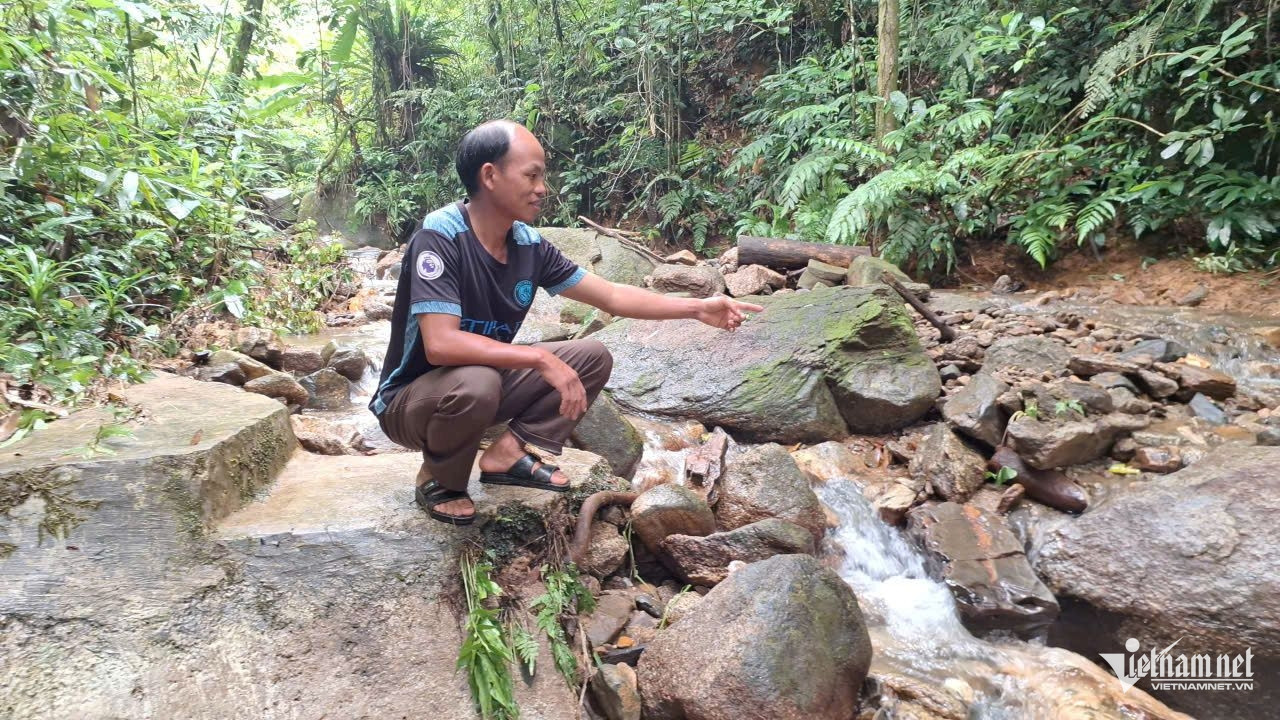
In Phuc village, Que Phong commune, in Nghe An province, the Khe Hoi Duong gravity-fed clean water supply system remains in place. Storage tanks built in scattered clusters across residential areas are still present. However, most of the Thai ethnic people in the village have not benefited from the project for many years.
Built in 2004 funded by Program 135 to serve 174 households, the infrastructure consists of one water collection tank and a pipeline network delivering water to 12 small storage tanks across the village.
But only two out of the 12 tanks can now be used, drawing auxiliary water sources from mountain streams to supply 13 households. The remaining 10 tanks have long been abandoned.
Ngan Thi Phuong, head of Phuc village, stated that the project was built a long time ago and was damaged repeatedly by rain and floods. Due to a lack of repair funding, the system has been virtually non-functional since 2007.
This is not an isolated case. Along the Nam Giai area in Que Phong commune, multiple gravity-fed water projects share a similar fate. Cang village has three abandoned storage tanks, and the water supply facility in Tong village has likewise ceased operation.
Most of these projects, constructed many years ago, have deteriorated over time or have been damaged by natural disasters. They also lack resources for maintenance and repairs.
The same situation is seen in Pa Khom village, Tri Le commune, home to 100 Hmong ethnic households located over 1,000 meters above sea level.
According to village head Tho Ba Ly, the State invested in two gravity-fed water supply systems. The system in Pa Khom serves 75 households, while the facility in Pieng Luong supplies water to 25 households.
However, at the headwaters of Pa Khom stream, the dam barrier section of the collection tank was swept away entirely by floods. To secure usable water, villagers had to manually dam an auxiliary stream and improvise ways to pipe it back to the village.
In Minh Chau village, Tri Le commune, where 368 Hmong, Thai, and Khmu ethnic households reside, there are two state-invested gravity-fed water systems. Yet to date, the facility in D1 cluster has broken down, leaving 75 households without a stable water source.
While many facilities in Nghe An are no longer functional due to old age, degradation, and natural disasters, in Quang Tri, newly invested projects also fail to deliver adequate water supply efficiency.
According to the Tan Thanh Mountainous Commune People's Committee, there are currently four gravity-fed water supply facilities in the area. However, some have degraded, while newly built facilities still fail to supply sufficient water to residents.
A prime example is the Hoa Thanh village water supply project, constructed in 2024 with a total investment of 4 billion VND from the National Target Program for Socio-Economic Development in Ethnic Minority and Mountainous Areas (2021–2025).
Nevertheless, during the dry seasons of 2025 and 2026, over 100 households still received no water from the project for daily use. The remaining 137 households were forced to schedule specific time slots to collect water.
Water remains scarce despite existing infrastructure for several reasons.
First is the impact of natural disasters and harsh environmental conditions. Most highland gravity-fed water systems rely directly on mountain streams, ravines, and surface water sources. Heavy rains and floods can wash away intake dams, collection tanks, and pipelines, while prolonged dry seasons reduce or completely dry up water catchments.
Some projects were funded without high adaptability to water source fluctuations and climatic conditions. When water availability declines or demand increases, systems quickly become overloaded or run dry.
The Hoa Thanh project is an example. Despite being newly built, water cannot be supplied adequately to all 237 households, particularly those at higher elevations. This highlights the need for closer evaluation across all stages, from water source surveys, capacity design, elevation, and distribution networks to dry season supply capability.
Another bottleneck lies in post-investment management, upkeep, and maintenance mechanisms. Many completed projects are put into operation, but funding allocated for regular maintenance and repairs remains limited.
Cases in Phuc and Pa Khom villages demonstrate that the problem is not merely old infrastructure, but also the lack of clearly defined funding sources and repair responsibilities when breakdowns occur.
Tien Pham

