 Vietnamnet.vn

 Podcast



Although the sell-off had somewhat cooled compared to the previous week, the market remained gripped by panic.
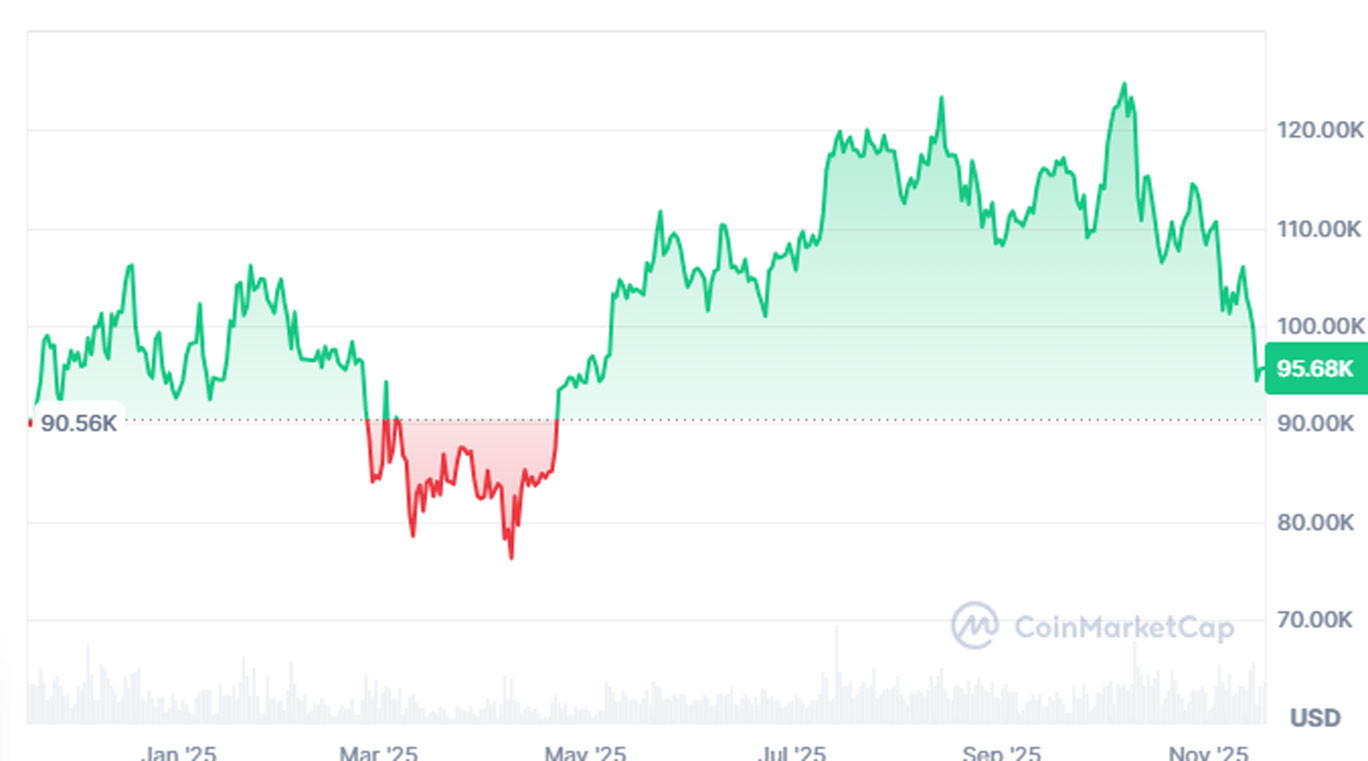
By 3:00 PM Vietnam time on November 17, Bitcoin had recovered slightly to around $95,600, but still posted a 10.2% drop over seven days. It had fallen nearly 18% from $116,000 on October 27, and 23.7% from its peak of $125,300 on October 7.
This marked one of the steepest corrections in recent months, erasing over $600 billion in market value in just over five weeks. Bitcoin’s market cap now stands at approximately $1.9 trillion - its lowest since June 2025.
The break below the psychological $100,000 threshold triggered a domino effect across the entire cryptocurrency market.
Ethereum has dropped 25% in three weeks to $3,180. Solana is down 31%. Dogecoin has lost 24%. Many other tokens and meme coins have plummeted by dozens of percentage points.
The Fear & Greed Index has plunged into the 15–17 range - signaling “extreme fear,” and its lowest point since March 2023.
Macro vacuum and Fed rate cuts in doubt
The sharp sell-off has been largely attributed to a prolonged absence of key U.S. macroeconomic data during the 43-day government shutdown from October 1 to November 13. With CPI, PPI, and non-farm payroll reports suspended, investors were left without crucial signals to anticipate the Federal Reserve’s policy moves.
As a result, expectations for a Fed rate cut at the upcoming December 10 meeting have dropped sharply from over 90% in late October to just under 40% as of November 17. Some strategists now believe the next rate cut may be postponed until late Q1 or early Q2 2026.
Meanwhile, a strengthening U.S. dollar has put pressure on all risk assets, including Bitcoin.
Compounding the pain, U.S.-based Bitcoin ETFs have seen net outflows for three consecutive weeks, totaling billions of dollars.
Large-scale “whale” investors are increasingly locking in profits, further accelerating the downward spiral.
End-of-cycle fears and credit freeze risk
While many analysts view this correction as a necessary pullback after Bitcoin failed to hold above $120,000, a new concern is emerging: the market may have entered the final phase of its four-year cycle.
Historically, Bitcoin tends to surge in the 12–18 months following a halving event, then enter a prolonged distribution phase followed by a downturn lasting another 12–18 months.
We are now in the 20th month since the April 2024 halving - a critical period historically associated with peak profit-taking and market exits by long-term investors.
The biggest risk now may be a potential credit freeze for companies heavily invested in digital assets. Over the past 18 months, many firms issued convertible bonds or debt to acquire Bitcoin and tokens through leveraged strategies.
However, global liquidity has increasingly flowed toward government bonds (as countries seek to cover fiscal deficits) and large-scale AI infrastructure projects.
If access to credit tightens or freezes entirely, these companies may be forced to liquidate their digital assets, triggering another sharp decline.
In the past, Bitcoin has plunged 75% from its $69,000 high in November 2021 to $16,600 in November 2022. More recently, it fell 30% from $106,000 in December 2024 to $75,000 in July 2025.
The current 23.7% drop from its recent peak could worsen if sentiment continues to deteriorate.
At present, many small investors are choosing to stay on the sidelines or cut losses, waiting for clearer signals.
An opportunity in disguise?
Still, some experts argue this could represent one of the best long-term accumulation opportunities of 2025.
The current market differs significantly from previous cycles. The participation of major ETFs, institutional banks, and even national entities has created a deep layer of liquidity capable of absorbing large-scale selling by whales.
This structural maturity may help prevent extreme collapses seen in past years.
With regulatory frameworks gradually improving and real-world applications expanding, the crypto market is expected to recover strongly from the second half of 2026 through early 2027.
For now, this may be a cleansing phase - a test of patience and conviction for investors.
Manh Ha
.svg)
