 Vietnamnet.vn

 Podcast



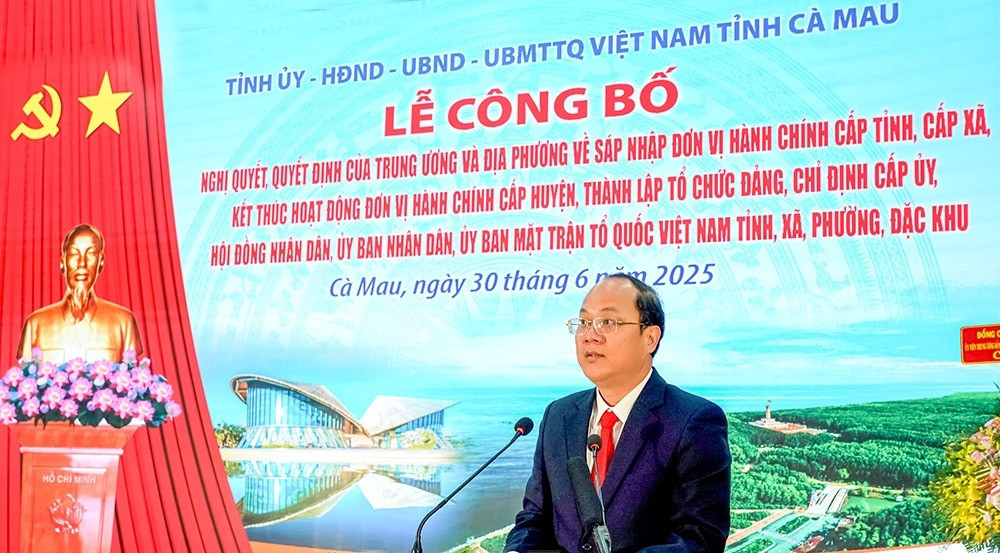
To successfully implement the Resolution of the 1st Ca Mau Provincial Party Congress for the 2025–2030 term, what solutions does the province adopt to mobilize and use resources effectively?
The Provincial Party Committee identifies the mobilization and effective use of resources as a key, decisive factor.
First is mobilizing financial and investment resources. Thoroughly grasping the viewpoint that "State capital is seed capital, leading and activating all social resources," Ca Mau will focus on promoting administrative reform and improving the investment business environment to attract strategic investors and large domestic and foreign corporations, especially in the fields of renewable energy, marine economy, and logistics infrastructure.
The province will diversify investment forms, especially public-private partnerships (PPP), to complete the transport and urban infrastructure systems. In using financial resources, the province follows the principle of "focus and prioritization, no dispersion"; prioritizing public investment capital for inter-regional transport infrastructure, climate change adaptation infrastructure, and urgent social security projects.
Second, developing human resources and identifying them as the most valuable resource. The Resolution of the Provincial Party Congress defines “breakthroughs in human resource development” as one of three strategic breakthroughs.
Third, resources from mechanisms and institutions are identified as the “resource of resources.” Ca Mau has proposed that the central authorities allow pilot special mechanisms and policies to leverage the province’s advantages at the southernmost tip of the country. The province is focusing on institutional breakthroughs, innovating local lawmaking and enforcement, and removing procedural bottlenecks related to land and site clearance to accelerate key projects.
Fourth, mobilizing resources from the strength of great national unity. Politics leads the way, culture lights the way, science shapes the way, and the people execute. All Party’s policies succeed only with public consensus and joint efforts.
How is the province leveraging its potential and advantages to promote fast and sustainable economic development?
After the merger, Ca Mau has a natural area of more than 7,942 square kilometers and a population of over 2.6 million. It has a coastline of 310 kilometers, borders the sea on three sides, and has a maritime area of more than 120,000 square kilometers.
To fully realize this potential, the Resolution of the 1st Provincial Party Congress identifies four strategic pillars:
* completing transport connectivity infrastructure, especially expressways, airports, and seaports, to enable economic zones and industrial parks with comparative advantages; developing digital infrastructure in a synchronized manner;
* developing the marine economy with a strong focus on renewable energy (especially wind power, with a view to electricity exports), improving the efficiency of marine resource exploitation linked to safeguarding national sovereignty, investing in and gradually using seaports effectively, and developing high value-added processing industries;
* developing clean, high-tech agriculture with shrimp and rice as key products;
* and accelerating services and tourism based on existing advantages, historical values, and distinctive local cultural identity.
First is infrastructure. The province is accelerating the implementation of projects and disbursement of public investment right from the start of the term, using public investment to lead and activate social investment and promote PPPs, especially for important and strategic projects that have received guidance from the central authorities and the province in line with planning.
In addition, Ca Mau is reviewing, adjusting, and effectively implementing construction and urban plans, urban development programs, and urban upgrading schemes; mobilizing diverse resources to invest in essential infrastructure and projects to ensure urban flood prevention (in wards such as An Xuyen, Tan Thanh, Ly Van Lam, Bac Lieu, and Vinh Trach); renovating and relocating riverside housing; upgrading essential urban infrastructure; developing and investing in infrastructure and increasing occupancy rates in industrial parks and clusters linked to urban development; and planning and prioritizing land funds and accelerating the development of social housing.
At the same time, the province will continue to invest in, upgrade, and develop information and communications infrastructure, digital infrastructure, education, and healthcare to meet development needs and people’s creative and cultural demands; develop shared databases and dedicated data transmission networks; deploy unified, secure digital solutions with seamless connectivity from the provincial level to the grassroots; form and develop a network of innovation centers; and proactively seek new technologies at home and abroad, and cooperate in technology transfer and the commercialization of scientific research outcomes.
to be continued...
Ngan Anh
.svg)
