 Vietnamnet.vn

 Podcast



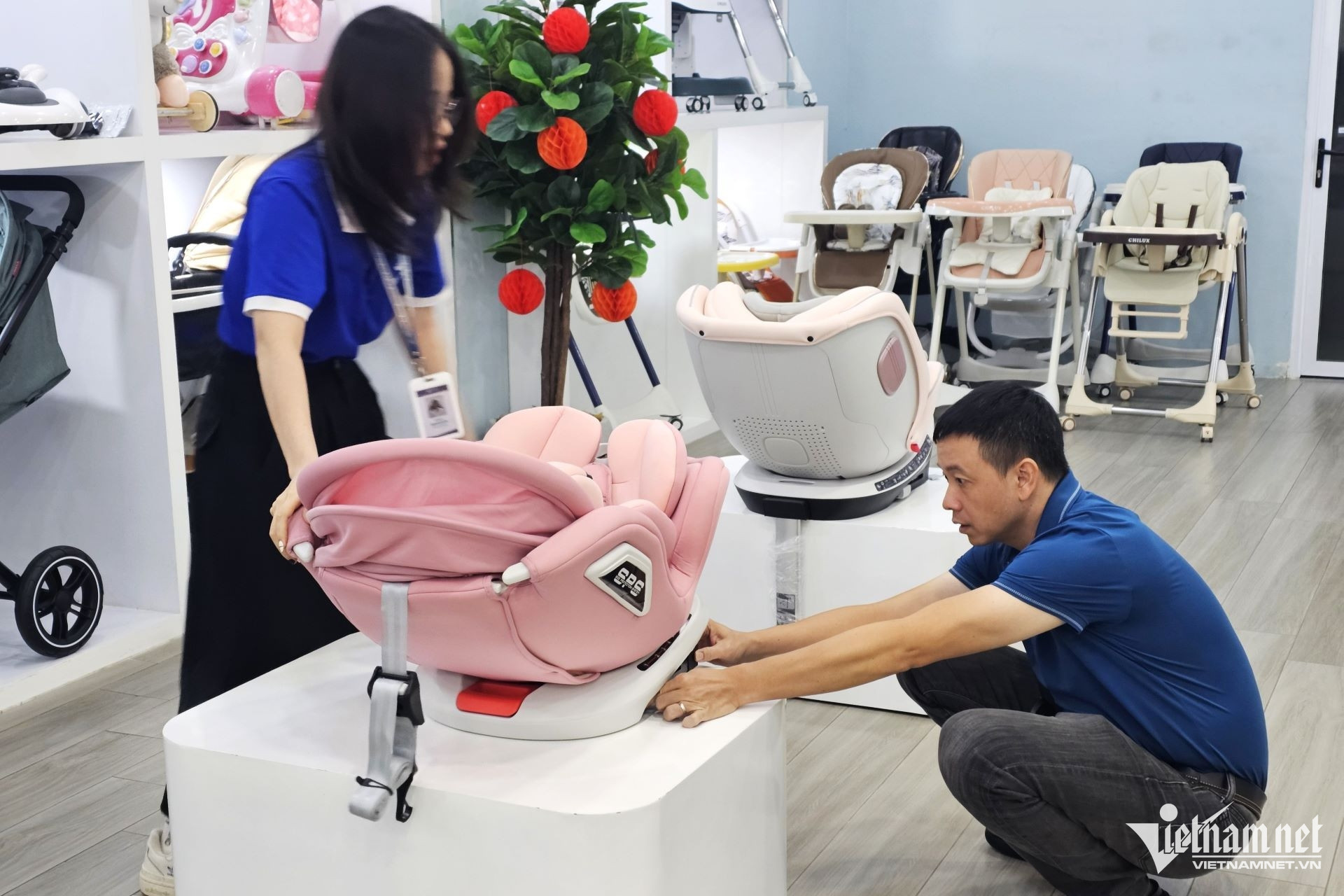
Many vehicle owners are still hesitant to buy certified child seats, while e-commerce platforms have begun offering ultra-cheap safety devices priced at just VND200,000.
Under the 2024 Law on Road Traffic Order and Safety and Decree No168/2024/ND-CP, effective from July 1, 2026, drivers of private passenger vehicles will face fines ranging from VND800,000 to VND1 million if they allow children under 10 years old and shorter than 1.35 meters to sit in the front passenger seat, or if they don’t provide an appropriate child restraint system in the rear seats.
A VietNamNet survey of baby product stores along major retail streets in Hanoi, including Xa Dan, Pham Ngoc Thach, Thai Ha, and Cau Giay, found that child car seats are prominently displayed in highly visible locations.
Sales staff at these stores said the products comply with international standards such as ECE R44/04 or the latest European ECE R129 (i-Size) regulations.
In the premium segment, prices typically range from VND7 million to VND15 million, dominated by major European and Japanese brands such as Cybex, Combi, Chicco, and Britax. These models generally feature secure ISOFIX installation systems, impact-absorbing padding, ventilation functions, 360-degree rotation, and premium antibacterial fabrics.
Products in the mass-market segment are priced between VND2 million and VND5 million, including brands such as Joie, Chilux, Gluck, and Zaracos. According to a manager at a baby products store on Thai Ha Street, this price range is affordable for most urban families. These seats meet safety standards and can be used by children from infancy to four or six years old.
However, sales activity remains subdued. Lan Anh, an employee at a baby products chain on Truong Cong Giai Street in Cau Giay, said: “In the past, very few customers asked about child car seats. Over the past month, there have been a handful of customers coming in to learn more about them.”
“Parents ask detailed questions about age suitability, installation methods, and safety standards. However, most are still in the information-gathering stage and are waiting for more detailed guidance from authorities before deciding to make a purchase,” she said.
“Most customers prioritize solutions that are sufficiently safe and compliant with regulations rather than premium features. As long as the seat has a clear origin, meets safety standards, and can be installed securely, that is enough,” she added.
In contrast to the quiet atmosphere at traditional retail stores, e-commerce platforms are seeing a surge of advertisements for child vehicle restraint products. Simply typing the keyword "child car seat" into the Google search engine yields a barrage of listings offering "safety harnesses" and "fabric-cushioned seats" at incredibly low prices.
These products typically cost between VND100,000 and VND200,000 and are promoted with slogans such as compact, space-saving, and helping drivers avoid fines, appealing directly to consumers seeking the cheapest compliance option.
Most of these products appear to consist only of thin fabric cushions combined with nylon straps and lack any structural frame capable of absorbing impact forces. This raises serious questions about their ability to protect children during sudden braking or traffic accidents.
According to Vietnam’s National Technical Regulation QCVN 123:2024/BGTVT, a child restraint system (CRS) must be a complete safety system consisting of a rigid frame, safety harnesses, and force-resistant locking mechanisms. It must be capable of being securely attached to a vehicle and pass dynamic crash-testing requirements.
Cheap fabric belts or foam cushions can hardly satisfy these criteria. Brittle plastic buckles snap easily, and simple fabric straps priced at just VND200,000 cannot disperse impact forces like the intended function of a car safety belt.
Nguyen Thu Huong (Hoang Mai, Hanoi) is pondering about buying a child seat to install in her compact car. "The rear cabin is cramped; installing a child seat means losing almost an entire seating spot. My family has two kids, making it even more of a dilemma. Good seats are expensive, and cheap ones do not offer peace of mind,” she stated.
As the enforcement date for the child seat regulation is fast approaching, the market has yet to witness major fluctuations or exponential growth.
Seemingly, the prevailing mindset among many vehicle owners is that unless they are directly impacted, they will not truly spend money to invest in additional equipment. Quite a few individuals still retain the habit of "waiting until the last minute" or expecting that there will be cheaper and more compact solutions to cope with the new law.
Pham Huyen
.svg)
