 Vietnamnet.vn

 Podcast



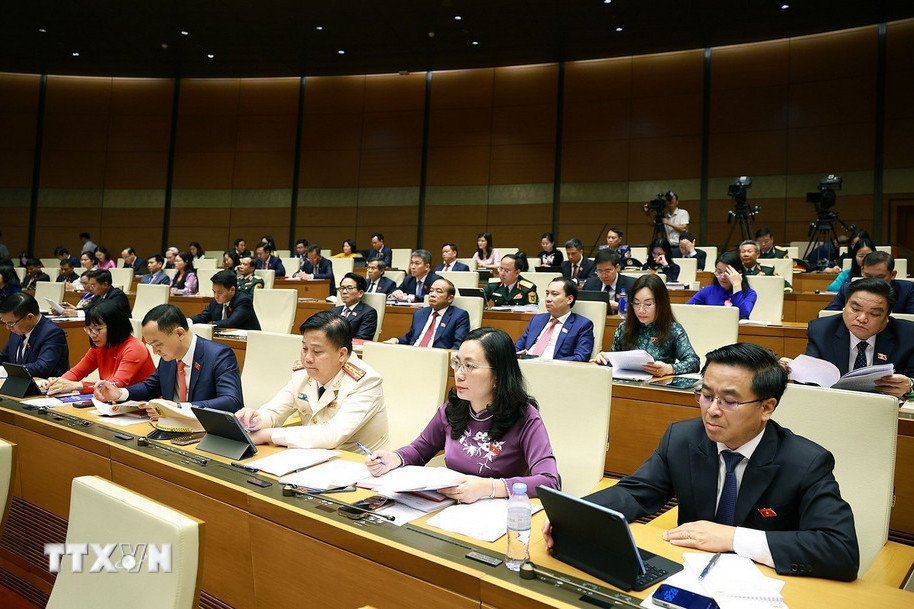
Alongside legal amendments is a large-scale administrative reform program aimed at standardizing and digitizing all procedures on digital platforms, ensuring interconnectivity and data sharing among agencies to minimize time and compliance costs for citizens and businesses.
The ultimate goal is not only to improve the quality of national governance, but also to place Vietnam’s investment environment among the top three in ASEAN and the top 30 globally by 2028, thereby turning institutional reform into a “runway” for a high and sustainable growth cycle in the 2026–2030 period.
In other words, the Party Central Committee has set the growth destination, while the National Assembly is the body that writes the rules of the game to make that destination a reality.
For the country to take off
An economy that wants to move fast cannot continue running on yesterday’s legal tracks. Beyond fixing overlapping provisions among laws on land, investment, construction, planning, or trade, the NA must define the rules for a new growth model, one driven by science and technology, innovation, and digital transformation.
For many years, the economy has operated mainly on familiar drivers such as labor-intensive production, investment, exports, consumption, and bank credit. These remain important, but they are no longer sufficient to bring the country into a double-digit growth trajectory.
To move faster in the coming period, Vietnam must shift its growth engine, relying more on digital technology, biotechnology, new materials, supporting industries, modern logistics, energy, the marine economy, high-quality services, and models that have yet to be fully defined today.
Alongside this shift, all new growth drivers require a corresponding legal framework. An AI company often does not lack ideas; what it lacks is a clear enough sandbox for experimentation. A large infrastructure project not only lacks capital; it is often constrained by laws that do not “speak the same language.”
Meanwhile, a private enterprise seeking to grow needs not just market access, but also confidence that property rights, access to land, capital, and data are protected by a stable legal system.
In that sense, the NA is not only writing laws but also shaping the space for Vietnamese enterprises to grow.
A particularly notable point in the Party Central Committee’s conclusion is the requirement to shift strongly from “pre-inspection” to “post-inspection” in state management. This touches on how the State views businesses, innovation, and the logic of development in the new phase.
Management is no longer about “standing at the gate to block from the outset” but about setting standards, defining responsibilities, and supervising outcomes. This shift creates real room for private enterprises, new economic models, and those willing to explore uncharted paths.
At first glance, issues such as capital market development, stock market upgrading, international financial centers, or free trade zones may seem like financial matters, but at their core, they remain issues of legislation and institution-building.
Capital always flows to where rules are clear and trust is strong. Therefore, when the legal framework for corporate bonds becomes more transparent, the capital market will gain a stronger foundation for recovery.
When the legal corridor for international financial centers is aligned with modern standards, long-term capital has more reason to stay; and when ownership rights and disclosure standards are firmly protected, the stock market moves closer to becoming a pillar for industrialization.
The NA’s supervisory role
But the role of the NA is not just about writing laws. Equally important is the supreme supervision of law enforcement, forcing the administrative apparatus to move in accordance with the spirit of reform so that laws are not distorted at the implementation stage.
Citizens and businesses experience the law through whether licensing time is shorter, whether projects face fewer procedural hurdles, whether small businesses can access capital more easily, and whether technology firms feel confident enough to invest long-term. In other words, laws only truly live when they shape everyday decisions.
Therefore, the real measure of the 16th NA will not only be the number of laws passed, but also whether administrative delays are reduced, compliance costs are lowered, business confidence is strengthened, domestic markets become a stronger consumption base, and tourism, services and purchasing power are supported by institutional reform.
What the NA is building is not only growth but also social trust in a predictable future, where businesses dare to invest, people dare to spend, young people dare to start businesses, and the public sector dares to take responsibility.
Tu Giang
.svg)
