 Vietnamnet.vn

 Podcast



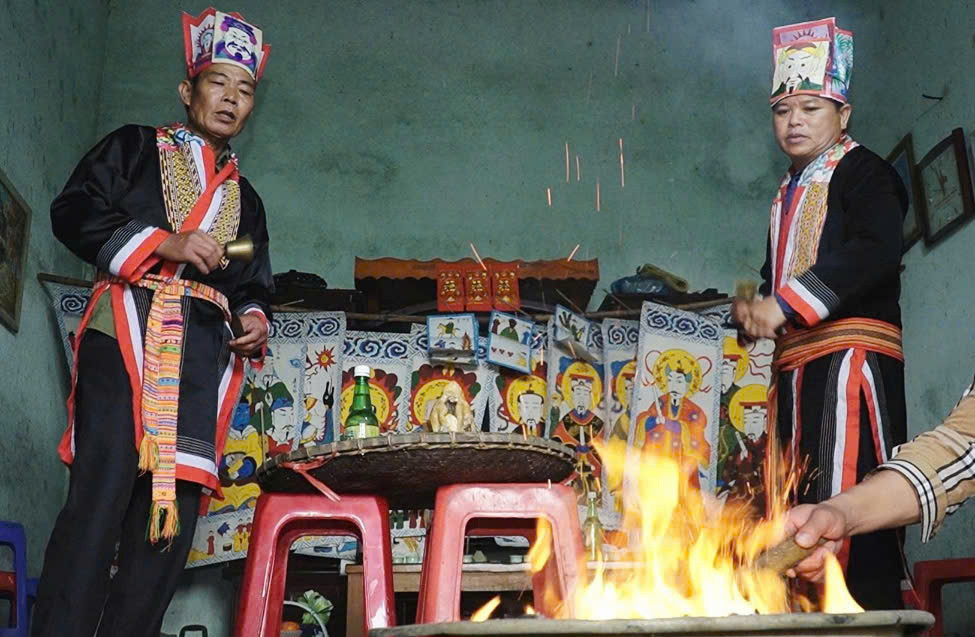
The "sacred shield" of the great forest
Truc Bai Son is the mountainous region where the Dao Thanh Y and Dao Thanh Phan ethnic groups have lived for generations in Duong Hoa commune. For them, the forest is not just a livelihood but a cultural and spiritual space intimately connected to community life.
Previously, people primarily practiced shifting cultivation and exploited the forest for survival. In recent years, along with settled farming and forestry development policies, awareness of forest protection has improved significantly. People have shifted toward living in harmony with nature, both utilizing and preserving forest resources.
Artisan Chiu Chan Dau from Ly Quang village stated that in the past, the festival usually took place over 1 day and 1 night. Currently, some villages still organize it, though not annually.
The Khoi Kem ritual is held at the beginning of the year, around the second lunar month, as an important custom of the Dao people. Before entering the forest for production, the community performs a ceremony to ask permission from the gods, wishing for a year of favorable weather and bountiful harvests.
Chiu Nhi Mui (Ly Quang village) said that Khoi Kem is a shared ritual between both the Dao Thanh Y and Dao Thanh Phan. For the Dao, one must perform a ceremony to ask permission before entering the forest.
“The forest has gods and its own laws; one cannot act arbitrarily,” Mui explained. The Khoi Kem ceremony is not only to pray for luck but also to remind each other to protect the forest. Anyone entering the forest must be conscious and not cut trees indiscriminately,” Mui explained.
This ritual simultaneously plays the role of a community convention in forest protection. Through rites and prayers, people are reminded of their responsibility toward forest resources, limiting arbitrary exploitation and maintaining natural balance.
Tang Lap Dung, a prestigious person in Lo Ma Cooc village, shared: “Since ancient times, Khoi Kem has been not only a spiritual ritual but also a convention for the Dao to protect the forest, which everyone must follow. The elders always remind their children that the forest has its laws; and performing the ceremony is not just to ask permission, but to live responsibly with the forest.”
From cultural preservation to tourism development
The restoration of this ritual into a festival is opening new directions for tourism.
From a closed community ritual, Khoi Kem is gradually stepping outside the villages. Following the reorganization of administrative units, Duong Hoa commune was established through the merger of three communes: Quang Son, Quang Long, and Duong Hoa.
As an area facing many difficulties with over 40 percent being ethnic minorities, the local authorities identified a development path based on cultural and natural advantages.
The Resolution of the Commune Party Congress for the 2025-2030 term sets a goal to preserve and promote traditional cultural values associated with sustainable tourism development.
Among these, restoring the Khoi Kem ritual and organizing it as a festival is one of the core solutions. The Truc Bai Son area has great potential for ecotourism, featuring Nui Duc, stone streams, Truc Bai Son Lake, and the 1,507m high Quang Nam Chau peak.
Nguyen Son Ha, Vice Chair of the Duong Hoa Commune People's Committee, stated that restoring the Khoi Kem ritual and organizing it as a festival for the first time expresses the aspirations of the people, preserves the traditional culture of the Dao, and aims to build tourism products to attract visitors to the northeastern border forests of Quang Ninh province.
The Khoi Kem Festival not only meets the cultural needs of the people but also step-by-step forms a new tourism product. Combining cultural preservation with tourism exploitation is expected to create additional livelihoods while promoting the image of the Dao community.
From a traditional ritual, Khoi Kem is becoming a pillar for sustainable local development, where people discover a harmonious way of living with the forest while preserving their identity amid modern changes.
My Dung
.svg)
