 Vietnamnet.vn

 Podcast



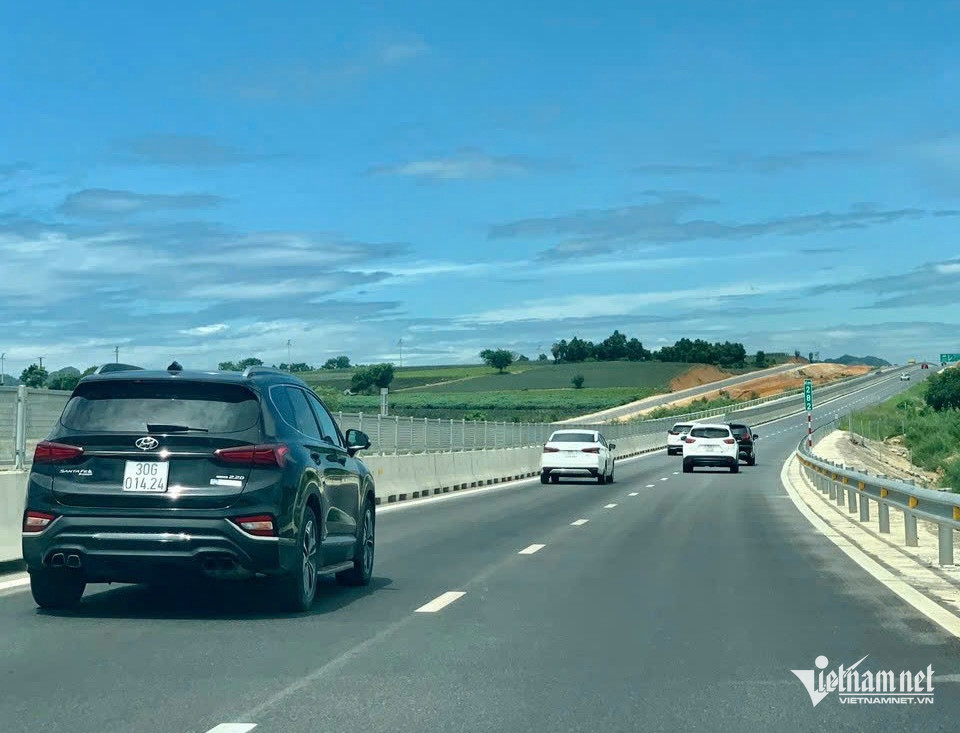
Does the driver in front have to move to the right lane to yield?
The scenario has sparked heated debate among Vietnamese drivers in recent days. Some people argue that a driver traveling at the legal speed limit has no obligation to yield to a vehicle intending to exceed it. Others contend that the left lane is fundamentally intended for overtaking, meaning drivers should not occupy it continuously, regardless of their speed.
Huynh Thanh Minh, a Hanoi reader, believes it is important to distinguish between a vehicle traveling slowly in the left lane and one that is already maintaining a high speed within the legal limit while another vehicle behind wishes to travel faster.
If the vehicle is traveling only 70-80 km/h on an expressway with a speed limit of 90-120 km/h and continues occupying the left lane, moving to a more appropriate lane to avoid obstructing traffic is necessary, he said.
However, if the driver is already traveling at a high speed and keeping pace with traffic ahead, having to move into the middle lane every time a faster vehicle approaches from behind before returning to the left lane may not be practical.
Minh noted that many Vietnamese expressways have only two or three lanes in each direction. The middle lane is often occupied by trucks, buses or slower-moving vehicles. A car traveling in the left lane that repeatedly changes to the middle lane to let others pass must perform more lane changes, increasing the risk of collisions.
His view has received considerable support. Many drivers argue that if a vehicle is already traveling at the maximum legal speed, remaining in the left lane does not necessarily constitute a violation. Vehicles behind that wish to travel faster should overtake only when conditions permit.
"Every lane has an allowable speed range. Driving within the legal speed limit for that lane means complying with the law," reader Pham Ngoc Hai commented.
"I set my cruise control at 120 km/h and still get flashed by cars behind or honked at by trucks. I refuse to change lanes because I'm already driving legally," reader Nguyen An wrote.
From this perspective, the purpose of an expressway should be to maintain a steady, predictable flow of traffic rather than forcing drivers to make frequent lane changes at high speeds.
Supporters of this view argue that safety should not mean yielding under all circumstances. If changing lanes cannot be done safely, drivers should not move simply because the vehicle behind is flashing its headlights or sounding its horn.
That argument has also drawn strong criticism. Many drivers say the reasoning of "I'm already driving at the speed limit" overlooks a key distinction: speed compliance and lane discipline are separate issues.
According to this group, driving within the legal speed limit does not automatically give a driver the right to remain indefinitely in the left lane. The lane adjacent to the median should be reserved for overtaking vehicles or those legitimately traveling faster when conditions allow.
"The law requires drivers to give way to overtaking vehicles when it is safe to do so. Sometimes a vehicle may be rushing someone to the hospital and can later justify exceeding the speed limit to the authorities. A driver who insists on staying in the left lane the whole time isn't acting reasonably."
Reader Thanh Nguyen took an even firmer stance.
"In developed countries, it is mandatory to keep the lane next to the median always clear and to yield when a vehicle behind requests to overtake, instead of using the excuse 'I am driving at the correct speed, and if he drives faster, he is wrong' to hold the lane. That is narrow-minded thinking."
From a more neutral perspective, many readers believe that the two opinions are not entirely opposite in their goals. Both want traffic on the expressway to be safer, smoother, and have fewer conflicts.
“The solution is to clearly stipulate the speed limit, for example in lane number 1 the minimum speed must be 90, lane number 2 is 70. If you drive below that, you get a camera fine. If so, the cars running at low speed will not dare to drive in that lane anymore, and naturally the expressway will become more orderly," reader Hoang Long proposed.
Hoang Hiep
.svg)
